
+- IOPList.Org (https://www.ioplist.org)
+-- Forum: Off Topic (https://www.ioplist.org/forumdisplay.php?fid=25)
+--- Forum: World News (https://www.ioplist.org/forumdisplay.php?fid=27)
+--- Thread: THIS DAY IN HISTORY (/showthread.php?tid=6805)
RE: THIS DAY IN HISTORY - IceWizard - 05-18-2022
Mount St. Helens erupts

1980
May 18
At 8:32 a.m. PDT on May 18, 1980, Mount St. Helens, a volcanic peak in southwestern
Washington, suffers a massive eruption, killing 57 people and devastating some 210
square miles of wilderness.
Called Louwala-Clough, or “the Smoking Mountain,” by Native Americans, Mount St. Helens
is located in the Cascade Range and stood 9,680 feet before its eruption. The volcano has
erupted periodically during the last 4,500 years, and the last active period was between
1831 and 1857. On March 20, 1980, noticeable volcanic activity began with a series of earth
tremors centered on the ground just beneath the north flank of the mountain. These
earthquakes escalated, and on March 27 a minor eruption occurred, and Mount St. Helens
began emitting steam and ash through its crater and vents.
Small eruptions continued daily, and in April people familiar with the mountain noticed changes
to the structure of its north face. A scientific study confirmed that a bulge more than a mile
in diameter was moving upward and outward over the high north slope by as much as six feet
per day. The bulge was caused by an intrusion of magma below the surface, and authorities
began evacuating hundreds of people from the sparsely settled area near the mountain.
A few people refused to leave.
On the morning of May 18, Mount St. Helens was shaken by an earthquake of about 5.0 magnitude,
and the entire north side of the summit began to slide down the mountain. The giant landslide
of rock and ice, one of the largest recorded in history, was followed and overtaken by an
enormous explosion of steam and volcanic gases, which surged northward along the ground
at high speed. The lateral blast stripped trees from most hill slopes within six miles of the
volcano and leveled nearly all vegetation for as far as 12 miles away. Approximately 10 million
trees were felled by the blast.
The landslide debris, liquefied by the violent explosion, surged down the mountain at speeds in
excess of 100 miles per hour. The avalanche flooded Spirit Lake and roared down the valley of
the Toutle River for a distance of 13 miles, burying the river to an average depth of 150 feet.
Mudflows, pyroclastic flows, and floods added to the destruction, destroying roads, bridges, parks,
and thousands more acres of forest. Simultaneous with the avalanche, a vertical eruption of
gas and ash formed a mushrooming column over the volcano more than 12 miles high. Ash from
the eruption fell on Northwest cities and towns like snow and drifted around the globe for two
weeks. Fifty-seven people, thousands of animals, and millions of fish were killed by the
eruption of Mount St. Helens.
By late in the afternoon of May 18, the eruption subsided, and by early the next day it had
essentially ceased. Mount St. Helens’ volcanic cone was completely blasted away and replaced
by a horseshoe-shaped crater–the mountain lost 1,700 feet from the eruption. The volcano
produced five smaller explosive eruptions during the summer and fall of 1980 and remains
active today. In 1982, Congress made Mount St. Helens a protected research area.
Mount St. Helens became active again in 2004. On March 8, 2005, a 36,000-foot plume of
steam and ash was expelled from the mountain, accompanied by a minor earthquake. Another
minor eruption took place in 2008. Though a new dome has been growing steadily near the
top of the peak and small earthquakes are frequent, scientists do not expect a repeat of the
1980 catastrophe anytime soon.
ALSO ON THIS DAY
21ST CENTURY
2012
Facebook raises $16 billion in largest
tech IPO in U.S. history
Facebook, the world’s largest social network, holds its initial public offering (IPO)
and raises $16 billion. It was the largest technology IPO in American history to that
date, and the third-largest IPO ever in the United States, after those of Visa and
General Motors. At the ... read more
US GOVERNMENT
1896
Supreme Court rules "separate but equal"
constitutional in Plessy v. Ferguson
In a major victory for supporters of racial segregation, the U.S. Supreme Court rules
seven to one that a Louisiana law providing for “equal but separate accommodations
for the white and colored races” on its railroad cars is constitutional. The high court
held that as long as ... read more
U.S. PRESIDENTS
1860
Abraham Lincoln nominated for presidency
at Republican Convention
Abraham Lincoln, a one-time U.S. representative from Illinois, is nominated for the
U.S. presidency by the Republican National Convention meeting in Chicago, Illinois.
Hannibal Hamlin of Maine was nominated for the vice presidency. Lincoln, a
Kentucky-born lawyer and former Whig ... read more
INDIA
1974
India joins the nuclear club
In the Rajasthan Desert in the municipality of Pokhran, India successfully detonates
its first nuclear weapon, a fission bomb similar in explosive power to the U.S. atomic
bomb dropped on Hiroshima, Japan. The test fell on the traditional anniversary of
the Buddha’s ... read more

RELIGION
1920
Pope John Paul II born
On May 18, 1920, Karol Jozef Wojtyla is born in the Polish town of Wadowice, 35 miles
southwest of Krakow. Wojtyla went on to become Pope John Paul II, history’s most
well-traveled pope and the first non-Italian to hold the position since the 16th century.
After high school, the ... read more
WORLD WAR II
1943
Adolf Hitler gives the order for Operation Alaric
On May 18, 1943, Adolf Hitler launches Operation Alaric, the German occupation of
Italy in the event its Axis partner either surrendered or switched its allegiance. This
operation was considered so top secret that Hitler refused to issue a written order.
Instead, he communicated ... read more

U.S. PRESIDENTS
1861
Newspaper prints scathing report about
First Lady Mary Todd Lincoln
An obscure California newspaper casts first lady Mary Todd Lincoln in an unflattering
light on May 18, 1861. Quoting a report in the Sacramento Union, the Humboldt Times
recounted a tale of how Mrs. Lincoln had usurped her husband’s presidential duty
of appointing federal ... read more
NATIVE AMERICAN HISTORY
1871
Chief Satanta attacks wagon trains,
killing teamsters
The Kiowa Chief Satanta joins with other Native Americans to massacre a wagon train
near the Red River in northeastern Texas. One of the leading chiefs of the Kiowa in the
1860s and 1870s, Satanta was a fearsome warrior but also a skilled orator and diplomat.
He helped negotiate ... read more
ART, LITERATURE, AND FILM HISTORY
1980
Ian Curtis of Joy Division dies by suicide
On the evening of May 18, 1980, Ian Curtis, lead singer and lyricist of the British group
Joy Division, hangs himself in his Cheshire kitchen. He was only 23 years old. Joy Division
was one of four hugely important British post-punk bands that could trace its origins
to a ... read more

ART, LITERATURE, AND FILM HISTORY
1593
Playwright Thomas Kyd’s accusations lead to
an arrest warrant for Christopher Marlowe
Scholars believe an arrest warrant was issued on May 18, 1593 for Christopher Marlowe,
after fellow writer Thomas Kyd accused Marlowe of heresy. Playwright Thomas Kyd, whose
Spanish Tragedie (also called Hieronomo) was influential in the development of the revenge
tragedy, was ... read more
CRIME
1926
Popular evangelist Aimee
Semple McPherson disappears
Aimee Semple McPherson, a nationally known evangelist, disappears from Venice Beach in
Los Angeles, California. Police dispatched planes and ships in an effort to find her, but she
was nowhere to be found. Authorities later discovered that radio announcer Kenneth Ormiston,
a ... read more
CHINA
1989
One million protesters take to the streets in Beijing
A crowd of protesters, estimated to number more than one million, marches through
the streets of Beijing calling for a more democratic political system. Just a few weeks
later, the Chinese government moved to crush the protests. Protests in China had been
brewing since the ... read more

CIVIL WAR
1863
The Siege of Vicksburg commences
On May 18, Union General Ulysses S. Grant surrounds Vicksburg, the last Confederate
stronghold on the Mississippi River, in one of the most brilliant campaigns of the war.
Beginning in the winter of 1862-63, Grant made several attempts to capture Vicksburg.
In March, he marched ... read more
AMERICAN REVOLUTION
1783
United Empire Loyalists reach Canada
On May 18, 1783, the first United Empire Loyalists, known to American Patriots as Tories,
arrive in Canada to take refuge under the British crown in Parrtown, Saint John,
Nova Scotia (now New Brunswick), Canada. The town was located on the Bay of Fundy
just north of the border ... read more
WORLD WAR I
1917
U.S. Congress passes Selective Service Act
Some six weeks after the United States formally entered the First World War, the
U.S Congress passes the Selective Service Act on May 18, 1917, giving the U.S. president
the power to draft soldiers. When he went before Congress on April 2, 1917, to deliver
his war message, ... read more
1980
May 18
At 8:32 a.m. PDT on May 18, 1980, Mount St. Helens, a volcanic peak in southwestern
Washington, suffers a massive eruption, killing 57 people and devastating some 210
square miles of wilderness.
Called Louwala-Clough, or “the Smoking Mountain,” by Native Americans, Mount St. Helens
is located in the Cascade Range and stood 9,680 feet before its eruption. The volcano has
erupted periodically during the last 4,500 years, and the last active period was between
1831 and 1857. On March 20, 1980, noticeable volcanic activity began with a series of earth
tremors centered on the ground just beneath the north flank of the mountain. These
earthquakes escalated, and on March 27 a minor eruption occurred, and Mount St. Helens
began emitting steam and ash through its crater and vents.
Small eruptions continued daily, and in April people familiar with the mountain noticed changes
to the structure of its north face. A scientific study confirmed that a bulge more than a mile
in diameter was moving upward and outward over the high north slope by as much as six feet
per day. The bulge was caused by an intrusion of magma below the surface, and authorities
began evacuating hundreds of people from the sparsely settled area near the mountain.
A few people refused to leave.
On the morning of May 18, Mount St. Helens was shaken by an earthquake of about 5.0 magnitude,
and the entire north side of the summit began to slide down the mountain. The giant landslide
of rock and ice, one of the largest recorded in history, was followed and overtaken by an
enormous explosion of steam and volcanic gases, which surged northward along the ground
at high speed. The lateral blast stripped trees from most hill slopes within six miles of the
volcano and leveled nearly all vegetation for as far as 12 miles away. Approximately 10 million
trees were felled by the blast.
The landslide debris, liquefied by the violent explosion, surged down the mountain at speeds in
excess of 100 miles per hour. The avalanche flooded Spirit Lake and roared down the valley of
the Toutle River for a distance of 13 miles, burying the river to an average depth of 150 feet.
Mudflows, pyroclastic flows, and floods added to the destruction, destroying roads, bridges, parks,
and thousands more acres of forest. Simultaneous with the avalanche, a vertical eruption of
gas and ash formed a mushrooming column over the volcano more than 12 miles high. Ash from
the eruption fell on Northwest cities and towns like snow and drifted around the globe for two
weeks. Fifty-seven people, thousands of animals, and millions of fish were killed by the
eruption of Mount St. Helens.
By late in the afternoon of May 18, the eruption subsided, and by early the next day it had
essentially ceased. Mount St. Helens’ volcanic cone was completely blasted away and replaced
by a horseshoe-shaped crater–the mountain lost 1,700 feet from the eruption. The volcano
produced five smaller explosive eruptions during the summer and fall of 1980 and remains
active today. In 1982, Congress made Mount St. Helens a protected research area.
Mount St. Helens became active again in 2004. On March 8, 2005, a 36,000-foot plume of
steam and ash was expelled from the mountain, accompanied by a minor earthquake. Another
minor eruption took place in 2008. Though a new dome has been growing steadily near the
top of the peak and small earthquakes are frequent, scientists do not expect a repeat of the
1980 catastrophe anytime soon.
ALSO ON THIS DAY
21ST CENTURY
2012
Facebook raises $16 billion in largest
tech IPO in U.S. history
Facebook, the world’s largest social network, holds its initial public offering (IPO)
and raises $16 billion. It was the largest technology IPO in American history to that
date, and the third-largest IPO ever in the United States, after those of Visa and
General Motors. At the ... read more
US GOVERNMENT
1896
Supreme Court rules "separate but equal"
constitutional in Plessy v. Ferguson
In a major victory for supporters of racial segregation, the U.S. Supreme Court rules
seven to one that a Louisiana law providing for “equal but separate accommodations
for the white and colored races” on its railroad cars is constitutional. The high court
held that as long as ... read more
U.S. PRESIDENTS
1860
Abraham Lincoln nominated for presidency
at Republican Convention
Abraham Lincoln, a one-time U.S. representative from Illinois, is nominated for the
U.S. presidency by the Republican National Convention meeting in Chicago, Illinois.
Hannibal Hamlin of Maine was nominated for the vice presidency. Lincoln, a
Kentucky-born lawyer and former Whig ... read more
INDIA
1974
India joins the nuclear club
In the Rajasthan Desert in the municipality of Pokhran, India successfully detonates
its first nuclear weapon, a fission bomb similar in explosive power to the U.S. atomic
bomb dropped on Hiroshima, Japan. The test fell on the traditional anniversary of
the Buddha’s ... read more
RELIGION
1920
Pope John Paul II born
On May 18, 1920, Karol Jozef Wojtyla is born in the Polish town of Wadowice, 35 miles
southwest of Krakow. Wojtyla went on to become Pope John Paul II, history’s most
well-traveled pope and the first non-Italian to hold the position since the 16th century.
After high school, the ... read more
WORLD WAR II
1943
Adolf Hitler gives the order for Operation Alaric
On May 18, 1943, Adolf Hitler launches Operation Alaric, the German occupation of
Italy in the event its Axis partner either surrendered or switched its allegiance. This
operation was considered so top secret that Hitler refused to issue a written order.
Instead, he communicated ... read more
U.S. PRESIDENTS
1861
Newspaper prints scathing report about
First Lady Mary Todd Lincoln
An obscure California newspaper casts first lady Mary Todd Lincoln in an unflattering
light on May 18, 1861. Quoting a report in the Sacramento Union, the Humboldt Times
recounted a tale of how Mrs. Lincoln had usurped her husband’s presidential duty
of appointing federal ... read more
NATIVE AMERICAN HISTORY
1871
Chief Satanta attacks wagon trains,
killing teamsters
The Kiowa Chief Satanta joins with other Native Americans to massacre a wagon train
near the Red River in northeastern Texas. One of the leading chiefs of the Kiowa in the
1860s and 1870s, Satanta was a fearsome warrior but also a skilled orator and diplomat.
He helped negotiate ... read more
ART, LITERATURE, AND FILM HISTORY
1980
Ian Curtis of Joy Division dies by suicide
On the evening of May 18, 1980, Ian Curtis, lead singer and lyricist of the British group
Joy Division, hangs himself in his Cheshire kitchen. He was only 23 years old. Joy Division
was one of four hugely important British post-punk bands that could trace its origins
to a ... read more
ART, LITERATURE, AND FILM HISTORY
1593
Playwright Thomas Kyd’s accusations lead to
an arrest warrant for Christopher Marlowe
Scholars believe an arrest warrant was issued on May 18, 1593 for Christopher Marlowe,
after fellow writer Thomas Kyd accused Marlowe of heresy. Playwright Thomas Kyd, whose
Spanish Tragedie (also called Hieronomo) was influential in the development of the revenge
tragedy, was ... read more
CRIME
1926
Popular evangelist Aimee
Semple McPherson disappears
Aimee Semple McPherson, a nationally known evangelist, disappears from Venice Beach in
Los Angeles, California. Police dispatched planes and ships in an effort to find her, but she
was nowhere to be found. Authorities later discovered that radio announcer Kenneth Ormiston,
a ... read more
CHINA
1989
One million protesters take to the streets in Beijing
A crowd of protesters, estimated to number more than one million, marches through
the streets of Beijing calling for a more democratic political system. Just a few weeks
later, the Chinese government moved to crush the protests. Protests in China had been
brewing since the ... read more
CIVIL WAR
1863
The Siege of Vicksburg commences
On May 18, Union General Ulysses S. Grant surrounds Vicksburg, the last Confederate
stronghold on the Mississippi River, in one of the most brilliant campaigns of the war.
Beginning in the winter of 1862-63, Grant made several attempts to capture Vicksburg.
In March, he marched ... read more
AMERICAN REVOLUTION
1783
United Empire Loyalists reach Canada
On May 18, 1783, the first United Empire Loyalists, known to American Patriots as Tories,
arrive in Canada to take refuge under the British crown in Parrtown, Saint John,
Nova Scotia (now New Brunswick), Canada. The town was located on the Bay of Fundy
just north of the border ... read more
WORLD WAR I
1917
U.S. Congress passes Selective Service Act
Some six weeks after the United States formally entered the First World War, the
U.S Congress passes the Selective Service Act on May 18, 1917, giving the U.S. president
the power to draft soldiers. When he went before Congress on April 2, 1917, to deliver
his war message, ... read more
RE: THIS DAY IN HISTORY - IceWizard - 05-19-2022
Lawrence of Arabia dies

1935
May 19
T.E. Lawrence, known to the world as Lawrence of Arabia, dies as a retired Royal Air Force
mechanic living under an assumed name. The legendary war hero, author and archaeological
scholar succumbed to injuries suffered in a motorcycle accident six days before.
Thomas Edward Lawrence was born in Tremadog, Wales, in 1888. In 1896, his family moved
to Oxford. Lawrence studied architecture and archaeology, for which he made a trip to
Ottoman (Turkish)-controlled Syria and Palestine in 1909. In 1911, he won a fellowship to
join an expedition excavating an ancient Hittite settlement on the Euphrates River. He worked
there for three years and in his free time traveled and learned Arabic. In 1914, he explored
the Sinai, near the frontier of Ottoman-controlled Arabia and British-controlled Egypt. The
maps Lawrence and his associates made had immediate strategic value upon the outbreak
of war between Britain and the Ottoman Empire in October 1914.
Lawrence enlisted in the war and because of his expertise in Arab affairs was assigned to Cairo
as an intelligence officer. He spent more than a year in Egypt, processing intelligence information
and in 1916 accompanied a British diplomat to Arabia, where Hussein ibn Ali, the emir of Mecca,
had proclaimed a revolt against Turkish rule. Lawrence convinced his superiors to aid
Hussein’s rebellion, and he was sent to join the Arabian army of Hussein’s son Faisal as a liaison officer.
Under Lawrence’s guidance, the Arabians launched an effective guerrilla war against the Turkish
lines. He proved a gifted military strategist and was greatly admired by the Bedouin people of
Arabia. In July 1917, Arabian forces captured Aqaba near the Sinai and joined the British march
on Jerusalem. Lawrence was promoted to the rank of lieutenant colonel. In November, he was
captured by the Turks while reconnoitering behind enemy lines in Arab dress and was tortured
and sexually abused before escaping. He rejoined his army, which slowly worked its way north
to Damascus, which fell in October 1918.
Arabia was liberated, but Lawrence’s hope that the peninsula would be united as a single nation
was dashed when Arabian factionalism came to the fore after Damascus. Lawrence, exhausted
and disillusioned, left for England. Feeling that Britain had exacerbated the rivalries between the
Arabian groups, he appeared before King George V and politely refused the medals offered to him.
After the war, he lobbied hard for independence for Arab countries and appeared at the Paris
peace conference in Arab robes. He became something of a legendary figure in his own lifetime,
and in 1922 he gave up higher-paying appointments to enlist in the Royal Air Force (RAF) under
an assumed name, John Hume Ross. He had just completed writing his monumental war memoir,
The Seven Pillars of Wisdom, and he hoped to escape his fame and acquire material for a new book.
Found out by the press, he was discharged, but in 1923 he managed to enlist as a private in the
Royal Tanks Corps under another assumed name, T.E. Shaw, a reference to his friend, Irish writer
George Bernard Shaw. In 1925, Lawrence rejoined the RAF and two years later legally changed
his last name to Shaw.
In 1927, an abridged version of his memoir was published and generated tremendous publicity,
but the press was unable to locate Lawrence (he was posted to a base in India). In 1929, he
returned to England and spent the next six years writing and working as an RAF mechanic.
In 1932, his English translation of Homer’s Odyssey was published under the name of T.E. Shaw.
The Mint, a fictionalized account of Royal Air Force recruit training, was not published until 1955
because of its explicitness.
In February 1935, Lawrence was discharged from the RAF and returned to his simple cottage
at Clouds Hill, Dorset. On May 13, he was critically injured while driving his motorcycle through
the Dorset countryside. He had swerved to avoid two boys on bicycles. On May 19, he died at
the hospital of his former RAF camp. Britain mourned his passing.
ALSO ON THIS DAY
1970S
1975
New York City’s Chinatown shuts down
to protest police brutality
New York City’s Chinatown is almost entirely shut down on May 19, 1975,
with shuttered stores displaying signs reading “Closed to Protest Police Brutality.”
The demonstration is a reaction to the New York Police Department’s treatment
of Peter Yew, a Chinese-American ... read more

AFRICA
2016
EgyptAir flight 804 disappears
over the Mediterranean Sea
On May 19, 2016, 66 passengers and crew flying from Cairo to Paris on EgyptAir
flight 804 disappeared over the Mediterranean Sea. It took a month to find the
wreckage. At first the flight was thought to be a casualty of terrorism, but the
true cause was revealed the next year. ... read more

GREAT BRITAIN
1536
Anne Boleyn, second wife of
King Henry VIII, is executed
On May 19, 1536, Anne Boleyn, the infamous second wife of King Henry VIII,
is executed on charges including adultery, incest and conspiracy against the king.
Catherine of Aragon King Henry had become enamored of
Anne Boleyn in the ... read more
EXPLORATION
1588
Spanish Armada sets sail
to secure English Channel
A massive Spanish fleet, known as the “Invincible Armada,” sets sail from
Lisbon on a mission to secure control of the English Channel and transport
a Spanish invasion army to Britain from the Netherlands. In the late 1580s,
Queen Elizabeth’s support of the Dutch rebels in the ... read more
U.S. PRESIDENTS
1864
President Lincoln proposes equal
treatment of soldiers’ dependents
President Abraham Lincoln writes to anti-slavery Congressional leader
Senator Charles Sumner of Massachusetts on May 19, 1864, proposing
that widows and children of soldiers should be given equal treatment
regardless of race. Lincoln shared many of his
friend Sumner’s views on ... read more
WESTWARD EXPANSION
1836
Young Texan girl kidnapped
during Native American raid
During a raid, Comanche, Kiowa and Caddo Native Americans in Texas
kidnap Cynthia Ann Parker (who was around 9 or 10 years old) and kill
her family. Adopted into the Comanche tribe, she lived with them until
Texas Rangers recaptured her and
forced her to return to live again ... read more

ART, LITERATURE, AND FILM HISTORY
1897
Poet and playwright Oscar Wilde
is released after two years in prison
On May 19, 1897, writer Oscar Wilde is released from jail after two years
of hard labor. His experiences in prison were the basis for his last work,
The Ballad of Reading Gaol (1898). Wilde was born and educated in Ireland.
He studied at Oxford, graduated with honors
in 1878, and ... read more

INVENTIONS & SCIENCE
1997
Avian flu kills young boy
A three-year-old boy dies of avian influenza in Hong Kong on May 19, 1997.
By the time the outbreak was controlled, six people were dead and 1.6 million
domestic fowl were destroyed. The young boy, the first victim of the flu outbreak,
had been hospitalized six days earlier ... read more

COLD WAR
1967
Soviets ratify treaty banning nuclear weapons from outer space
One of the first major treaties designed to limit the spread of nuclear weapons
goes into effect as the Soviet Union ratifies an agreement banning nuclear
weapons from outer space. The United States, Great Britain and several dozen
other nations had already signed and/or ratified ... read more

WORLD WAR II
1943
FDR and Winston Churchill plot D-Day
On May 19, 1943, British Prime Minister Winston Churchill and U.S. President
Franklin Roosevelt set a date for the cross-Channel landing that would become
D-Day—May 1, 1944. That date will prove a bit premature, as bad weather
becomes a factor. Addressing a joint session of ... read more

WORLD WAR I
1916
Britain and France conclude
Sykes-Picot agreement
On May 19, 1916, representatives of Great Britain and France secretly reach
an accord, known as the Sykes-Picot agreement, by which most of the Arab
lands under the rule of the Ottoman Empire are to be divided into British and
French spheres of influence with the conclusion of ... read more
1935
May 19
T.E. Lawrence, known to the world as Lawrence of Arabia, dies as a retired Royal Air Force
mechanic living under an assumed name. The legendary war hero, author and archaeological
scholar succumbed to injuries suffered in a motorcycle accident six days before.
Thomas Edward Lawrence was born in Tremadog, Wales, in 1888. In 1896, his family moved
to Oxford. Lawrence studied architecture and archaeology, for which he made a trip to
Ottoman (Turkish)-controlled Syria and Palestine in 1909. In 1911, he won a fellowship to
join an expedition excavating an ancient Hittite settlement on the Euphrates River. He worked
there for three years and in his free time traveled and learned Arabic. In 1914, he explored
the Sinai, near the frontier of Ottoman-controlled Arabia and British-controlled Egypt. The
maps Lawrence and his associates made had immediate strategic value upon the outbreak
of war between Britain and the Ottoman Empire in October 1914.
Lawrence enlisted in the war and because of his expertise in Arab affairs was assigned to Cairo
as an intelligence officer. He spent more than a year in Egypt, processing intelligence information
and in 1916 accompanied a British diplomat to Arabia, where Hussein ibn Ali, the emir of Mecca,
had proclaimed a revolt against Turkish rule. Lawrence convinced his superiors to aid
Hussein’s rebellion, and he was sent to join the Arabian army of Hussein’s son Faisal as a liaison officer.
Under Lawrence’s guidance, the Arabians launched an effective guerrilla war against the Turkish
lines. He proved a gifted military strategist and was greatly admired by the Bedouin people of
Arabia. In July 1917, Arabian forces captured Aqaba near the Sinai and joined the British march
on Jerusalem. Lawrence was promoted to the rank of lieutenant colonel. In November, he was
captured by the Turks while reconnoitering behind enemy lines in Arab dress and was tortured
and sexually abused before escaping. He rejoined his army, which slowly worked its way north
to Damascus, which fell in October 1918.
Arabia was liberated, but Lawrence’s hope that the peninsula would be united as a single nation
was dashed when Arabian factionalism came to the fore after Damascus. Lawrence, exhausted
and disillusioned, left for England. Feeling that Britain had exacerbated the rivalries between the
Arabian groups, he appeared before King George V and politely refused the medals offered to him.
After the war, he lobbied hard for independence for Arab countries and appeared at the Paris
peace conference in Arab robes. He became something of a legendary figure in his own lifetime,
and in 1922 he gave up higher-paying appointments to enlist in the Royal Air Force (RAF) under
an assumed name, John Hume Ross. He had just completed writing his monumental war memoir,
The Seven Pillars of Wisdom, and he hoped to escape his fame and acquire material for a new book.
Found out by the press, he was discharged, but in 1923 he managed to enlist as a private in the
Royal Tanks Corps under another assumed name, T.E. Shaw, a reference to his friend, Irish writer
George Bernard Shaw. In 1925, Lawrence rejoined the RAF and two years later legally changed
his last name to Shaw.
In 1927, an abridged version of his memoir was published and generated tremendous publicity,
but the press was unable to locate Lawrence (he was posted to a base in India). In 1929, he
returned to England and spent the next six years writing and working as an RAF mechanic.
In 1932, his English translation of Homer’s Odyssey was published under the name of T.E. Shaw.
The Mint, a fictionalized account of Royal Air Force recruit training, was not published until 1955
because of its explicitness.
In February 1935, Lawrence was discharged from the RAF and returned to his simple cottage
at Clouds Hill, Dorset. On May 13, he was critically injured while driving his motorcycle through
the Dorset countryside. He had swerved to avoid two boys on bicycles. On May 19, he died at
the hospital of his former RAF camp. Britain mourned his passing.
ALSO ON THIS DAY
1970S
1975
New York City’s Chinatown shuts down
to protest police brutality
New York City’s Chinatown is almost entirely shut down on May 19, 1975,
with shuttered stores displaying signs reading “Closed to Protest Police Brutality.”
The demonstration is a reaction to the New York Police Department’s treatment
of Peter Yew, a Chinese-American ... read more
AFRICA
2016
EgyptAir flight 804 disappears
over the Mediterranean Sea
On May 19, 2016, 66 passengers and crew flying from Cairo to Paris on EgyptAir
flight 804 disappeared over the Mediterranean Sea. It took a month to find the
wreckage. At first the flight was thought to be a casualty of terrorism, but the
true cause was revealed the next year. ... read more
GREAT BRITAIN
1536
Anne Boleyn, second wife of
King Henry VIII, is executed
On May 19, 1536, Anne Boleyn, the infamous second wife of King Henry VIII,
is executed on charges including adultery, incest and conspiracy against the king.
Catherine of Aragon King Henry had become enamored of
Anne Boleyn in the ... read more
EXPLORATION
1588
Spanish Armada sets sail
to secure English Channel
A massive Spanish fleet, known as the “Invincible Armada,” sets sail from
Lisbon on a mission to secure control of the English Channel and transport
a Spanish invasion army to Britain from the Netherlands. In the late 1580s,
Queen Elizabeth’s support of the Dutch rebels in the ... read more
U.S. PRESIDENTS
1864
President Lincoln proposes equal
treatment of soldiers’ dependents
President Abraham Lincoln writes to anti-slavery Congressional leader
Senator Charles Sumner of Massachusetts on May 19, 1864, proposing
that widows and children of soldiers should be given equal treatment
regardless of race. Lincoln shared many of his
friend Sumner’s views on ... read more
WESTWARD EXPANSION
1836
Young Texan girl kidnapped
during Native American raid
During a raid, Comanche, Kiowa and Caddo Native Americans in Texas
kidnap Cynthia Ann Parker (who was around 9 or 10 years old) and kill
her family. Adopted into the Comanche tribe, she lived with them until
Texas Rangers recaptured her and
forced her to return to live again ... read more
ART, LITERATURE, AND FILM HISTORY
1897
Poet and playwright Oscar Wilde
is released after two years in prison
On May 19, 1897, writer Oscar Wilde is released from jail after two years
of hard labor. His experiences in prison were the basis for his last work,
The Ballad of Reading Gaol (1898). Wilde was born and educated in Ireland.
He studied at Oxford, graduated with honors
in 1878, and ... read more
INVENTIONS & SCIENCE
1997
Avian flu kills young boy
A three-year-old boy dies of avian influenza in Hong Kong on May 19, 1997.
By the time the outbreak was controlled, six people were dead and 1.6 million
domestic fowl were destroyed. The young boy, the first victim of the flu outbreak,
had been hospitalized six days earlier ... read more
COLD WAR
1967
Soviets ratify treaty banning nuclear weapons from outer space
One of the first major treaties designed to limit the spread of nuclear weapons
goes into effect as the Soviet Union ratifies an agreement banning nuclear
weapons from outer space. The United States, Great Britain and several dozen
other nations had already signed and/or ratified ... read more
WORLD WAR II
1943
FDR and Winston Churchill plot D-Day
On May 19, 1943, British Prime Minister Winston Churchill and U.S. President
Franklin Roosevelt set a date for the cross-Channel landing that would become
D-Day—May 1, 1944. That date will prove a bit premature, as bad weather
becomes a factor. Addressing a joint session of ... read more
WORLD WAR I
1916
Britain and France conclude
Sykes-Picot agreement
On May 19, 1916, representatives of Great Britain and France secretly reach
an accord, known as the Sykes-Picot agreement, by which most of the Arab
lands under the rule of the Ottoman Empire are to be divided into British and
French spheres of influence with the conclusion of ... read more
RE: THIS DAY IN HISTORY - IceWizard - 05-20-2022
Levi Strauss and Jacob Davis
receive patent for blue jeans

1873
May 20
On May 20, 1873, San Francisco businessman Levi Strauss and Reno, Nevada,
tailor Jacob Davis are given a patent to create work pants reinforced with metal
rivets, marking the birth of one of the world’s most famous garments: blue jeans.
In San Francisco, Strauss established a wholesale dry goods business under his
own name and worked as the West Coast representative of his family’s firm. His
new business imported clothing, fabric and other dry goods to sell in the small
stores opening all over California and other Western states to supply the rapidly
expanding communities of gold miners and other settlers. By 1866, Strauss had
moved his company to expanded headquarters and was a well-known businessman
and supporter of the Jewish community in San Francisco.
Jacob Davis, a tailor in Reno, Nevada, was one of Levi Strauss’ regular customers.
In 1872, he wrote a letter to Strauss about his method of making work pants with
metal rivets on the stress points—at the corners of the pockets and the base of the
button fly—to make them stronger. As Davis didn’t have the money for the necessary
paperwork, he suggested that Strauss provide the funds and that the two men get
the patent together. Strauss agreed enthusiastically, and the patent for “Improvement
in Fastening Pocket-Openings”–the innovation that would produce blue jeans as we
know them–was granted to both men on May 20, 1873.
Strauss brought Davis to San Francisco to oversee the first manufacturing facility for
“waist overalls,” as the original jeans were known. At first they employed seamstresses
working out of their homes, but by the 1880s, Strauss had opened his own factory. The
famous 501 brand jean—known until 1890 as “XX”—was soon a bestseller, and the
company grew quickly. By the 1920s, Levi’s denim waist overalls were the top-selling
men’s work pant in the United States. As decades passed, the craze only grew, and
now blue jeans are worn and beloved by people old, young and everything in between
around the world.
ALSO ON THIS DAY
SPORTS
1989
Sunday Silence wins
Preakness Stakes by a nose
On May 20, 1989, Sunday Silence edges by Easy Goer to win the
closest race in the 114-year history of the Preakness Stakes by a
nose. Sunday Silence had already beaten Easy Goer in the
Kentucky Derby by two-and-a-half lengths, putting the horse one
victory away from winning the ... read more
GAY RIGHTS
1996
Supreme Court defends rights of
gays and lesbians in Romer v. Evans
In a victory for the gay and lesbian civil rights movement, the U.S.
Supreme Court votes six to three to strike down an amendment to
Colorado’s state constitution that would have prevented any city,
town, or county in the state from taking any legislative, executive,
or judicial ... read more

ROARING TWENTIES
1927
Charles Lindbergh takes off across the
Atlantic in the Spirit of St. Louis
At 7:52 a.m., American aviator Charles A. Lindbergh takes off from Roosevelt
Field on Long Island, New York, on the world’s first solo, nonstop flight across
the Atlantic Ocean and the first ever nonstop flight between New York to Paris.
Lindbergh, a young airmail pilot, was a ... read more

EXPLORATION
1498
Vasco da Gama reaches India
Portuguese explorer Vasco de Gama becomes the first European to reach India
via the Atlantic Ocean when he arrives at Calicut on the Malabar Coast.
Da Gama sailed from Lisbon, Portugal, in July 1497, rounded the Cape of
Good Hope, and anchored at Malindi on the east coast of ... read more
EXPLORATION
1506
Christopher Columbus dies
On May 20, 1506, the Italian explorer Christopher Columbus dies in
Valladolid, Spain. Columbus was the first European to explore the Americas
since the Vikings set up colonies in Greenland and Newfoundland in the
10th century. He explored the West Indies, South America and ... read more
VIETNAM WAR
1969
Battle for "Hamburger Hill" ends
after 10 grueling days
After 10 days and 10 bloody assaults, Hill 937 in South Vietnam is finally
captured by U.S. and South Vietnamese troops. The Americans who fought
there cynically dubbed Hill 937 “Hamburger Hill” because the battle and
its high casualty rate reminded them of a meat grinder. ... read more

WORLD WAR II
1940
Germans break through to
English Channel at Abbeville, France
On May 20, 1940, the German army in northern France reaches the
English Channel. In reaching Abbeville, German armored columns, led
by General Heinz Guderian (a tank expert), severed all communication
between the British Expeditionary Force (BEF) in the north and
the main French ... read more

U.S. PRESIDENTS
1862
President Lincoln signs the Homestead Act
On May 20, 1862, President Abraham Lincoln signs the Homestead Act,
which opens government-owned land to small family farmers (“homesteaders”).
The act gave “any person” who was the head of a family 160 acres to
try his hand at farming for five years. The individual had to be at ... read more
ART, LITERATURE, AND FILM HISTORY
1998
Frank Sinatra is laid to rest
Long before his stature in the world of show business earned him the
nickname “Chairman of the Board,” Frank Sinatra was known simply
as “The Voice.” During a career that saw him go from skinny teen idol
to middle-aged playboy, Sinatra’s personality and looks were
certainly major ... read more

ART, LITERATURE, AND FILM HISTORY
1946
English poet W.H. Auden becomes a U.S. citizen
English poet W.H. Auden becomes an American citizen on May 20, 1946.
Auden, who was born in 1907 in England, had his first poem published
in a collection called Public School Verse when he was 17. He entered
Oxford the following year and befriended several men who
became ... read more

ART, LITERATURE, AND FILM HISTORY
2007
"The Simpsons" airs 400th episode
On May 20, 2007, Fox’s long-running animated series The Simpsons airs
its 400th episode. The Simpsons was created by Matt Groenig, whose
comic strip Life Is Hell caught the attention of the Hollywood producer
James L. Brooks. Brooks enlisted Groenig to create a
cartoon short that ... read more

CRIME
2005
Convicted sex offender Mary Kay Letourneau
marries former victim
On May 20, 2005, ex-teacher and convicted sex offender Mary Kay Letourneau,
43, marries her former student and the father of two of her children,
Vili Fualaau, 22. Just nine months earlier, Letourneau had been released
from prison after serving a seven-and-a-half year sentence ... read more

receive patent for blue jeans
1873
May 20
On May 20, 1873, San Francisco businessman Levi Strauss and Reno, Nevada,
tailor Jacob Davis are given a patent to create work pants reinforced with metal
rivets, marking the birth of one of the world’s most famous garments: blue jeans.
In San Francisco, Strauss established a wholesale dry goods business under his
own name and worked as the West Coast representative of his family’s firm. His
new business imported clothing, fabric and other dry goods to sell in the small
stores opening all over California and other Western states to supply the rapidly
expanding communities of gold miners and other settlers. By 1866, Strauss had
moved his company to expanded headquarters and was a well-known businessman
and supporter of the Jewish community in San Francisco.
Jacob Davis, a tailor in Reno, Nevada, was one of Levi Strauss’ regular customers.
In 1872, he wrote a letter to Strauss about his method of making work pants with
metal rivets on the stress points—at the corners of the pockets and the base of the
button fly—to make them stronger. As Davis didn’t have the money for the necessary
paperwork, he suggested that Strauss provide the funds and that the two men get
the patent together. Strauss agreed enthusiastically, and the patent for “Improvement
in Fastening Pocket-Openings”–the innovation that would produce blue jeans as we
know them–was granted to both men on May 20, 1873.
Strauss brought Davis to San Francisco to oversee the first manufacturing facility for
“waist overalls,” as the original jeans were known. At first they employed seamstresses
working out of their homes, but by the 1880s, Strauss had opened his own factory. The
famous 501 brand jean—known until 1890 as “XX”—was soon a bestseller, and the
company grew quickly. By the 1920s, Levi’s denim waist overalls were the top-selling
men’s work pant in the United States. As decades passed, the craze only grew, and
now blue jeans are worn and beloved by people old, young and everything in between
around the world.
ALSO ON THIS DAY
SPORTS
1989
Sunday Silence wins
Preakness Stakes by a nose
On May 20, 1989, Sunday Silence edges by Easy Goer to win the
closest race in the 114-year history of the Preakness Stakes by a
nose. Sunday Silence had already beaten Easy Goer in the
Kentucky Derby by two-and-a-half lengths, putting the horse one
victory away from winning the ... read more
GAY RIGHTS
1996
Supreme Court defends rights of
gays and lesbians in Romer v. Evans
In a victory for the gay and lesbian civil rights movement, the U.S.
Supreme Court votes six to three to strike down an amendment to
Colorado’s state constitution that would have prevented any city,
town, or county in the state from taking any legislative, executive,
or judicial ... read more
ROARING TWENTIES
1927
Charles Lindbergh takes off across the
Atlantic in the Spirit of St. Louis
At 7:52 a.m., American aviator Charles A. Lindbergh takes off from Roosevelt
Field on Long Island, New York, on the world’s first solo, nonstop flight across
the Atlantic Ocean and the first ever nonstop flight between New York to Paris.
Lindbergh, a young airmail pilot, was a ... read more
EXPLORATION
1498
Vasco da Gama reaches India
Portuguese explorer Vasco de Gama becomes the first European to reach India
via the Atlantic Ocean when he arrives at Calicut on the Malabar Coast.
Da Gama sailed from Lisbon, Portugal, in July 1497, rounded the Cape of
Good Hope, and anchored at Malindi on the east coast of ... read more
EXPLORATION
1506
Christopher Columbus dies
On May 20, 1506, the Italian explorer Christopher Columbus dies in
Valladolid, Spain. Columbus was the first European to explore the Americas
since the Vikings set up colonies in Greenland and Newfoundland in the
10th century. He explored the West Indies, South America and ... read more
VIETNAM WAR
1969
Battle for "Hamburger Hill" ends
after 10 grueling days
After 10 days and 10 bloody assaults, Hill 937 in South Vietnam is finally
captured by U.S. and South Vietnamese troops. The Americans who fought
there cynically dubbed Hill 937 “Hamburger Hill” because the battle and
its high casualty rate reminded them of a meat grinder. ... read more
WORLD WAR II
1940
Germans break through to
English Channel at Abbeville, France
On May 20, 1940, the German army in northern France reaches the
English Channel. In reaching Abbeville, German armored columns, led
by General Heinz Guderian (a tank expert), severed all communication
between the British Expeditionary Force (BEF) in the north and
the main French ... read more
U.S. PRESIDENTS
1862
President Lincoln signs the Homestead Act
On May 20, 1862, President Abraham Lincoln signs the Homestead Act,
which opens government-owned land to small family farmers (“homesteaders”).
The act gave “any person” who was the head of a family 160 acres to
try his hand at farming for five years. The individual had to be at ... read more
ART, LITERATURE, AND FILM HISTORY
1998
Frank Sinatra is laid to rest
Long before his stature in the world of show business earned him the
nickname “Chairman of the Board,” Frank Sinatra was known simply
as “The Voice.” During a career that saw him go from skinny teen idol
to middle-aged playboy, Sinatra’s personality and looks were
certainly major ... read more
ART, LITERATURE, AND FILM HISTORY
1946
English poet W.H. Auden becomes a U.S. citizen
English poet W.H. Auden becomes an American citizen on May 20, 1946.
Auden, who was born in 1907 in England, had his first poem published
in a collection called Public School Verse when he was 17. He entered
Oxford the following year and befriended several men who
became ... read more
ART, LITERATURE, AND FILM HISTORY
2007
"The Simpsons" airs 400th episode
On May 20, 2007, Fox’s long-running animated series The Simpsons airs
its 400th episode. The Simpsons was created by Matt Groenig, whose
comic strip Life Is Hell caught the attention of the Hollywood producer
James L. Brooks. Brooks enlisted Groenig to create a
cartoon short that ... read more
CRIME
2005
Convicted sex offender Mary Kay Letourneau
marries former victim
On May 20, 2005, ex-teacher and convicted sex offender Mary Kay Letourneau,
43, marries her former student and the father of two of her children,
Vili Fualaau, 22. Just nine months earlier, Letourneau had been released
from prison after serving a seven-and-a-half year sentence ... read more
RE: THIS DAY IN HISTORY - IceWizard - 05-21-2022
“Long Island Lolita” is arrested

1992
May 21
Amy Fisher, the so-called “Long Island Lolita,” is arrested for shooting
Mary Jo Buttafuoco on the front porch of her Massapequa, New York, home.
Fisher, only 17 at the time of the shooting, was having an affair with
38-year-old Joey Buttafuoco, Mary Jo’s husband. The tawdry story soon
became a tabloid and talk-show fixture, the source of three television movies
and countless jokes.
Mary Jo Buttafuoco survived the attack but was left with a bullet lodged in her
head and a partially paralyzed face. Fisher, who pled guilty to the shooting, was
convicted of assault and received a sentence of 5 to 15 years the following year.
Mary Jo called her a “prostitute,” yet seemed to think her husband was blameless
in the affair. The courts, however, were less forgiving; Joey was convicted of statutory
rape and received a six-month jail sentence in 1993.
While in prison, Fisher claimed that she had been raped by guards and filed a $220
million lawsuit. But the judge who received the complaint said that it read like a
“cheap dime-store novel.” Fisher also claimed that her defense attorney, with whom
she was having an affair at the time, coerced her into pleading guilty. This line of appeal
was not very successful but Mary Jo Buttafuoco, apparently having a change of heart,
eventually helped Fisher get out of prison.
After taking anger-management courses in jail, Fisher wrote to apologize to Mary Jo,
who later appeared at her parole hearing and forgave her. Fisher was released on parole
in May 1999, after serving nearly seven years.
ALSO ON THIS DAY
ROARING TWENTIES
1927
Charles Lindbergh completes the first solo,
nonstop transatlantic flight
American pilot Charles A. Lindbergh lands at Le Bourget Field in Paris,
successfully completing the first solo, nonstop transatlantic flight and
the first ever nonstop flight between New York to Paris. His single-engine
monoplane, The Spirit of St. Louis, had lifted off from ... read more

WOMEN’S HISTORY
1932
Amelia Earhart becomes the first woman to make solo,
nonstop transatlantic flight
Five years to the day that American aviator Charles Lindbergh became
the first pilot to accomplish a solo, nonstop flight across the Atlantic Ocean,
female aviator Amelia Earhart becomes the first pilot to repeat the feat,
landing her plane in Ireland after flying across the ... read more

EXPLORATION
1542
Spanish conquistador Hernando de Soto
dies in American wilderness
On the banks of the Mississippi River in present-day Louisiana, Spanish
conquistador Hernando de Soto dies, ending a three-year journey for gold
that took him halfway across what is now the United States. In order that
local peoples would not learn of his death, and thus disprove ... read more
WORLD WAR II
1942
Thousands of Jews die in Nazi gas chambers;
IG Farben sets up factory
On May 21, 1942, 4,300 Jews are deported from the Polish town of Chelm
to the Nazi extermination camp at Sobibor, where all are gassed to death.
On the same day, the German firm IG Farben sets up a factory just outside
Auschwitz, in order to take advantage of Jewish slave ... read more

19TH CENTURY
1881
American Red Cross founded
In Washington, D.C., humanitarians Clara Barton and Adolphus Solomons
found the American National Red Cross, an organization established to
provide humanitarian aid to victims of wars and natural disasters in
congruence with the International Red Cross. Barton, born in ... read more
WORLD WAR II
1940
Nazis kill “unfit” people in East Prussia
On May 21, 1940, a “special unit” carries out its mission-and murders more
than 1,500 hospital patients in East Prussia. Mentally ill patients from throughout
East Prussia had been transferred to the district of Soldau, also in East Prussia.
A special military unit, basically a ... read more

WORLD WAR I
1911
French troops occupy Fez, sparking
second Moroccan Crisis
Six years after the First Moroccan Crisis, during which Kaiser Wilhelm’s sensational
appearance in Morocco provoked international outrage and led to a strengthening
of the bonds between Britain and France against Germany, French troops occupy
the Moroccan city of Fez on May 21, ... read more
U.S. PRESIDENTS
2000
Former president James Garfield’s
spine put on display
On May 21, 2000, the bones of President James Garfield’s spine are on display for
a final day at the National Museum of Health and Medicine in Washington, D.C.
The exhibit featured medical oddities from the museum’s archives. The British
medical journal The Lancet published a ... read more

WESTWARD EXPANSION
1539
Black Spanish explorer Estevan is reported killed
Word reaches Fray Marcos that Native Americans have killed his guide Estevan,
a Black enslaved man who was the first non-Indian to visit the pueblo lands of
the American Southwest. Thought to have been born sometime around 1500
on the west coast of Morocco, Estevan was sold to ... read more
ART, LITERATURE, AND FILM HISTORY
1999
Soap star Susan Lucci wins first Emmy
after 19 nominations
“The streak is over…Susan Lucci!” announces Shemar Moore of The Young and
the Restless on this night in 1999, right before presenting the Daytime Emmy
Award for Best Actress to the tearful star of ABC’s All My Children. The award
was Lucci’s first win in 19 straight years of ... read more

NATURAL DISASTERS & ENVIRONMENT
1960
Huge earthquake hits Chile
On May 21, 1960, the first tremor of a series hits Valdivia, Chile. By the time
they end, the quakes and their aftereffects kill 5,000 people and leave another
2 million homeless. Registering a magnitude of 7.6, the first earthquake was
powerful and killed several people. It ... read more

CRIME
1924
Murderers Leopold and Loeb
gain national attention
Fourteen-year-old Bobby Franks is abducted from a Chicago, Illinois, street and
killed in what later proves to be one of the most unusual murders in American
history. The killers, Nathan Leopold and Richard Loeb, were wealthy and intelligent
teenagers whose sole motive for ... read more

COLD WAR
1956
United States drops hydrogen bomb
over Bikini Atoll
The United States conducts the first airborne test of an improved hydrogen bomb,
dropping it from a plane over the tiny island of Namu in the Bikini Atoll in the
Pacific Ocean on May 21, 1956. (Because of the time difference, it was still May 20
in the U.S.) The successful test ... read more

INVENTIONS & SCIENCE
1901
Connecticut enacts first speed-limit law
On May 21, 1901, Connecticut becomes the first state to pass a law regulating
motor vehicles, limiting their speed to 12 mph in cities and 15 mph on country
roads. Speed limits had been set earlier in the United States for non-motorized
vehicles: In 1652, the colony of New ... read more

AMERICAN REVOLUTION
1758
Lenape tribe abducts Mary Campbell
from western Pennsylvania
On May 21, 1758, Mary Campbell, believed to be ten years old, is abducted from
her home in Cumberland County, Pennsylvania by members of the Lenape tribe;
she becomes an icon of the French and Indian War. According to Indian Country Today,
kidnappings of white women and children ... read more
1992
May 21
Amy Fisher, the so-called “Long Island Lolita,” is arrested for shooting
Mary Jo Buttafuoco on the front porch of her Massapequa, New York, home.
Fisher, only 17 at the time of the shooting, was having an affair with
38-year-old Joey Buttafuoco, Mary Jo’s husband. The tawdry story soon
became a tabloid and talk-show fixture, the source of three television movies
and countless jokes.
Mary Jo Buttafuoco survived the attack but was left with a bullet lodged in her
head and a partially paralyzed face. Fisher, who pled guilty to the shooting, was
convicted of assault and received a sentence of 5 to 15 years the following year.
Mary Jo called her a “prostitute,” yet seemed to think her husband was blameless
in the affair. The courts, however, were less forgiving; Joey was convicted of statutory
rape and received a six-month jail sentence in 1993.
While in prison, Fisher claimed that she had been raped by guards and filed a $220
million lawsuit. But the judge who received the complaint said that it read like a
“cheap dime-store novel.” Fisher also claimed that her defense attorney, with whom
she was having an affair at the time, coerced her into pleading guilty. This line of appeal
was not very successful but Mary Jo Buttafuoco, apparently having a change of heart,
eventually helped Fisher get out of prison.
After taking anger-management courses in jail, Fisher wrote to apologize to Mary Jo,
who later appeared at her parole hearing and forgave her. Fisher was released on parole
in May 1999, after serving nearly seven years.
ALSO ON THIS DAY
ROARING TWENTIES
1927
Charles Lindbergh completes the first solo,
nonstop transatlantic flight
American pilot Charles A. Lindbergh lands at Le Bourget Field in Paris,
successfully completing the first solo, nonstop transatlantic flight and
the first ever nonstop flight between New York to Paris. His single-engine
monoplane, The Spirit of St. Louis, had lifted off from ... read more
WOMEN’S HISTORY
1932
Amelia Earhart becomes the first woman to make solo,
nonstop transatlantic flight
Five years to the day that American aviator Charles Lindbergh became
the first pilot to accomplish a solo, nonstop flight across the Atlantic Ocean,
female aviator Amelia Earhart becomes the first pilot to repeat the feat,
landing her plane in Ireland after flying across the ... read more
EXPLORATION
1542
Spanish conquistador Hernando de Soto
dies in American wilderness
On the banks of the Mississippi River in present-day Louisiana, Spanish
conquistador Hernando de Soto dies, ending a three-year journey for gold
that took him halfway across what is now the United States. In order that
local peoples would not learn of his death, and thus disprove ... read more
WORLD WAR II
1942
Thousands of Jews die in Nazi gas chambers;
IG Farben sets up factory
On May 21, 1942, 4,300 Jews are deported from the Polish town of Chelm
to the Nazi extermination camp at Sobibor, where all are gassed to death.
On the same day, the German firm IG Farben sets up a factory just outside
Auschwitz, in order to take advantage of Jewish slave ... read more
19TH CENTURY
1881
American Red Cross founded
In Washington, D.C., humanitarians Clara Barton and Adolphus Solomons
found the American National Red Cross, an organization established to
provide humanitarian aid to victims of wars and natural disasters in
congruence with the International Red Cross. Barton, born in ... read more
WORLD WAR II
1940
Nazis kill “unfit” people in East Prussia
On May 21, 1940, a “special unit” carries out its mission-and murders more
than 1,500 hospital patients in East Prussia. Mentally ill patients from throughout
East Prussia had been transferred to the district of Soldau, also in East Prussia.
A special military unit, basically a ... read more
WORLD WAR I
1911
French troops occupy Fez, sparking
second Moroccan Crisis
Six years after the First Moroccan Crisis, during which Kaiser Wilhelm’s sensational
appearance in Morocco provoked international outrage and led to a strengthening
of the bonds between Britain and France against Germany, French troops occupy
the Moroccan city of Fez on May 21, ... read more
U.S. PRESIDENTS
2000
Former president James Garfield’s
spine put on display
On May 21, 2000, the bones of President James Garfield’s spine are on display for
a final day at the National Museum of Health and Medicine in Washington, D.C.
The exhibit featured medical oddities from the museum’s archives. The British
medical journal The Lancet published a ... read more
WESTWARD EXPANSION
1539
Black Spanish explorer Estevan is reported killed
Word reaches Fray Marcos that Native Americans have killed his guide Estevan,
a Black enslaved man who was the first non-Indian to visit the pueblo lands of
the American Southwest. Thought to have been born sometime around 1500
on the west coast of Morocco, Estevan was sold to ... read more
ART, LITERATURE, AND FILM HISTORY
1999
Soap star Susan Lucci wins first Emmy
after 19 nominations
“The streak is over…Susan Lucci!” announces Shemar Moore of The Young and
the Restless on this night in 1999, right before presenting the Daytime Emmy
Award for Best Actress to the tearful star of ABC’s All My Children. The award
was Lucci’s first win in 19 straight years of ... read more
NATURAL DISASTERS & ENVIRONMENT
1960
Huge earthquake hits Chile
On May 21, 1960, the first tremor of a series hits Valdivia, Chile. By the time
they end, the quakes and their aftereffects kill 5,000 people and leave another
2 million homeless. Registering a magnitude of 7.6, the first earthquake was
powerful and killed several people. It ... read more
CRIME
1924
Murderers Leopold and Loeb
gain national attention
Fourteen-year-old Bobby Franks is abducted from a Chicago, Illinois, street and
killed in what later proves to be one of the most unusual murders in American
history. The killers, Nathan Leopold and Richard Loeb, were wealthy and intelligent
teenagers whose sole motive for ... read more
COLD WAR
1956
United States drops hydrogen bomb
over Bikini Atoll
The United States conducts the first airborne test of an improved hydrogen bomb,
dropping it from a plane over the tiny island of Namu in the Bikini Atoll in the
Pacific Ocean on May 21, 1956. (Because of the time difference, it was still May 20
in the U.S.) The successful test ... read more
INVENTIONS & SCIENCE
1901
Connecticut enacts first speed-limit law
On May 21, 1901, Connecticut becomes the first state to pass a law regulating
motor vehicles, limiting their speed to 12 mph in cities and 15 mph on country
roads. Speed limits had been set earlier in the United States for non-motorized
vehicles: In 1652, the colony of New ... read more
AMERICAN REVOLUTION
1758
Lenape tribe abducts Mary Campbell
from western Pennsylvania
On May 21, 1758, Mary Campbell, believed to be ten years old, is abducted from
her home in Cumberland County, Pennsylvania by members of the Lenape tribe;
she becomes an icon of the French and Indian War. According to Indian Country Today,
kidnappings of white women and children ... read more
RE: THIS DAY IN HISTORY - IceWizard - 05-22-2022
A thousand pioneers head West
as part of the Great Emigration
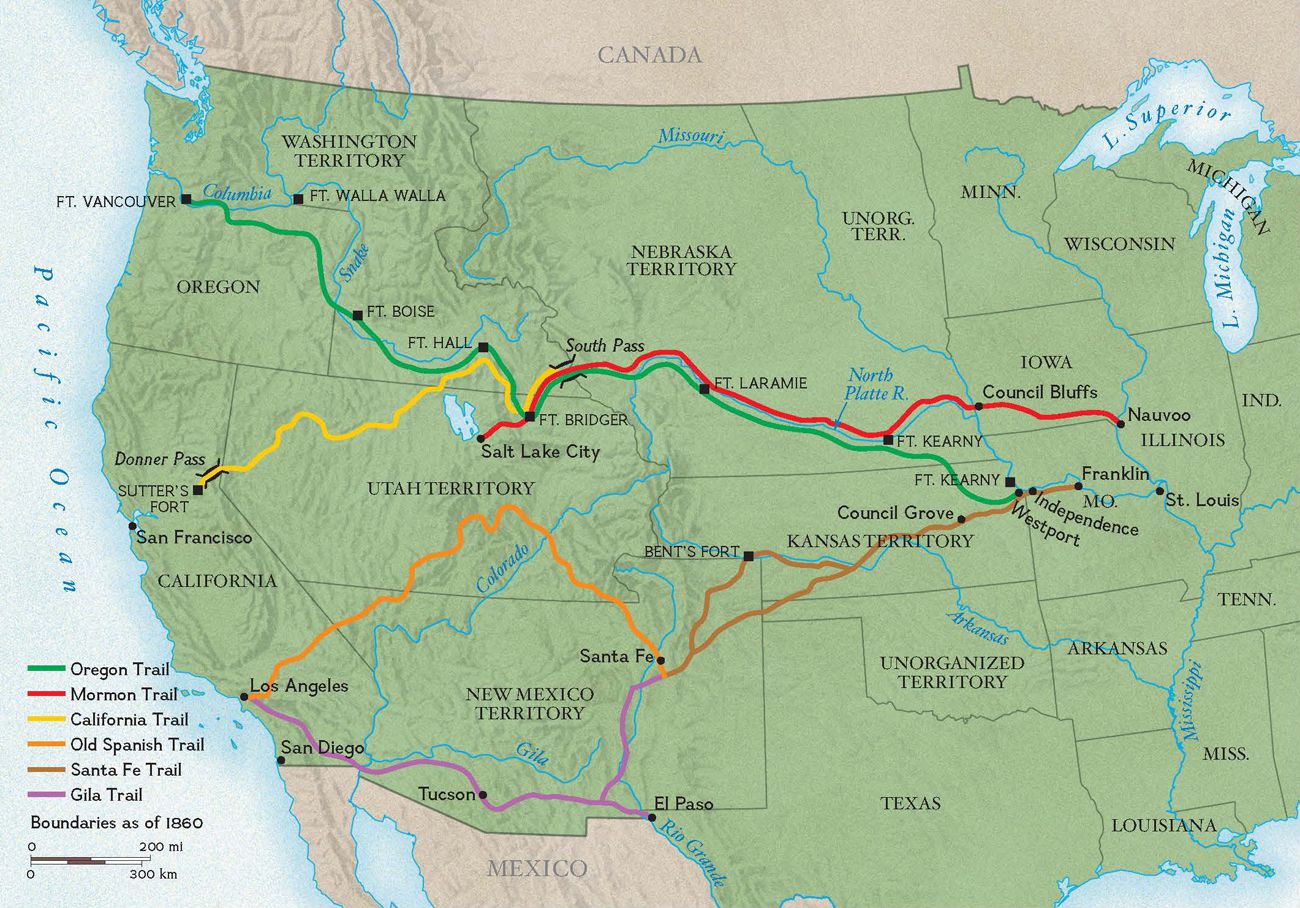
1843
May 22
The first major wagon train to the northwest departs from Elm Grove,
Missouri, on the Oregon Trail.
Although U.S. sovereignty over the Oregon Territory was not clearly established
until 1846, American fur trappers and missionary groups had been living in the
region for decades, to say nothing of the Native Americans who had settled the
land centuries earlier. Dozens of books and lectures proclaimed Oregon’s agricultural
potential, piquing the interest of white American farmers. The first overland
immigrants to Oregon, intending primarily to farm, came in 1841 when a small band
of 70 pioneers left Independence, Missouri. They followed a route blazed by fur traders,
which took them west along the Platte River through the Rocky Mountains via the easy
South Pass in Wyoming and then northwest to the Columbia River. In the years to come,
pioneers came to call the route the Oregon Trail.
In 1842, a slightly larger group of 100 pioneers made the 2,000-mile journey to Oregon.
The next year, however, the number of emigrants skyrocketed to 1,000. The sudden
increase was a product of a severe depression in the Midwest combined with a flood of
propaganda from fur traders, missionaries, and government officials extolling the virtues
of the land. Farmers dissatisfied with their prospects in Ohio, Illinois, Kentucky, and
Tennessee, hoped to find better lives in the supposed paradise of Oregon.
On this day in 1843, some 1,000 men, women, and children climbed aboard their wagons
and steered their horses west out of the small town of Elm Grove, Missouri. The train
comprised more than 100 wagons with a herd of 5,000 oxen and cattle trailing behind.
Dr. Elijah White, a Presbyterian missionary who had made the trip the year before,
served as guide.
The first section of the Oregon Trail ran through the relatively flat country of the Great Plains.
Obstacles were few, though the river crossings could be dangerous for wagons. The danger
of Native American attacks was a small but genuine risk. To be on the safe side, the pioneers
drew their wagons into a circle at night to create a makeshift stockade. If they feared
Native Americans might raid their livestock—the Plains tribes valued the horses, though
generally ignored the oxen—they would drive the animals into the enclosure.
The pioneers quickly learned that they were more likely to be injured or killed by a host of
more mundane causes. Obstacles included accidental discharge of firearms, falling off mules
or horses, drowning in river crossings, and disease. After entering the mountains, the trail
also became much more difficult, with steep ascents and descents over rocky terrain. The
pioneers risked injury from overturned and runaway wagons.
Yet, as with the 1,000-person party that made the journey in 1843, the vast majority of
pioneers on the trail survived to reach their destination in the fertile, well-watered land of
western Oregon. The migration of 1844 was smaller than that of the previous season, but
in 1845 it jumped to nearly 3,000. Thereafter, migration on the Oregon Trail was an annual
event, although the practice of traveling in giant convoys of wagons gave way to many smaller
bands of one or two-dozen wagons. The trail was heavily traveled until 1884, when the
Union Pacific constructed a railway along the route.
ALSO ON THIS DAY
CRIME
2017
Manchester Arena bombed
during Ariana Grande concert
Just moments after Ariana Grande finished the final song of her May 22, 2017
concert at Manchester Arena, a suicide bomber detonated an explosion on the
premises, killing 22 concertgoers and injuring 116 more. ISIS claimed responsibility
for what was the deadliest act of ... read more

GREAT BRITAIN
1455
The War of the Roses begins
In the opening battle of England’s War of the Roses, the Yorkists defeat King Henry VI’s
Lancastrian forces at St. Albans, 20 miles northwest of London. Many Lancastrian nobles
perished, including Edmund Beaufort, the duke of Somerset, and the king was forced
to submit to the ... read more
MIDDLE EAST
1990
South Yemen and North Yemen are unified
as the Republic of Yemen
After 150 years apart, Marxist South Yemen and conservative North Yemen are unified
as the Republic of Yemen. Ali Abdullah, president of North Yemen, became the new
country’s president, and Ali Salem Al-Baidh, leader of the South Yemeni Socialist Party,
vice president. The first ... read more

U.S. PRESIDENTS
1972
President Nixon arrives in Moscow
for historic summit
On May 22, 1972, President Richard Nixon arrives in Moscow for a summit with Soviet
leaders. Although it was Nixon’s first visit to the Soviet Union as president, he had
visited Moscow once before–as U.S. vice president. As Eisenhower’s vice president,
Nixon made frequent ... read more

WORLD WAR II
1939
The Pact of Steel is signed;
the Axis is formed
On May 22, 1939, Italy and Germany agree to a military and political alliance, giving
birth formally to the Axis powers, which will ultimately include Japan. Mussolini coined
the nickname “Pact of Steel” (he had also come up with the metaphor of an “axis”
binding Rome and Berlin) ... read more
WORLD WAR I
1917
Crisis mounts in Austria-Hungary
amid hunger and discontent
With hunger and discontent spreading among the civilian and military populations
of the Austro-Hungarian Empire, a crisis mounts within its government, as
Hungarian Prime Minister Istvan Tisza resigns at the request of the Austrian emperor,
Karl I, on May 22, 1917. A great power ... read more
U.S. PRESIDENTS
1802
First Lady Martha Washington dies
President George Washington’s devoted widow and the nation’s first first lady,
Martha Dandridge Custis Washington, dies at her Mt. Vernon home on May 22, 1802.
She was 70 years old. Like her husband, Martha Washington was born in the
American colonies as a British subject ... read more
ART, LITERATURE, AND FILM HISTORY
1859
Sir Arthur Conan Doyle,
creator of Sherlock Holmes, is born
It’s the birthday of Sir Arthur Conan Doyle, the creator of master sleuth
Sherlock Holmes. Doyle was born in Scotland and studied medicine at the
University of Edinburgh, where he met Dr. Joseph Bell, a teacher with extraordinary
deductive reasoning power. Bell partly inspired ... read more

ART, LITERATURE, AND FILM HISTORY
1958
Jerry Lee Lewis drops a bombshell in London
The arrival in the United Kingdom of one of the biggest figures in rock and roll
was looked forward to with great anticipation in May of 1958. Nowhere in the
world were the teenage fans of the raucous music coming out of America more
enthusiastic than they were in England, and ... read more

ART, LITERATURE, AND FILM HISTORY
2004
Controversial documentary “Fahrenheit 9/11”
wins Palme d’Or prize
On May 22, 2004, Michael Moore’s documentary film Fahrenheit 9/11 beats out 18
other films to win the coveted Palme d’Or, the top prize at the Cannes Film Festival.
It became the first documentary to triumph at Cannes since The Silent World,
co-directed by Jacques Cousteau and ... read more
CRIME
2002
Chandra Levy’s remains found
The remains of former Federal Bureau of Prisons intern Chandra Levy are found on
May 22, 2002, over a year after the 24-year-old was last seen at a health club.
The bone remains, discovered by a man walking through Washington, D.C.’s
Rock Creek Park, were identified through ... read more

CRIME
1981
Atlanta child murderer is traced
using rare nylon fiber
Police staking out a bridge over the Chattahoochee River near Atlanta, Georgia,
hear a loud splash, and begin chasing Wayne Williams as he attempts to drive
away in a station wagon. After questioning him about his involvement in the
unprecedented string of child murders in ... read more

CIVIL WAR
1856
Southern congressman beats Northern senator
with a cane in the halls of Congress
Southern Congressman Preston Brooks savagely beats Northern Senator Charles Sumner
in the halls of Congress as tensions rise over the expansion of slavery. When the
controversial Kansas-Nebraska Act of 1854 was passed, popular sovereignty was
applied within the two new ... read more

AMERICAN REVOLUTION
1781
Patriot siege of Ninety Six,
South Carolina begins
On May 22, 1781, Major General Nathanael Greene and 1,000 Patriots attempt an
attack on the critical village of Ninety Six in the South Carolina backcountry. After
failing to seize the fortified settlement, they began a siege of it, which lasted until
their retreat on June 18, ... read more
as part of the Great Emigration
1843
May 22
The first major wagon train to the northwest departs from Elm Grove,
Missouri, on the Oregon Trail.
Although U.S. sovereignty over the Oregon Territory was not clearly established
until 1846, American fur trappers and missionary groups had been living in the
region for decades, to say nothing of the Native Americans who had settled the
land centuries earlier. Dozens of books and lectures proclaimed Oregon’s agricultural
potential, piquing the interest of white American farmers. The first overland
immigrants to Oregon, intending primarily to farm, came in 1841 when a small band
of 70 pioneers left Independence, Missouri. They followed a route blazed by fur traders,
which took them west along the Platte River through the Rocky Mountains via the easy
South Pass in Wyoming and then northwest to the Columbia River. In the years to come,
pioneers came to call the route the Oregon Trail.
In 1842, a slightly larger group of 100 pioneers made the 2,000-mile journey to Oregon.
The next year, however, the number of emigrants skyrocketed to 1,000. The sudden
increase was a product of a severe depression in the Midwest combined with a flood of
propaganda from fur traders, missionaries, and government officials extolling the virtues
of the land. Farmers dissatisfied with their prospects in Ohio, Illinois, Kentucky, and
Tennessee, hoped to find better lives in the supposed paradise of Oregon.
On this day in 1843, some 1,000 men, women, and children climbed aboard their wagons
and steered their horses west out of the small town of Elm Grove, Missouri. The train
comprised more than 100 wagons with a herd of 5,000 oxen and cattle trailing behind.
Dr. Elijah White, a Presbyterian missionary who had made the trip the year before,
served as guide.
The first section of the Oregon Trail ran through the relatively flat country of the Great Plains.
Obstacles were few, though the river crossings could be dangerous for wagons. The danger
of Native American attacks was a small but genuine risk. To be on the safe side, the pioneers
drew their wagons into a circle at night to create a makeshift stockade. If they feared
Native Americans might raid their livestock—the Plains tribes valued the horses, though
generally ignored the oxen—they would drive the animals into the enclosure.
The pioneers quickly learned that they were more likely to be injured or killed by a host of
more mundane causes. Obstacles included accidental discharge of firearms, falling off mules
or horses, drowning in river crossings, and disease. After entering the mountains, the trail
also became much more difficult, with steep ascents and descents over rocky terrain. The
pioneers risked injury from overturned and runaway wagons.
Yet, as with the 1,000-person party that made the journey in 1843, the vast majority of
pioneers on the trail survived to reach their destination in the fertile, well-watered land of
western Oregon. The migration of 1844 was smaller than that of the previous season, but
in 1845 it jumped to nearly 3,000. Thereafter, migration on the Oregon Trail was an annual
event, although the practice of traveling in giant convoys of wagons gave way to many smaller
bands of one or two-dozen wagons. The trail was heavily traveled until 1884, when the
Union Pacific constructed a railway along the route.
ALSO ON THIS DAY
CRIME
2017
Manchester Arena bombed
during Ariana Grande concert
Just moments after Ariana Grande finished the final song of her May 22, 2017
concert at Manchester Arena, a suicide bomber detonated an explosion on the
premises, killing 22 concertgoers and injuring 116 more. ISIS claimed responsibility
for what was the deadliest act of ... read more
GREAT BRITAIN
1455
The War of the Roses begins
In the opening battle of England’s War of the Roses, the Yorkists defeat King Henry VI’s
Lancastrian forces at St. Albans, 20 miles northwest of London. Many Lancastrian nobles
perished, including Edmund Beaufort, the duke of Somerset, and the king was forced
to submit to the ... read more
MIDDLE EAST
1990
South Yemen and North Yemen are unified
as the Republic of Yemen
After 150 years apart, Marxist South Yemen and conservative North Yemen are unified
as the Republic of Yemen. Ali Abdullah, president of North Yemen, became the new
country’s president, and Ali Salem Al-Baidh, leader of the South Yemeni Socialist Party,
vice president. The first ... read more
U.S. PRESIDENTS
1972
President Nixon arrives in Moscow
for historic summit
On May 22, 1972, President Richard Nixon arrives in Moscow for a summit with Soviet
leaders. Although it was Nixon’s first visit to the Soviet Union as president, he had
visited Moscow once before–as U.S. vice president. As Eisenhower’s vice president,
Nixon made frequent ... read more
WORLD WAR II
1939
The Pact of Steel is signed;
the Axis is formed
On May 22, 1939, Italy and Germany agree to a military and political alliance, giving
birth formally to the Axis powers, which will ultimately include Japan. Mussolini coined
the nickname “Pact of Steel” (he had also come up with the metaphor of an “axis”
binding Rome and Berlin) ... read more
WORLD WAR I
1917
Crisis mounts in Austria-Hungary
amid hunger and discontent
With hunger and discontent spreading among the civilian and military populations
of the Austro-Hungarian Empire, a crisis mounts within its government, as
Hungarian Prime Minister Istvan Tisza resigns at the request of the Austrian emperor,
Karl I, on May 22, 1917. A great power ... read more
U.S. PRESIDENTS
1802
First Lady Martha Washington dies
President George Washington’s devoted widow and the nation’s first first lady,
Martha Dandridge Custis Washington, dies at her Mt. Vernon home on May 22, 1802.
She was 70 years old. Like her husband, Martha Washington was born in the
American colonies as a British subject ... read more
ART, LITERATURE, AND FILM HISTORY
1859
Sir Arthur Conan Doyle,
creator of Sherlock Holmes, is born
It’s the birthday of Sir Arthur Conan Doyle, the creator of master sleuth
Sherlock Holmes. Doyle was born in Scotland and studied medicine at the
University of Edinburgh, where he met Dr. Joseph Bell, a teacher with extraordinary
deductive reasoning power. Bell partly inspired ... read more
ART, LITERATURE, AND FILM HISTORY
1958
Jerry Lee Lewis drops a bombshell in London
The arrival in the United Kingdom of one of the biggest figures in rock and roll
was looked forward to with great anticipation in May of 1958. Nowhere in the
world were the teenage fans of the raucous music coming out of America more
enthusiastic than they were in England, and ... read more
ART, LITERATURE, AND FILM HISTORY
2004
Controversial documentary “Fahrenheit 9/11”
wins Palme d’Or prize
On May 22, 2004, Michael Moore’s documentary film Fahrenheit 9/11 beats out 18
other films to win the coveted Palme d’Or, the top prize at the Cannes Film Festival.
It became the first documentary to triumph at Cannes since The Silent World,
co-directed by Jacques Cousteau and ... read more
CRIME
2002
Chandra Levy’s remains found
The remains of former Federal Bureau of Prisons intern Chandra Levy are found on
May 22, 2002, over a year after the 24-year-old was last seen at a health club.
The bone remains, discovered by a man walking through Washington, D.C.’s
Rock Creek Park, were identified through ... read more
CRIME
1981
Atlanta child murderer is traced
using rare nylon fiber
Police staking out a bridge over the Chattahoochee River near Atlanta, Georgia,
hear a loud splash, and begin chasing Wayne Williams as he attempts to drive
away in a station wagon. After questioning him about his involvement in the
unprecedented string of child murders in ... read more
CIVIL WAR
1856
Southern congressman beats Northern senator
with a cane in the halls of Congress
Southern Congressman Preston Brooks savagely beats Northern Senator Charles Sumner
in the halls of Congress as tensions rise over the expansion of slavery. When the
controversial Kansas-Nebraska Act of 1854 was passed, popular sovereignty was
applied within the two new ... read more
AMERICAN REVOLUTION
1781
Patriot siege of Ninety Six,
South Carolina begins
On May 22, 1781, Major General Nathanael Greene and 1,000 Patriots attempt an
attack on the critical village of Ninety Six in the South Carolina backcountry. After
failing to seize the fortified settlement, they began a siege of it, which lasted until
their retreat on June 18, ... read more
RE: THIS DAY IN HISTORY - IceWizard - 05-23-2022
Police kill famous outlaws
Bonnie and Clyde

1934
May 23
On May 23, 1934, notorious criminals Bonnie Parker and Clyde Barrow are shot to death
by Texas and Louisiana state police while driving a stolen car near Sailes, Louisiana.
Bonnie Parker met the charismatic Clyde Barrow in Texas when she was 19 years old and
her husband (she married when she was 16) was serving time in jail for murder. Shortly
after they met, Barrow was imprisoned for robbery. Parker visited him every day, and
smuggled a gun into prison to help him escape, but he was soon caught in Ohio and sent
back to jail. When Barrow was paroled in 1932, he immediately hooked up with Parker,
and the couple began a life of crime together.
After they stole a car and committed several robberies, Parker was caught by police and
sent to jail for two months. Released in mid-1932, she rejoined Barrow. Over the next
two years, the couple teamed with various accomplices to rob a string of banks and stores
across five states—Texas, Oklahoma, Missouri, New Mexico and Louisiana. To law enforcement
agents, the Barrow Gang—including Barrow’s childhood friend, Raymond Hamilton, W.D. Jones,
Henry Methvin, Barrow’s brother Buck and his wife Blanche, among others—were cold-blooded
criminals who didn’t hesitate to kill anyone who got in their way, especially police or sheriff’s
deputies. Among the public, however, Parker and Barrow’s reputation as dangerous outlaws
was mixed with a romantic view of the couple as “Robin Hood”-like folk heroes.
Their fame was increased by the fact that Bonnie was a woman—an unlikely criminal—and by
the fact that the couple posed for playful photographs together, which were later found by police
and released to the media. Police almost captured the famous duo twice in the spring of 1933,
with surprise raids on their hideouts in Joplin and Platte City, Missouri. Buck Barrow was killed
in the second raid, and Blanche was arrested, but Bonnie and Clyde escaped once again.
In January 1934, they attacked the Eastham Prison Farm in Texas to help Hamilton break out
of jail, shooting several guards with machine guns and killing one.
Texan prison officials hired a retired Texas Ranger, Captain Frank Hamer, as a special investigator
to track down Parker and Barrow. After a three-month search, Hamer traced the couple to
Louisiana, where Henry Methvin’s family lived. Before dawn on May 23, Hamer and a group
of Louisiana and Texas lawmen hid in the bushes along a country road outside Sailes. When
Parker and Barrow appeared, the officers opened fire, killing the couple in a hail of bullets.
All told, the Barrow Gang was believed responsible for the deaths of 13 people, including nine
police officers. Parker and Barrow are still seen by many as romantic figures, however, especially
after the success of the 1967 film Bonnie and Clyde, starring Faye Dunaway and Warren Beatty.
ALSO ON THIS DAY
ART, LITERATURE, AND FILM HISTORY
1921
"Shuffle Along," the first major African American
hit musical, premieres on Broadway
Deeply in debt and relegated to a shabby theater, the musical Shuffle Along debuts
at the Sixty-Third Street Music Hall on May 23, 1921. The odds are stacked against
the revue-style show, written and performed by African Americans, but it will run for
over a year, making it the ... read more

21ST CENTURY
2015
Ireland legalizes same-sex marriage
On May 23, 2015 thousands of LGBTQ activists celebrated as Ireland became the first
country to legalize same-sex marriage through referendum. The referendum passed
with 62% of voters (1.2 million people) voting yes. The vote attracted a large turnout,
with 60.5% of eligible ... read more

HOLOCAUST
1960
High-ranking Nazi official
Adolf Eichmann captured
On May 23, 1960, Israeli Prime Minister David Ben-Gurion announces to the world
that Nazi war criminal Adolf Eichmann has been captured and will stand trial in Israel.
Eichmann, the Nazi SS officer who organized Adolf Hitler’s “final solution of the
Jewish question,” was seized ... read more

EARLY 20TH CENTURY US
1911
New York Public Library dedicated
In a ceremony presided over by President William Howard Taft, the New York Public Library,
the largest marble structure ever constructed in the United States, is dedicated in
New York City. Occupying a two-block section of Fifth Avenue between 40th and
42nd Streets, the ... read more

GREAT BRITAIN
1701
Captain Kidd is executed
At London’s Execution Dock, British privateer William Kidd, popularly known as
Captain Kidd, is hanged for piracy and murder. Born in Strathclyde, Scotland,
Kidd established himself as a sea captain before settling in New York in 1690,
where he bought property and married. At ... read more
WORLD WAR II
1945
Nazi SS Chief Heinrich Himmler dies by suicide
On May 23, 1945, Heinrich Himmler, chief of the SS, assistant chief of the Gestapo,
and architect of Hitler’s program to exterminate European Jews, dies by suicide one
day after being arrested by the British. As head of the Waffen-Schutzstaffel
(the military arm of the Nazi ... read more

WORLD WAR II
1941
Lord Mountbatten, cousin to a king,
sunk by German dive-bombers
On May 23, 1941, Captain Lord Louis Mountbatten, second cousin of King George VI of Britain
and the only man other than the king to hold rank in all three military services simultaneously,
is among those thrown into the Mediterranean Sea when his destroyer, the HMS Kelly, is ... read more

U.S. PRESIDENTS
2004
George W. Bush recovers from bicycle accident
On May 23, 2004, as reported in the Washington Post, President George Bush recovers from
a bicycle accident he’d had the day before. Bush had taken up mountain biking for exercise
at the suggestion of physicians. Reporter Dana Milbank recounted how Bush fell from his mountain ... read more

ART, LITERATURE, AND FILM HISTORY
1979
Tom Petty defies his record label
and files for bankruptcy
The music industry is notorious for its creative accounting practices and for onerous contracts
that can keep even some top-selling artists perpetually in debt to their record labels. In a
typical recording contract, a record label advances an artist a certain sum of money ... read more

NATURAL DISASTERS & ENVIRONMENT
1960
Deadly tsunami hits Hawaii
A tsunami caused by an earthquake off the coast of Chile travels across the Pacific Ocean and
kills 61 people in Hilo, Hawaii, on May 23, 1960. The massive 9.5-magnitude quake had killed
thousands in Chile the previous day. The earthquake, involving a severe plate shift, caused ... read more

COLD WAR
1949
Federal Republic of Germany is established
The Federal Republic of Germany (popularly known as West Germany) is formally established
as a separate and independent nation. This action marked the effective end to any discussion
of reuniting East and West Germany. In the period after World War II, Germany was divided
into ... read more

AMERICAN REVOLUTION
1777
Meigs Expedition claims Patriot victory
on Long Island
At Sag Harbor, New York, Patriot troops under the command of Lieutenant Colonel Return
Jonathan Meigs capture several British vessels and burn Redcoat supplies. With the help of
two local men, Meigs and his Connecticut raiders grabbed the British commander from his
bed in the ... read more
WORLD WAR I
1915
Italy declares war on Austria-Hungary
On May 23, 1915, Italy declares war on Austria-Hungary, entering World War I on the side
of the Allies—Britain, France and Russia. When World War I broke out in the summer of 1914,
Italy declared itself neutral in the conflict, despite its membership in the so-called Triple ... read more
Bonnie and Clyde
1934
May 23
On May 23, 1934, notorious criminals Bonnie Parker and Clyde Barrow are shot to death
by Texas and Louisiana state police while driving a stolen car near Sailes, Louisiana.
Bonnie Parker met the charismatic Clyde Barrow in Texas when she was 19 years old and
her husband (she married when she was 16) was serving time in jail for murder. Shortly
after they met, Barrow was imprisoned for robbery. Parker visited him every day, and
smuggled a gun into prison to help him escape, but he was soon caught in Ohio and sent
back to jail. When Barrow was paroled in 1932, he immediately hooked up with Parker,
and the couple began a life of crime together.
After they stole a car and committed several robberies, Parker was caught by police and
sent to jail for two months. Released in mid-1932, she rejoined Barrow. Over the next
two years, the couple teamed with various accomplices to rob a string of banks and stores
across five states—Texas, Oklahoma, Missouri, New Mexico and Louisiana. To law enforcement
agents, the Barrow Gang—including Barrow’s childhood friend, Raymond Hamilton, W.D. Jones,
Henry Methvin, Barrow’s brother Buck and his wife Blanche, among others—were cold-blooded
criminals who didn’t hesitate to kill anyone who got in their way, especially police or sheriff’s
deputies. Among the public, however, Parker and Barrow’s reputation as dangerous outlaws
was mixed with a romantic view of the couple as “Robin Hood”-like folk heroes.
Their fame was increased by the fact that Bonnie was a woman—an unlikely criminal—and by
the fact that the couple posed for playful photographs together, which were later found by police
and released to the media. Police almost captured the famous duo twice in the spring of 1933,
with surprise raids on their hideouts in Joplin and Platte City, Missouri. Buck Barrow was killed
in the second raid, and Blanche was arrested, but Bonnie and Clyde escaped once again.
In January 1934, they attacked the Eastham Prison Farm in Texas to help Hamilton break out
of jail, shooting several guards with machine guns and killing one.
Texan prison officials hired a retired Texas Ranger, Captain Frank Hamer, as a special investigator
to track down Parker and Barrow. After a three-month search, Hamer traced the couple to
Louisiana, where Henry Methvin’s family lived. Before dawn on May 23, Hamer and a group
of Louisiana and Texas lawmen hid in the bushes along a country road outside Sailes. When
Parker and Barrow appeared, the officers opened fire, killing the couple in a hail of bullets.
All told, the Barrow Gang was believed responsible for the deaths of 13 people, including nine
police officers. Parker and Barrow are still seen by many as romantic figures, however, especially
after the success of the 1967 film Bonnie and Clyde, starring Faye Dunaway and Warren Beatty.
ALSO ON THIS DAY
ART, LITERATURE, AND FILM HISTORY
1921
"Shuffle Along," the first major African American
hit musical, premieres on Broadway
Deeply in debt and relegated to a shabby theater, the musical Shuffle Along debuts
at the Sixty-Third Street Music Hall on May 23, 1921. The odds are stacked against
the revue-style show, written and performed by African Americans, but it will run for
over a year, making it the ... read more
21ST CENTURY
2015
Ireland legalizes same-sex marriage
On May 23, 2015 thousands of LGBTQ activists celebrated as Ireland became the first
country to legalize same-sex marriage through referendum. The referendum passed
with 62% of voters (1.2 million people) voting yes. The vote attracted a large turnout,
with 60.5% of eligible ... read more
HOLOCAUST
1960
High-ranking Nazi official
Adolf Eichmann captured
On May 23, 1960, Israeli Prime Minister David Ben-Gurion announces to the world
that Nazi war criminal Adolf Eichmann has been captured and will stand trial in Israel.
Eichmann, the Nazi SS officer who organized Adolf Hitler’s “final solution of the
Jewish question,” was seized ... read more
EARLY 20TH CENTURY US
1911
New York Public Library dedicated
In a ceremony presided over by President William Howard Taft, the New York Public Library,
the largest marble structure ever constructed in the United States, is dedicated in
New York City. Occupying a two-block section of Fifth Avenue between 40th and
42nd Streets, the ... read more
GREAT BRITAIN
1701
Captain Kidd is executed
At London’s Execution Dock, British privateer William Kidd, popularly known as
Captain Kidd, is hanged for piracy and murder. Born in Strathclyde, Scotland,
Kidd established himself as a sea captain before settling in New York in 1690,
where he bought property and married. At ... read more
WORLD WAR II
1945
Nazi SS Chief Heinrich Himmler dies by suicide
On May 23, 1945, Heinrich Himmler, chief of the SS, assistant chief of the Gestapo,
and architect of Hitler’s program to exterminate European Jews, dies by suicide one
day after being arrested by the British. As head of the Waffen-Schutzstaffel
(the military arm of the Nazi ... read more
WORLD WAR II
1941
Lord Mountbatten, cousin to a king,
sunk by German dive-bombers
On May 23, 1941, Captain Lord Louis Mountbatten, second cousin of King George VI of Britain
and the only man other than the king to hold rank in all three military services simultaneously,
is among those thrown into the Mediterranean Sea when his destroyer, the HMS Kelly, is ... read more
U.S. PRESIDENTS
2004
George W. Bush recovers from bicycle accident
On May 23, 2004, as reported in the Washington Post, President George Bush recovers from
a bicycle accident he’d had the day before. Bush had taken up mountain biking for exercise
at the suggestion of physicians. Reporter Dana Milbank recounted how Bush fell from his mountain ... read more
ART, LITERATURE, AND FILM HISTORY
1979
Tom Petty defies his record label
and files for bankruptcy
The music industry is notorious for its creative accounting practices and for onerous contracts
that can keep even some top-selling artists perpetually in debt to their record labels. In a
typical recording contract, a record label advances an artist a certain sum of money ... read more
NATURAL DISASTERS & ENVIRONMENT
1960
Deadly tsunami hits Hawaii
A tsunami caused by an earthquake off the coast of Chile travels across the Pacific Ocean and
kills 61 people in Hilo, Hawaii, on May 23, 1960. The massive 9.5-magnitude quake had killed
thousands in Chile the previous day. The earthquake, involving a severe plate shift, caused ... read more
COLD WAR
1949
Federal Republic of Germany is established
The Federal Republic of Germany (popularly known as West Germany) is formally established
as a separate and independent nation. This action marked the effective end to any discussion
of reuniting East and West Germany. In the period after World War II, Germany was divided
into ... read more
AMERICAN REVOLUTION
1777
Meigs Expedition claims Patriot victory
on Long Island
At Sag Harbor, New York, Patriot troops under the command of Lieutenant Colonel Return
Jonathan Meigs capture several British vessels and burn Redcoat supplies. With the help of
two local men, Meigs and his Connecticut raiders grabbed the British commander from his
bed in the ... read more
WORLD WAR I
1915
Italy declares war on Austria-Hungary
On May 23, 1915, Italy declares war on Austria-Hungary, entering World War I on the side
of the Allies—Britain, France and Russia. When World War I broke out in the summer of 1914,
Italy declared itself neutral in the conflict, despite its membership in the so-called Triple ... read more
RE: THIS DAY IN HISTORY - IceWizard - 05-24-2022
Brooklyn Bridge opens

1883
May 24
After 14 years, the Brooklyn Bridge over the East River opens, connecting the great
cities of New York and Brooklyn for the first time in history. Thousands of residents of Brooklyn
and Manhattan Island turned out to witness the dedication ceremony, which was presided
over by President Chester A. Arthur and New York Governor Grover Cleveland. Designed
by the late John A. Roebling, the Brooklyn Bridge was the largest suspension bridge
ever built to that date.
John Roebling, born in Germany in 1806, was a great pioneer in the design of steel suspension
bridges. He studied industrial engineering in Berlin and at the age of 25 immigrated to western
Pennsylvania, where he attempted, unsuccessfully, to make his living as a farmer. He later
moved to the state capital in Harrisburg, where he found work as a civil engineer. He promoted
the use of wire cable and established a successful wire-cable factory.
Roebling is credited with a major breakthrough in suspension-bridge technology: a web truss
added to either side of the bridge roadway that greatly stabilized the structure. Using this
model, Roebling successfully bridged the Niagara Gorge at Niagara Falls, New York, and the
Ohio River at Cincinnati, Ohio. On the basis of these achievements, New York State accepted
Roebling’s design for a bridge connecting Brooklyn and Manhattan–with a span of 1,595
feet–and appointed him chief engineer. It was to be the world’s first steel suspension bridge.
Just before construction began in 1869, Roebling was fatally injured while taking a few final
compass readings across the East River. A boat smashed the toes on one of his feet, and three
weeks later he died of tetanus. He was the first of more than two dozen people who would
die building his bridge. His 32-year-old son, Washington A. Roebling, took over as chief
engineer. Roebling had worked with his father on several bridges and had helped design
the Brooklyn Bridge.
The two granite foundations of the Brooklyn Bridge were built in timber caissons, or
watertight chambers, sunk to depths of 44 feet on the Brooklyn side and 78 feet on the
New York side. Compressed air pressurized the caissons, allowing underwater construction.
At that time, little was known of the risks of working under such conditions, and more
than a hundred workers suffered from cases of compression sickness. Compression
sickness, or the “bends,” is caused by the appearance of nitrogen bubbles in the
bloodstream that result from rapid decompression. Several died, and Washington
Roebling himself became bedridden from the condition in 1872. Other workers died
as a result of more conventional construction accidents, such as collapses and a fire.
Roebling continued to direct construction operations from his home, and his wife, Emily,
carried his instructions to the workers. In 1877, Washington and Emily moved into a home
with a view of the bridge. Roebling’s health gradually improved, but he remained partially
paralyzed for the rest of his life. On May 24, 1883, Emily Roebling was given the first ride
over the completed bridge, with a rooster, a symbol of victory, in her lap. Within 24 hours,
an estimated 250,000 people walked across the Brooklyn Bridge, using a broad promenade
above the roadway that John Roebling designed solely for the enjoyment of pedestrians.
The Brooklyn Bridge, with its unprecedented length and two stately towers, was dubbed
the “eighth wonder of the world.” The connection it provided between the massive population
centers of Brooklyn and Manhattan changed the course of New York City forever. In 1898,
the city of Brooklyn formally merged with New York City, Staten Island, and a few farm towns,
forming Greater New York.
ALSO ON THIS DAY
SPORTS
1964
Riot erupts at Lima, Peru soccer match,
killing hundreds
A referee’s call in a soccer match between Peru and Argentina sparks a riot
on May 24, 1964. More than 300 fans were killed and another 500 people
were injured in the violent melee that followed at National Stadium in Lima, Peru.
The match was a qualifier for the 1964 Olympics ... read more

INVENTIONS & SCIENCE
1844
Samuel Morse demonstrates the telegraph
with the message,
“What hath God wrought?”
In a demonstration witnessed by members of Congress, American inventor
Samuel F.B. Morse dispatches a telegraph message from the U.S. Capitol to
Alfred Vail at a railroad station in Baltimore, Maryland.
The message—“What Hath God Wrought?”—was telegraphed back to the
Capitol a ... read more

INVENTIONS & SCIENCE
1543
Astronomer Nicolaus Copernicus dies
On May 24, 1543, Polish astronomer Nicolaus Copernicus dies in what is
now Frombork, Poland. The father of modern astronomy, he was the first
modern European scientist to propose that Earth and other planets revolve
around the sun. Prior to the publication of his major ... read more
WORLD WAR II
1943
Auschwitz gets a new doctor:
“the Angel of Death”
On May 24, 1943, the extermination camp at Auschwitz, Poland, receives a
new doctor, 32-year-old Josef Mengele, a man who will earn the nickname
“the Angel of Death.” Born March 16, 1911, in Bavaria, Mengele studied
philosophy under Alfred Rosenberg, whose racial theories highly ... read more

WORLD WAR II
1941
German battleship, the Bismarck,
sinks Britain’s HMS Hood
On May 24, 1941, Germany’s largest battleship, the Bismarck, sinks the pride
of the British fleet, HMS Hood. The Bismarck was the most modern of Germany’s
battleships, a prize coveted by other nation’s navies, even while still in the
blueprint stage (Hitler handed over a copy of ... read more

Bismarck
SPORTS
1935
MLB holds first night game
The Cincinnati Reds beat the Philadelphia Phillies 2-1 on May 24, 1935 in
Major League Baseball’s first-ever night game, played courtesy of recently
installed lights at Crosley Field in Cincinnati. The first-ever night game in
professional baseball took place May 2, 1930, when a ... read more

U.S. PRESIDENTS
1797
Thomas Jefferson inquires about
a former flame
On May 24, 1797, future President Thomas Jefferson writes to his friend
Angelica Church, inquiring casually about their mutual friend, Maria Cosway,
a woman who had once captured his heart and inspired a romantically
themed essay. In 1786, a widowed Thomas Jefferson met Maria ... read more
CRIME
1989
Lori Ann Auker disappears from a parking lot
Lori Ann Auker, a 19-year-old pet shop worker, disappears from Northumberland
County, Pennsylvania. After failing to show up for work, her car was found the
next day in the parking lot of the Susquehanna Valley Mall where The Pet Place
was located. Police had no clues as to what ... read more

AMERICAN REVOLUTION
1775
John Hancock becomes president of Congress
On May 24, 1775, John Hancock is elected president of the Second Continental Congress.
John Hancock is best known for his large signature on the Declaration of Independence,
which he jested the British could read without spectacles. He was serving as
president of Congress upon ... read more
WORLD WAR I
1917
British naval convoy system introduced
On May 24, 1917, driven by the spectacular success of the German U-boat
submarines and their attacks on Allied and neutral ships at sea, the British Royal Navy
introduces a newly created convoy system, whereby all merchant ships crossing
the Atlantic Ocean would travel in groups ... read more
1883
May 24
After 14 years, the Brooklyn Bridge over the East River opens, connecting the great
cities of New York and Brooklyn for the first time in history. Thousands of residents of Brooklyn
and Manhattan Island turned out to witness the dedication ceremony, which was presided
over by President Chester A. Arthur and New York Governor Grover Cleveland. Designed
by the late John A. Roebling, the Brooklyn Bridge was the largest suspension bridge
ever built to that date.
John Roebling, born in Germany in 1806, was a great pioneer in the design of steel suspension
bridges. He studied industrial engineering in Berlin and at the age of 25 immigrated to western
Pennsylvania, where he attempted, unsuccessfully, to make his living as a farmer. He later
moved to the state capital in Harrisburg, where he found work as a civil engineer. He promoted
the use of wire cable and established a successful wire-cable factory.
Roebling is credited with a major breakthrough in suspension-bridge technology: a web truss
added to either side of the bridge roadway that greatly stabilized the structure. Using this
model, Roebling successfully bridged the Niagara Gorge at Niagara Falls, New York, and the
Ohio River at Cincinnati, Ohio. On the basis of these achievements, New York State accepted
Roebling’s design for a bridge connecting Brooklyn and Manhattan–with a span of 1,595
feet–and appointed him chief engineer. It was to be the world’s first steel suspension bridge.
Just before construction began in 1869, Roebling was fatally injured while taking a few final
compass readings across the East River. A boat smashed the toes on one of his feet, and three
weeks later he died of tetanus. He was the first of more than two dozen people who would
die building his bridge. His 32-year-old son, Washington A. Roebling, took over as chief
engineer. Roebling had worked with his father on several bridges and had helped design
the Brooklyn Bridge.
The two granite foundations of the Brooklyn Bridge were built in timber caissons, or
watertight chambers, sunk to depths of 44 feet on the Brooklyn side and 78 feet on the
New York side. Compressed air pressurized the caissons, allowing underwater construction.
At that time, little was known of the risks of working under such conditions, and more
than a hundred workers suffered from cases of compression sickness. Compression
sickness, or the “bends,” is caused by the appearance of nitrogen bubbles in the
bloodstream that result from rapid decompression. Several died, and Washington
Roebling himself became bedridden from the condition in 1872. Other workers died
as a result of more conventional construction accidents, such as collapses and a fire.
Roebling continued to direct construction operations from his home, and his wife, Emily,
carried his instructions to the workers. In 1877, Washington and Emily moved into a home
with a view of the bridge. Roebling’s health gradually improved, but he remained partially
paralyzed for the rest of his life. On May 24, 1883, Emily Roebling was given the first ride
over the completed bridge, with a rooster, a symbol of victory, in her lap. Within 24 hours,
an estimated 250,000 people walked across the Brooklyn Bridge, using a broad promenade
above the roadway that John Roebling designed solely for the enjoyment of pedestrians.
The Brooklyn Bridge, with its unprecedented length and two stately towers, was dubbed
the “eighth wonder of the world.” The connection it provided between the massive population
centers of Brooklyn and Manhattan changed the course of New York City forever. In 1898,
the city of Brooklyn formally merged with New York City, Staten Island, and a few farm towns,
forming Greater New York.
ALSO ON THIS DAY
SPORTS
1964
Riot erupts at Lima, Peru soccer match,
killing hundreds
A referee’s call in a soccer match between Peru and Argentina sparks a riot
on May 24, 1964. More than 300 fans were killed and another 500 people
were injured in the violent melee that followed at National Stadium in Lima, Peru.
The match was a qualifier for the 1964 Olympics ... read more
INVENTIONS & SCIENCE
1844
Samuel Morse demonstrates the telegraph
with the message,
“What hath God wrought?”
In a demonstration witnessed by members of Congress, American inventor
Samuel F.B. Morse dispatches a telegraph message from the U.S. Capitol to
Alfred Vail at a railroad station in Baltimore, Maryland.
The message—“What Hath God Wrought?”—was telegraphed back to the
Capitol a ... read more
INVENTIONS & SCIENCE
1543
Astronomer Nicolaus Copernicus dies
On May 24, 1543, Polish astronomer Nicolaus Copernicus dies in what is
now Frombork, Poland. The father of modern astronomy, he was the first
modern European scientist to propose that Earth and other planets revolve
around the sun. Prior to the publication of his major ... read more
WORLD WAR II
1943
Auschwitz gets a new doctor:
“the Angel of Death”
On May 24, 1943, the extermination camp at Auschwitz, Poland, receives a
new doctor, 32-year-old Josef Mengele, a man who will earn the nickname
“the Angel of Death.” Born March 16, 1911, in Bavaria, Mengele studied
philosophy under Alfred Rosenberg, whose racial theories highly ... read more
WORLD WAR II
1941
German battleship, the Bismarck,
sinks Britain’s HMS Hood
On May 24, 1941, Germany’s largest battleship, the Bismarck, sinks the pride
of the British fleet, HMS Hood. The Bismarck was the most modern of Germany’s
battleships, a prize coveted by other nation’s navies, even while still in the
blueprint stage (Hitler handed over a copy of ... read more
Bismarck
SPORTS
1935
MLB holds first night game
The Cincinnati Reds beat the Philadelphia Phillies 2-1 on May 24, 1935 in
Major League Baseball’s first-ever night game, played courtesy of recently
installed lights at Crosley Field in Cincinnati. The first-ever night game in
professional baseball took place May 2, 1930, when a ... read more
U.S. PRESIDENTS
1797
Thomas Jefferson inquires about
a former flame
On May 24, 1797, future President Thomas Jefferson writes to his friend
Angelica Church, inquiring casually about their mutual friend, Maria Cosway,
a woman who had once captured his heart and inspired a romantically
themed essay. In 1786, a widowed Thomas Jefferson met Maria ... read more
CRIME
1989
Lori Ann Auker disappears from a parking lot
Lori Ann Auker, a 19-year-old pet shop worker, disappears from Northumberland
County, Pennsylvania. After failing to show up for work, her car was found the
next day in the parking lot of the Susquehanna Valley Mall where The Pet Place
was located. Police had no clues as to what ... read more
AMERICAN REVOLUTION
1775
John Hancock becomes president of Congress
On May 24, 1775, John Hancock is elected president of the Second Continental Congress.
John Hancock is best known for his large signature on the Declaration of Independence,
which he jested the British could read without spectacles. He was serving as
president of Congress upon ... read more
WORLD WAR I
1917
British naval convoy system introduced
On May 24, 1917, driven by the spectacular success of the German U-boat
submarines and their attacks on Allied and neutral ships at sea, the British Royal Navy
introduces a newly created convoy system, whereby all merchant ships crossing
the Atlantic Ocean would travel in groups ... read more
RE: THIS DAY IN HISTORY - IceWizard - 05-25-2022
Constitutional Convention begins

1787
May 25
Four years after the United States won its independence from England, 55 state delegates,
including George Washington, James Madison and Benjamin Franklin, convene in Philadelphia
to compose a new U.S. constitution on May 25, 1787.
The Articles of Confederation, ratified several months before the British surrender at Yorktown
in 1781, provided for a loose confederation of U.S. states, which were sovereign in most of
their affairs. On paper, Congress—the central authority—had the power to govern foreign affairs,
conduct war, and regulate currency, but in practice these powers were sharply limited because
Congress was given no authority to enforce its requests to the states for money or troops.
By 1786, it was apparent that the Union would soon break up if the Articles of Confederation
were not amended or replaced. Five states met in Annapolis, Maryland, to discuss the issue,
and all the states were invited to send delegates to a new constitutional convention to be
held in Philadelphia.
On May 25, 1787, delegates representing every state except Rhode Island convened at
Philadelphia’s Pennsylvania State House for the Constitutional Convention. The building, which is
now known as Independence Hall, had earlier seen the drafting of the Declaration of Independence
and the signing of the Articles of Confederation. The assembly immediately discarded the idea
of amending the Articles of Confederation and set about drawing up a new scheme of government.
Revolutionary War hero George Washington, a delegate from Virginia, was elected convention president.
During three months of debate, the delegates devised a brilliant federal system characterized
by an intricate system of checks and balances. The convention was divided over the issue of
state representation in Congress, as more populated states sought proportional legislation,
and smaller states wanted equal representation. The problem was resolved by the Connecticut
Compromise, which proposed a bicameral legislature with proportional representation in the
lower house (House of Representatives) and equal representation of the states in the
upper house (Senate).
On September 17, 1787, the Constitution of the United States of America was signed by 38 of
the 41 delegates present at the conclusion of the convention. As dictated by Article VII, the
document would not become binding until it was ratified by nine of the 13 states.
Beginning on December 7, five states—Delaware, Pennsylvania, New Jersey, Georgia, and
Connecticut—ratified it in quick succession. However, other states, especially Massachusetts,
opposed the document, as it failed to reserve un-delegated powers to the states and lacked
constitutional protection of basic political rights, such as freedom of speech, religion, and the press.
In February 1788, a compromise was reached under which Massachusetts and other states
would agree to ratify the document with the assurance that amendments would be immediately
proposed. The Constitution was thus narrowly ratified in Massachusetts, followed by Maryland
and South Carolina. On June 21, 1788, New Hampshire became the ninth state to ratify the
document, and it was subsequently agreed that government under the U.S. Constitution would
begin on March 4, 1789.
On September 25, 1789, the first Congress of the United States adopted 12 amendments to
the U.S. Constitution–the Bill of Rights–and sent them to the states for ratification. Ten of these
amendments were ratified in 1791. In November 1789, North Carolina became the 12th state
to ratify the U.S. Constitution. Rhode Island, which opposed federal control of currency and
was critical of compromise on the issue of slavery, resisted ratifying the Constitution until the
U.S. government threatened to sever commercial relations with the state. On May 29, 1790,
Rhode Island voted by two votes to ratify the document, and the last of the original 13 colonies
joined the United States. Today the U.S. Constitution is the oldest written national constitution
in operation in the world.
ALSO ON THIS DAY
Black History Milestones:
George Floyd Protests
21ST CENTURY
2020
George Floyd is killed by a police officer,
igniting historic protests
On the evening of May 25, 2020, white Minneapolis police officer Derek Chauvin
kills George Floyd, a Black man, by kneeling on his neck for almost 10 minutes.
The death, recorded by bystanders, touched off what may have been the largest
protest movement in U.S. history and a ... read more

Etan Patz
CRIME
1979
6-year-old Etan Patz—boy on milk carton
goes missing
On the morning of May 25, 1979, six-year-old Etan Patz walked the two blocks
from his home to his bus stop in Manhattan. It was his first time walking there
alone before school, and the last day his parents would ever see him. That’s
because someone abducted Etan during that ... read more

GREAT BRITAIN
1660
The English Restoration begins
Under invitation by leaders of the English Commonwealth, Charles II, the exiled
king of England, lands at Dover, England, to assume the throne and end 11 years
of military rule. Prince of Wales at the time of the English Civil War, Charles fled
to France after Oliver Cromwell’s ... read more
INVENTIONS & SCIENCE
1994
Pennsylvania man buried with
his beloved Corvette
On May 25, 1994, the ashes of 71-year-old George Swanson are buried
(according to Swanson’s request) in the driver’s seat of his 1984 white Corvette
in Irwin, Pennsylvania. Swanson, a beer distributor and former U.S. Army sergeant
during World War II, died the previous March 31 ... read more

ART, LITERATURE, AND FILM HISTORY
1977
"Star Wars" opens in theaters
On May 25, 1977, Memorial Day weekend opens with an intergalactic bang as the
first of George Lucas’ blockbuster Star Wars movies hits American theaters. The
incredible success of Star Wars–it received seven Oscars, and earned $461 million
in U.S. ticket sales and a gross of ... read more

SPORTS
1935
Babe Ruth hits last home run
On May 25, 1935, at Forbes Field in Pittsburgh, Pennsylvania, Babe Ruth hits
his 714th home run, a record for career home runs that would stand for almost
40 years. This was one of Ruth’s last games, and the last home run of his career.
Ruth went four for four on the day, hitting ... read more

U.S. PRESIDENTS
1961
JFK asks Congress to support the space program
On May 25, 1961, President John F. Kennedy announces to Congress his goal
of sending an American to the moon by the end of the decade and asks for
financial support of an accelerated space program. He made the task a national
priority and a mission in which all Americans would ... read more

1970S
1975
Grizzly bear is classified as a “threatened” species
In 1975, the grizzly bear–once the undisputed king of the western wilderness–is
given federal protection as a threatened species under the Endangered Species Act.
Before the Anglo-Americans began invading their territory, the grizzly bear
inhabited most of the country west of the ... read more

NATURAL DISASTERS & ENVIRONMENT
1979
American Airlines plane crashes in Chicago,
killing all aboard
Almost 300 people are killed on May 25, 1979 when an American Airlines flight
crashes and explodes after losing one engine just after takeoff. It was the beginning
of Memorial Day weekend in 1979 when 277 passengers filled Flight 191 from
Chicago’s O’Hare Airport bound for Los ... read more

CRIME
1861
President Lincoln suspends the writ of habeas corpus
during the Civil War
John Merryman, a state legislator from Maryland, is arrested for attempting to
hinder Union troops from moving from Baltimore to Washington during the
Civil War and is held at Fort McHenry by Union military officials. His attorney
immediately sought a writ of habeas corpus so ... read more
CRIME
1895
Oscar Wilde is sent to prison for indecency
Writer Oscar Wilde is sent to prison after being convicted of sodomy. The famed
writer of Dorian Gray and The Importance of Being Earnest brought attention
to his private life in a feud with Sir John Sholto Douglas, whose son was intimately
involved with Wilde. Homosexuality was ... read more
COLD WAR
1977
Chinese government removes ban
on Shakespeare
A new sign of political liberalization appears in China, when the communist government
lifts its decade-old ban on the writings of William Shakespeare. The action by the
Chinese government was additional evidence that the Cultural Revolution was over. ... read more

1787
May 25
Four years after the United States won its independence from England, 55 state delegates,
including George Washington, James Madison and Benjamin Franklin, convene in Philadelphia
to compose a new U.S. constitution on May 25, 1787.
The Articles of Confederation, ratified several months before the British surrender at Yorktown
in 1781, provided for a loose confederation of U.S. states, which were sovereign in most of
their affairs. On paper, Congress—the central authority—had the power to govern foreign affairs,
conduct war, and regulate currency, but in practice these powers were sharply limited because
Congress was given no authority to enforce its requests to the states for money or troops.
By 1786, it was apparent that the Union would soon break up if the Articles of Confederation
were not amended or replaced. Five states met in Annapolis, Maryland, to discuss the issue,
and all the states were invited to send delegates to a new constitutional convention to be
held in Philadelphia.
On May 25, 1787, delegates representing every state except Rhode Island convened at
Philadelphia’s Pennsylvania State House for the Constitutional Convention. The building, which is
now known as Independence Hall, had earlier seen the drafting of the Declaration of Independence
and the signing of the Articles of Confederation. The assembly immediately discarded the idea
of amending the Articles of Confederation and set about drawing up a new scheme of government.
Revolutionary War hero George Washington, a delegate from Virginia, was elected convention president.
During three months of debate, the delegates devised a brilliant federal system characterized
by an intricate system of checks and balances. The convention was divided over the issue of
state representation in Congress, as more populated states sought proportional legislation,
and smaller states wanted equal representation. The problem was resolved by the Connecticut
Compromise, which proposed a bicameral legislature with proportional representation in the
lower house (House of Representatives) and equal representation of the states in the
upper house (Senate).
On September 17, 1787, the Constitution of the United States of America was signed by 38 of
the 41 delegates present at the conclusion of the convention. As dictated by Article VII, the
document would not become binding until it was ratified by nine of the 13 states.
Beginning on December 7, five states—Delaware, Pennsylvania, New Jersey, Georgia, and
Connecticut—ratified it in quick succession. However, other states, especially Massachusetts,
opposed the document, as it failed to reserve un-delegated powers to the states and lacked
constitutional protection of basic political rights, such as freedom of speech, religion, and the press.
In February 1788, a compromise was reached under which Massachusetts and other states
would agree to ratify the document with the assurance that amendments would be immediately
proposed. The Constitution was thus narrowly ratified in Massachusetts, followed by Maryland
and South Carolina. On June 21, 1788, New Hampshire became the ninth state to ratify the
document, and it was subsequently agreed that government under the U.S. Constitution would
begin on March 4, 1789.
On September 25, 1789, the first Congress of the United States adopted 12 amendments to
the U.S. Constitution–the Bill of Rights–and sent them to the states for ratification. Ten of these
amendments were ratified in 1791. In November 1789, North Carolina became the 12th state
to ratify the U.S. Constitution. Rhode Island, which opposed federal control of currency and
was critical of compromise on the issue of slavery, resisted ratifying the Constitution until the
U.S. government threatened to sever commercial relations with the state. On May 29, 1790,
Rhode Island voted by two votes to ratify the document, and the last of the original 13 colonies
joined the United States. Today the U.S. Constitution is the oldest written national constitution
in operation in the world.
ALSO ON THIS DAY
Black History Milestones:
George Floyd Protests
21ST CENTURY
2020
George Floyd is killed by a police officer,
igniting historic protests
On the evening of May 25, 2020, white Minneapolis police officer Derek Chauvin
kills George Floyd, a Black man, by kneeling on his neck for almost 10 minutes.
The death, recorded by bystanders, touched off what may have been the largest
protest movement in U.S. history and a ... read more
Etan Patz
CRIME
1979
6-year-old Etan Patz—boy on milk carton
goes missing
On the morning of May 25, 1979, six-year-old Etan Patz walked the two blocks
from his home to his bus stop in Manhattan. It was his first time walking there
alone before school, and the last day his parents would ever see him. That’s
because someone abducted Etan during that ... read more
GREAT BRITAIN
1660
The English Restoration begins
Under invitation by leaders of the English Commonwealth, Charles II, the exiled
king of England, lands at Dover, England, to assume the throne and end 11 years
of military rule. Prince of Wales at the time of the English Civil War, Charles fled
to France after Oliver Cromwell’s ... read more
INVENTIONS & SCIENCE
1994
Pennsylvania man buried with
his beloved Corvette
On May 25, 1994, the ashes of 71-year-old George Swanson are buried
(according to Swanson’s request) in the driver’s seat of his 1984 white Corvette
in Irwin, Pennsylvania. Swanson, a beer distributor and former U.S. Army sergeant
during World War II, died the previous March 31 ... read more
ART, LITERATURE, AND FILM HISTORY
1977
"Star Wars" opens in theaters
On May 25, 1977, Memorial Day weekend opens with an intergalactic bang as the
first of George Lucas’ blockbuster Star Wars movies hits American theaters. The
incredible success of Star Wars–it received seven Oscars, and earned $461 million
in U.S. ticket sales and a gross of ... read more
SPORTS
1935
Babe Ruth hits last home run
On May 25, 1935, at Forbes Field in Pittsburgh, Pennsylvania, Babe Ruth hits
his 714th home run, a record for career home runs that would stand for almost
40 years. This was one of Ruth’s last games, and the last home run of his career.
Ruth went four for four on the day, hitting ... read more
U.S. PRESIDENTS
1961
JFK asks Congress to support the space program
On May 25, 1961, President John F. Kennedy announces to Congress his goal
of sending an American to the moon by the end of the decade and asks for
financial support of an accelerated space program. He made the task a national
priority and a mission in which all Americans would ... read more
1970S
1975
Grizzly bear is classified as a “threatened” species
In 1975, the grizzly bear–once the undisputed king of the western wilderness–is
given federal protection as a threatened species under the Endangered Species Act.
Before the Anglo-Americans began invading their territory, the grizzly bear
inhabited most of the country west of the ... read more
NATURAL DISASTERS & ENVIRONMENT
1979
American Airlines plane crashes in Chicago,
killing all aboard
Almost 300 people are killed on May 25, 1979 when an American Airlines flight
crashes and explodes after losing one engine just after takeoff. It was the beginning
of Memorial Day weekend in 1979 when 277 passengers filled Flight 191 from
Chicago’s O’Hare Airport bound for Los ... read more
CRIME
1861
President Lincoln suspends the writ of habeas corpus
during the Civil War
John Merryman, a state legislator from Maryland, is arrested for attempting to
hinder Union troops from moving from Baltimore to Washington during the
Civil War and is held at Fort McHenry by Union military officials. His attorney
immediately sought a writ of habeas corpus so ... read more
CRIME
1895
Oscar Wilde is sent to prison for indecency
Writer Oscar Wilde is sent to prison after being convicted of sodomy. The famed
writer of Dorian Gray and The Importance of Being Earnest brought attention
to his private life in a feud with Sir John Sholto Douglas, whose son was intimately
involved with Wilde. Homosexuality was ... read more
COLD WAR
1977
Chinese government removes ban
on Shakespeare
A new sign of political liberalization appears in China, when the communist government
lifts its decade-old ban on the writings of William Shakespeare. The action by the
Chinese government was additional evidence that the Cultural Revolution was over. ... read more
RE: THIS DAY IN HISTORY - IceWizard - 05-26-2022
"Dracula" goes on sale in London

1897
May 26
The first copies of the classic vampire novel Dracula, by Irish writer Bram Stoker, appear in London
bookshops on May 26, 1897.
A childhood invalid, Stoker grew up to become a football (soccer) star at Trinity College, Dublin.
After graduation, he got a job in civil service at Dublin Castle, where he worked for the next 10 years
while writing drama reviews for the Dublin Mail on the side. In this way, Stoker met the well-respected
actor Sir Henry Irving, who hired him as his manager. Stoker stayed in the post for most of the next
three decades, writing Irving’s voluminous correspondence for him and accompanying him on tours in
the United States. Over the years, Stoker began writing a number of horror stories for magazines, and
in 1890 he published his first novel, The Snake’s Pass.
Stoker would go on to publish 17 novels in all, but it was his 1897 novel Dracula that eventually earned
him literary fame and became known as a masterpiece of Victorian-era Gothic literature. Written in the
form of diaries and journals of its main characters, Dracula is the story of a vampire who makes his way
from Transylvania—a region of Eastern Europe now in Romania—to Yorkshire, England, and preys on
innocents there to get the blood he needs to live. Stoker had originally named the vampire “Count Wampyr.”
He found the name Dracula in a book on Wallachia and Moldavia written by retired diplomat William Wilkinson,
which he borrowed from a Yorkshire public library during his family’s vacations there.
Vampires–who left their burial places at night to drink the blood of humans–were popular figures in folk tales
from ancient times, but Stoker’s novel catapulted them into the mainstream of 20th-century literature. Upon
its release, Dracula enjoyed moderate success, though when Stoker died in 1912 none of his obituaries even
mentioned Dracula by name. Sales began to take off in the 1920s, when the novel was adapted for Broadway.
Dracula mania kicked into even higher gear with Universal’s blockbuster 1931 film, directed by Tod Browning
and starring the Hungarian actor Bela Lugosi. Dozens of vampire-themed movies, television shows and
literature followed, though Lugosi, with his exotic accent, remains the quintessential Count Dracula. Late
20th-century examples of the vampire craze include the bestselling novels of American writer Anne Rice and
the cult hit TV series Buffy the Vampire Slayer. The 21st century saw the wildly popular Twilight film
and book series.
ALSO ON THIS DAY
U.S. PRESIDENTS
1868
President Johnson acquitted
in Senate impeachment trial
At the end of a historic two-month trial, the U.S. Senate narrowly fails to convict President
Andrew Johnson of the impeachment charges levied against him by the House of Representatives
three months earlier. The senators voted 35 guilty and 19 not guilty on the second article of ... read more
NATIVE AMERICAN HISTORY
1637
Pequot massacres begin
During the Pequot War, an allied Puritan and Mohegan force under English Captain John Mason
attacks a Pequot village in Connecticut, burning or massacring some 500 Native American women,
men and children. As the Puritans of Massachusetts Bay spread further into Connecticut, they ... read more
RUSSIA
1896
Czar Nicholas II crowned
Nicholas II, the last czar, is crowned ruler of Russia in the old Ouspensky Cathedral in Moscow.
Nicholas was neither trained nor inclined to rule, which did not help the autocracy he sought to
preserve in an era desperate for change. Born in 1868, he succeeded to the Russian ... read more
INVENTIONS & SCIENCE
1927
Last day of Model T production at Ford
On May 26, 1927, Henry Ford and his son Edsel drive the 15 millionth Model T Ford out of their
factory, marking the famous automobile’s official last day of production. More than any other
vehicle, the relatively affordable and efficient Model T was responsible for accelerating ... read more

U.S. PRESIDENTS
1924
President Coolidge signs
Immigration Act of 1924
President Calvin Coolidge signs into law the Immigration Act of 1924, the most stringent U.S.
immigration policy up to that time in the nation’s history. The new law reflected the desire of
Americans to isolate themselves from the world after fighting World War I in Europe, ... read more

ART, LITERATURE, AND FILM HISTORY
1907
John Wayne is born
John Wayne, an actor who came to epitomize the American West, is born in Winterset, Iowa.
Born Marion Robert Morrison, Wayne’s family moved to Glendale, California, when he was six
years old. As a teen, he rose at four in the morning to deliver newspapers, and after school he ... read more

ART, LITERATURE, AND FILM HISTORY
1962
The British Invasion has an odd beginning
with clarinetist Acker Bilk
If you’d told a randomly selected group of American music fans in the spring of 1962 that a
British act would soon achieve total dominance of the American pop scene, change the face
of music and fashion and inspire a generation of future pop stars to take up an instrument and ... read more

1990S
1991
Plane crashes in Thai jungle
On May 26, 1991, a Boeing 767 crashes into the jungle near Bangkok, Thailand, and kills all
223 people on board. The plane was owned and operated by the Austrian company Lauda-Air
was the nation’s largest charter operation and famed race car driver Niki Lauda’s first foray into ... read more

COLD WAR
1960
United States charges Soviets
with espionage
During a meeting of the United Nations Security Council, U.S. ambassador to the United Nations
Henry Cabot Lodge charges that the Soviet Union has engaged in espionage activities at the
U.S. embassy in Moscow for years. The charges were obviously an attempt by the United States ... read more
CIVIL WAR
1865
One of the last Confederate generals surrenders
Confederate General Edmund Kirby Smith, commander of the Confederate Trans-Mississippi
division, surrenders on May 26, 1865, one of the last Confederate generals to capitulate.
Smith, who had become commander of the area in January 1863, was charged with keeping
the Mississippi ... read more

WORLD WAR II
1940
Britain’s Operation Dynamo gets underway as
President Roosevelt makes a radio appeal for the Red Cross
On May 26, 1940, American President Franklin D. Roosevelt makes known the dire straits of
Belgian and French civilians suffering the fallout of the British-German battle to reach the
northern coast of France, and appeals for support for the Red Cross “Tonight, over the once ... read more

1897
May 26
The first copies of the classic vampire novel Dracula, by Irish writer Bram Stoker, appear in London
bookshops on May 26, 1897.
A childhood invalid, Stoker grew up to become a football (soccer) star at Trinity College, Dublin.
After graduation, he got a job in civil service at Dublin Castle, where he worked for the next 10 years
while writing drama reviews for the Dublin Mail on the side. In this way, Stoker met the well-respected
actor Sir Henry Irving, who hired him as his manager. Stoker stayed in the post for most of the next
three decades, writing Irving’s voluminous correspondence for him and accompanying him on tours in
the United States. Over the years, Stoker began writing a number of horror stories for magazines, and
in 1890 he published his first novel, The Snake’s Pass.
Stoker would go on to publish 17 novels in all, but it was his 1897 novel Dracula that eventually earned
him literary fame and became known as a masterpiece of Victorian-era Gothic literature. Written in the
form of diaries and journals of its main characters, Dracula is the story of a vampire who makes his way
from Transylvania—a region of Eastern Europe now in Romania—to Yorkshire, England, and preys on
innocents there to get the blood he needs to live. Stoker had originally named the vampire “Count Wampyr.”
He found the name Dracula in a book on Wallachia and Moldavia written by retired diplomat William Wilkinson,
which he borrowed from a Yorkshire public library during his family’s vacations there.
Vampires–who left their burial places at night to drink the blood of humans–were popular figures in folk tales
from ancient times, but Stoker’s novel catapulted them into the mainstream of 20th-century literature. Upon
its release, Dracula enjoyed moderate success, though when Stoker died in 1912 none of his obituaries even
mentioned Dracula by name. Sales began to take off in the 1920s, when the novel was adapted for Broadway.
Dracula mania kicked into even higher gear with Universal’s blockbuster 1931 film, directed by Tod Browning
and starring the Hungarian actor Bela Lugosi. Dozens of vampire-themed movies, television shows and
literature followed, though Lugosi, with his exotic accent, remains the quintessential Count Dracula. Late
20th-century examples of the vampire craze include the bestselling novels of American writer Anne Rice and
the cult hit TV series Buffy the Vampire Slayer. The 21st century saw the wildly popular Twilight film
and book series.
ALSO ON THIS DAY
U.S. PRESIDENTS
1868
President Johnson acquitted
in Senate impeachment trial
At the end of a historic two-month trial, the U.S. Senate narrowly fails to convict President
Andrew Johnson of the impeachment charges levied against him by the House of Representatives
three months earlier. The senators voted 35 guilty and 19 not guilty on the second article of ... read more
NATIVE AMERICAN HISTORY
1637
Pequot massacres begin
During the Pequot War, an allied Puritan and Mohegan force under English Captain John Mason
attacks a Pequot village in Connecticut, burning or massacring some 500 Native American women,
men and children. As the Puritans of Massachusetts Bay spread further into Connecticut, they ... read more
RUSSIA
1896
Czar Nicholas II crowned
Nicholas II, the last czar, is crowned ruler of Russia in the old Ouspensky Cathedral in Moscow.
Nicholas was neither trained nor inclined to rule, which did not help the autocracy he sought to
preserve in an era desperate for change. Born in 1868, he succeeded to the Russian ... read more
INVENTIONS & SCIENCE
1927
Last day of Model T production at Ford
On May 26, 1927, Henry Ford and his son Edsel drive the 15 millionth Model T Ford out of their
factory, marking the famous automobile’s official last day of production. More than any other
vehicle, the relatively affordable and efficient Model T was responsible for accelerating ... read more
U.S. PRESIDENTS
1924
President Coolidge signs
Immigration Act of 1924
President Calvin Coolidge signs into law the Immigration Act of 1924, the most stringent U.S.
immigration policy up to that time in the nation’s history. The new law reflected the desire of
Americans to isolate themselves from the world after fighting World War I in Europe, ... read more
ART, LITERATURE, AND FILM HISTORY
1907
John Wayne is born
John Wayne, an actor who came to epitomize the American West, is born in Winterset, Iowa.
Born Marion Robert Morrison, Wayne’s family moved to Glendale, California, when he was six
years old. As a teen, he rose at four in the morning to deliver newspapers, and after school he ... read more
ART, LITERATURE, AND FILM HISTORY
1962
The British Invasion has an odd beginning
with clarinetist Acker Bilk
If you’d told a randomly selected group of American music fans in the spring of 1962 that a
British act would soon achieve total dominance of the American pop scene, change the face
of music and fashion and inspire a generation of future pop stars to take up an instrument and ... read more
1990S
1991
Plane crashes in Thai jungle
On May 26, 1991, a Boeing 767 crashes into the jungle near Bangkok, Thailand, and kills all
223 people on board. The plane was owned and operated by the Austrian company Lauda-Air
was the nation’s largest charter operation and famed race car driver Niki Lauda’s first foray into ... read more
COLD WAR
1960
United States charges Soviets
with espionage
During a meeting of the United Nations Security Council, U.S. ambassador to the United Nations
Henry Cabot Lodge charges that the Soviet Union has engaged in espionage activities at the
U.S. embassy in Moscow for years. The charges were obviously an attempt by the United States ... read more
CIVIL WAR
1865
One of the last Confederate generals surrenders
Confederate General Edmund Kirby Smith, commander of the Confederate Trans-Mississippi
division, surrenders on May 26, 1865, one of the last Confederate generals to capitulate.
Smith, who had become commander of the area in January 1863, was charged with keeping
the Mississippi ... read more
WORLD WAR II
1940
Britain’s Operation Dynamo gets underway as
President Roosevelt makes a radio appeal for the Red Cross
On May 26, 1940, American President Franklin D. Roosevelt makes known the dire straits of
Belgian and French civilians suffering the fallout of the British-German battle to reach the
northern coast of France, and appeals for support for the Red Cross “Tonight, over the once ... read more
RE: THIS DAY IN HISTORY - IceWizard - 05-28-2022
Ship carrying 937 Jewish refugees,
fleeing Nazi Germany,
is turned away in Cuba

1939
May 27
A boat carrying 937 Jewish refugees fleeing Nazi persecution is turned away from Havana, Cuba,
on May 27, 1939. Only 28 immigrants are admitted into the country. After appeals to the
United States and Canada for entry are denied, the rest are forced to sail back to Europe,
where they’re distributed among several countries including Great Britain and France.
READ MORE: A Ship of Jewish Refugees Was Refused US Landing in 1939.
This Was Their Fate
On May 13, the S.S. St. Louis sailed from Hamburg, Germany to Havana, Cuba. Most of the
passengers—many of them children—were German Jews escaping increasing persecution under
the Third Reich. Six months earlier, 91 people were killed and Jewish homes, businesses, and
synagogues were destroyed in what became known as the Kristallnacht pogrom. It was becoming
increasing clear the Nazis were accelerating their efforts to exterminate Jews by arresting them
and placing them in concentration camps. World War II and the formal implementation of
The Final Solution were just months from beginning.
The refugees had applied for U.S. visas, and planned to stay in Cuba until they could enter the
United States legally. Even before they set sail, their impending arrival was greeted with hostility
in Cuba. On May 8, there was a massive anti-Semitic demonstration in Havana. Right-wing
newspapers claimed that the incoming immigrants were Communists.
The St. Louis arrived in Havana on May 27. Roughly 28 people onboard had valid visas or travel
documents and were allowed to disembark. The Cuban government refused to admit the nearly
900 others. For seven days, the ship’s captain attempted to negotiate with Cuban officials,
but they refused to comply.
The ship sailed closer to Florida, hoping to disembark there, but it was not permitted to dock.
Some passengers attempted to cable President Franklin D. Roosevelt asking for refuge, but he
never responded. A State Department telegram stated that the asylum-seekers must “await their
turns on the waiting list and qualify for and obtain immigration visas before they may be admissible
into the United States.”
As a last resort, the St. Louis continued north to Canada, but it was rejected there, too.
“No country could open its doors wide enough to take in the hundreds of thousands of Jewish
people who want to leave Europe: the line must be drawn somewhere,” Frederick Blair, Canada’s
director of immigration, said at the time.
Faced with no other options, the ship returned to Europe. It docked in Antwerp, Belgium on June 17.
By then, several Jewish organizations had secured entry visas for the refugees in Belgium, France,
the Netherlands and Great Britain. The majority who had traveled on the ship survived the Holocaust;
254 later died as the Nazis swept through the continent.
ALSO ON THIS DAY
19TH CENTURY
1887
Chinese gold miners are slaughtered
in the Hells Canyon Massacre
The Hells Canyon Massacre begins on May 27, 1887, in Lewiston, Washington Territory,
in what is now Idaho. The mass slaughter of Chinese gold miners by a gang of white
horse thieves was one of many hate crimes perpetrated against Asian immigrants in
the American West during this ... read more
WORLD WAR II
1941
British navy sinks the German battleship Bismarck
On May 27, 1941, the British navy sinks the German battleship Bismarck in the North
Atlantic near France. The German death toll was more than 2,000. On February 14, 1939,
the 823-foot Bismarck was launched at Hamburg. Nazi leader Adolf Hitler hoped that
the state-of-the-art ... read more
WORLD WAR II
1943
U.S. Olympian Louis Zamperini’s plane
goes down in the Pacific
On May 27, 1943, a B-24 carrying U.S. airman and former Olympic runner Louis Zamperini
crashes into the Pacific Ocean. After surviving the crash, Zamperini floated on a raft in
shark-infested waters for more than a month before being picked up by the Japanese
and spending the ... read more
RUSSIA
1905
The Battle of Tsushima Strait
During the Russo-Japanese War, the Russian Baltic Fleet is nearly destroyed at the Battle
of Tsushima Strait. The decisive defeat, in which only 10 of 45 Russian warships escaped
to safety, convinced Russian leaders that further resistance against Japan’s imperial
designs for ... read more

RUSSIA
1703
St. Petersburg founded by Peter the Great
After winning access to the Baltic Sea through his victories in the Great Northern War,
Czar Peter I founds the city of St. Petersburg as the new Russian capital on May 27, 1703.
The reign of Peter, who became sole czar in 1696, was characterized by a series of
sweeping military, ... read more
RUSSIA
1994
Nobel laureate Aleksandr Solzhenitsyn
returns to Russia after exile
Two decades after being expelled from the USSR, Nobel laureate Aleksandr Solzhenitsyn
returns to Russia in an emotional homecoming. In 1945, Solzhenitsyn was sentenced to
eight years of hard labor for criticizing Stalin in a letter to a friend. His prison experiences
formed the ... read more

LANDMARKS
1937
Golden Gate Bridge opens
San Francisco’s Golden Gate Bridge, a stunning technological and artistic achievement,
opens to the public after five years of construction. On opening day–“Pedestrian Day”–some
200,000 bridge walkers marveled at the 4,200-foot-long suspension bridge, which spans
the Golden Gate ... read more

VIETNAM WAR
1971
Sweden announces support to Viet Cong
In Sweden, Foreign Minister Torsten Nilsson reveals that Sweden has been providing assistance
to the Viet Cong, including some $550,000 worth of medical supplies. Similar Swedish aid was
to go to Cambodian and Laotian civilians affected by the Indochinese fighting.
This support ... read more
U.S. PRESIDENTS
1941
FDR proclaims an unlimited national emergency
in response to Nazi threats
President Franklin D. Roosevelt announces a state of unlimited national emergency in
response to Nazi Germany’s threats of world domination on May 27, 1941. In a speech
on this day, he repeated his famous remark from a speech he made in 1933 during the
Great Depression: the only ... read more
WESTWARD EXPANSION
1831
Commanche kill mountain man Jedediah Smith
Jedediah Smith, one of the nation’s most important trapper-explorers, is killed by
Comanche tribesman on the Santa Fe Trail. Smith’s role in exploring the Far West
was not fully realized until modern scholars examined the records of his far-ranging
journeys. As with all of the ... read more
ART, LITERATURE, AND FILM HISTORY
1963
Dylan’s breakthrough album, "The Freewheelin’
Bob Dylan," is released
On May 27, 1963, Bob Dylan releases his second album, The Freewheelin’ Bob Dylan,
which goes on to transform him from a popular local act to a global phenomenon.
“Of all the precipitously emergent singers of folk songs in the continuing renascence
of that self-assertive ... read more
CRIME
2005
Murder suspect spends third day perched on crane
May 27, 2005, was the third day that Carl Edward Roland, 41, wanted by police in connection
with the murder of his ex-girlfriend Jennifer Gonzalez, spent perched on a crane 18 stories
above Atlanta’s Buckhead neighborhood. Police in Pinellas County, Florida, discovered
the badly ... read more
CIVIL WAR
1861
President Lincoln’s suspension of
habeas corpus is challenged
On May 27, 1861, Chief Justice Roger B. Taney of Maryland issues Ex parte Merryman,
challenging the authority of President Abraham Lincoln and the U.S. military to suspend
the writ of habeas corpus (the legal procedure that prevents the government from
holding an individual ... read more
COLD WAR
1972
SALT agreements signed
Soviet President Leonid Brezhnev and U.S. President Richard Nixon, meeting in Moscow,
sign the Strategic Arms Limitation Talks (SALT) agreements. At the time, these agreements
were the most far-reaching attempts to control nuclear weapons ever. Nixon and
Brezhnev seemed unlikely ... read more
AMERICAN REVOLUTION
1813
Thomas Jefferson writes to John Adams
On May 27, 1813, former President Thomas Jefferson writes former President John Adams
to let him know that their mutual friend, Dr. Benjamin Rush, has died. Rush’s passing
caused Jefferson to meditate upon the departure of the Revolutionary generation.
He wrote, We too must go; ... read more
WORLD WAR II
1940
British evacuation of Dunkirk turns savage
as Germans commit atrocity
On May 27, 1940, units from Germany’s SS Death’s Head division battle British troops just
50 miles from the port at Dunkirk, in northern France, as Britain’s Expeditionary Force
continues to fight to evacuate France. After holding off an SS company until their ammo
was spent, 99 ... read more

fleeing Nazi Germany,
is turned away in Cuba
1939
May 27
A boat carrying 937 Jewish refugees fleeing Nazi persecution is turned away from Havana, Cuba,
on May 27, 1939. Only 28 immigrants are admitted into the country. After appeals to the
United States and Canada for entry are denied, the rest are forced to sail back to Europe,
where they’re distributed among several countries including Great Britain and France.
READ MORE: A Ship of Jewish Refugees Was Refused US Landing in 1939.
This Was Their Fate
On May 13, the S.S. St. Louis sailed from Hamburg, Germany to Havana, Cuba. Most of the
passengers—many of them children—were German Jews escaping increasing persecution under
the Third Reich. Six months earlier, 91 people were killed and Jewish homes, businesses, and
synagogues were destroyed in what became known as the Kristallnacht pogrom. It was becoming
increasing clear the Nazis were accelerating their efforts to exterminate Jews by arresting them
and placing them in concentration camps. World War II and the formal implementation of
The Final Solution were just months from beginning.
The refugees had applied for U.S. visas, and planned to stay in Cuba until they could enter the
United States legally. Even before they set sail, their impending arrival was greeted with hostility
in Cuba. On May 8, there was a massive anti-Semitic demonstration in Havana. Right-wing
newspapers claimed that the incoming immigrants were Communists.
The St. Louis arrived in Havana on May 27. Roughly 28 people onboard had valid visas or travel
documents and were allowed to disembark. The Cuban government refused to admit the nearly
900 others. For seven days, the ship’s captain attempted to negotiate with Cuban officials,
but they refused to comply.
The ship sailed closer to Florida, hoping to disembark there, but it was not permitted to dock.
Some passengers attempted to cable President Franklin D. Roosevelt asking for refuge, but he
never responded. A State Department telegram stated that the asylum-seekers must “await their
turns on the waiting list and qualify for and obtain immigration visas before they may be admissible
into the United States.”
As a last resort, the St. Louis continued north to Canada, but it was rejected there, too.
“No country could open its doors wide enough to take in the hundreds of thousands of Jewish
people who want to leave Europe: the line must be drawn somewhere,” Frederick Blair, Canada’s
director of immigration, said at the time.
Faced with no other options, the ship returned to Europe. It docked in Antwerp, Belgium on June 17.
By then, several Jewish organizations had secured entry visas for the refugees in Belgium, France,
the Netherlands and Great Britain. The majority who had traveled on the ship survived the Holocaust;
254 later died as the Nazis swept through the continent.
ALSO ON THIS DAY
19TH CENTURY
1887
Chinese gold miners are slaughtered
in the Hells Canyon Massacre
The Hells Canyon Massacre begins on May 27, 1887, in Lewiston, Washington Territory,
in what is now Idaho. The mass slaughter of Chinese gold miners by a gang of white
horse thieves was one of many hate crimes perpetrated against Asian immigrants in
the American West during this ... read more
WORLD WAR II
1941
British navy sinks the German battleship Bismarck
On May 27, 1941, the British navy sinks the German battleship Bismarck in the North
Atlantic near France. The German death toll was more than 2,000. On February 14, 1939,
the 823-foot Bismarck was launched at Hamburg. Nazi leader Adolf Hitler hoped that
the state-of-the-art ... read more
WORLD WAR II
1943
U.S. Olympian Louis Zamperini’s plane
goes down in the Pacific
On May 27, 1943, a B-24 carrying U.S. airman and former Olympic runner Louis Zamperini
crashes into the Pacific Ocean. After surviving the crash, Zamperini floated on a raft in
shark-infested waters for more than a month before being picked up by the Japanese
and spending the ... read more
RUSSIA
1905
The Battle of Tsushima Strait
During the Russo-Japanese War, the Russian Baltic Fleet is nearly destroyed at the Battle
of Tsushima Strait. The decisive defeat, in which only 10 of 45 Russian warships escaped
to safety, convinced Russian leaders that further resistance against Japan’s imperial
designs for ... read more
RUSSIA
1703
St. Petersburg founded by Peter the Great
After winning access to the Baltic Sea through his victories in the Great Northern War,
Czar Peter I founds the city of St. Petersburg as the new Russian capital on May 27, 1703.
The reign of Peter, who became sole czar in 1696, was characterized by a series of
sweeping military, ... read more
RUSSIA
1994
Nobel laureate Aleksandr Solzhenitsyn
returns to Russia after exile
Two decades after being expelled from the USSR, Nobel laureate Aleksandr Solzhenitsyn
returns to Russia in an emotional homecoming. In 1945, Solzhenitsyn was sentenced to
eight years of hard labor for criticizing Stalin in a letter to a friend. His prison experiences
formed the ... read more
LANDMARKS
1937
Golden Gate Bridge opens
San Francisco’s Golden Gate Bridge, a stunning technological and artistic achievement,
opens to the public after five years of construction. On opening day–“Pedestrian Day”–some
200,000 bridge walkers marveled at the 4,200-foot-long suspension bridge, which spans
the Golden Gate ... read more
VIETNAM WAR
1971
Sweden announces support to Viet Cong
In Sweden, Foreign Minister Torsten Nilsson reveals that Sweden has been providing assistance
to the Viet Cong, including some $550,000 worth of medical supplies. Similar Swedish aid was
to go to Cambodian and Laotian civilians affected by the Indochinese fighting.
This support ... read more
U.S. PRESIDENTS
1941
FDR proclaims an unlimited national emergency
in response to Nazi threats
President Franklin D. Roosevelt announces a state of unlimited national emergency in
response to Nazi Germany’s threats of world domination on May 27, 1941. In a speech
on this day, he repeated his famous remark from a speech he made in 1933 during the
Great Depression: the only ... read more
WESTWARD EXPANSION
1831
Commanche kill mountain man Jedediah Smith
Jedediah Smith, one of the nation’s most important trapper-explorers, is killed by
Comanche tribesman on the Santa Fe Trail. Smith’s role in exploring the Far West
was not fully realized until modern scholars examined the records of his far-ranging
journeys. As with all of the ... read more
ART, LITERATURE, AND FILM HISTORY
1963
Dylan’s breakthrough album, "The Freewheelin’
Bob Dylan," is released
On May 27, 1963, Bob Dylan releases his second album, The Freewheelin’ Bob Dylan,
which goes on to transform him from a popular local act to a global phenomenon.
“Of all the precipitously emergent singers of folk songs in the continuing renascence
of that self-assertive ... read more
CRIME
2005
Murder suspect spends third day perched on crane
May 27, 2005, was the third day that Carl Edward Roland, 41, wanted by police in connection
with the murder of his ex-girlfriend Jennifer Gonzalez, spent perched on a crane 18 stories
above Atlanta’s Buckhead neighborhood. Police in Pinellas County, Florida, discovered
the badly ... read more
CIVIL WAR
1861
President Lincoln’s suspension of
habeas corpus is challenged
On May 27, 1861, Chief Justice Roger B. Taney of Maryland issues Ex parte Merryman,
challenging the authority of President Abraham Lincoln and the U.S. military to suspend
the writ of habeas corpus (the legal procedure that prevents the government from
holding an individual ... read more
COLD WAR
1972
SALT agreements signed
Soviet President Leonid Brezhnev and U.S. President Richard Nixon, meeting in Moscow,
sign the Strategic Arms Limitation Talks (SALT) agreements. At the time, these agreements
were the most far-reaching attempts to control nuclear weapons ever. Nixon and
Brezhnev seemed unlikely ... read more
AMERICAN REVOLUTION
1813
Thomas Jefferson writes to John Adams
On May 27, 1813, former President Thomas Jefferson writes former President John Adams
to let him know that their mutual friend, Dr. Benjamin Rush, has died. Rush’s passing
caused Jefferson to meditate upon the departure of the Revolutionary generation.
He wrote, We too must go; ... read more
WORLD WAR II
1940
British evacuation of Dunkirk turns savage
as Germans commit atrocity
On May 27, 1940, units from Germany’s SS Death’s Head division battle British troops just
50 miles from the port at Dunkirk, in northern France, as Britain’s Expeditionary Force
continues to fight to evacuate France. After holding off an SS company until their ammo
was spent, 99 ... read more