| Welcome, Guest |
You have to register before you can post on our site.
|
| Latest Threads |
Odds and Ends ... With So...
Forum: The Lounge
Last Post: IceWizard
11-13-2026, 01:20 AM
» Replies: 11
» Views: 3,059
|
Here are a couple I found
Forum: IOPList Suggested IOP's
Last Post: gujjernoran
11-12-2026, 08:26 PM
» Replies: 1
» Views: 788
|
www.MacroMass.COM.PH
Forum: IOPList (Approved & Recommended)
Last Post: Macro Mass
11-11-2026, 04:56 PM
» Replies: 3,854
» Views: 7,136,797
|
The Juke Box is OPEN
Forum: The Lounge
Last Post: Mr. HIND
11-09-2026, 08:03 AM
» Replies: 2,939
» Views: 1,662,490
|
MOVIES
Forum: The Lounge
Last Post: IceWizard
11-09-2026, 05:10 AM
» Replies: 147
» Views: 49,367
|
www.MacroMass.COM.PH
Forum: IOP Discounts, Offers & More
Last Post: Macro Mass
11-08-2026, 09:07 PM
» Replies: 143
» Views: 80,810
|
Humorous Smilies
Forum: The Lounge
Last Post: IceWizard
11-02-2026, 01:22 AM
» Replies: 4,936
» Views: 4,264,079
|
Deaths So Far (and it's j...
Forum: World News
Last Post: IceWizard
10-31-2026, 07:15 PM
» Replies: 51
» Views: 14,517
|
'Biscuit' the dog is late...
Forum: World News
Last Post: IceWizard
10-31-2026, 06:16 PM
» Replies: 0
» Views: 154
|
GAME - Change one word ga...
Forum: The Lounge
Last Post: IceWizard
10-15-2026, 05:21 AM
» Replies: 2,142
» Views: 1,019,591
|
|
|
| Kratom vendors |
|
Posted by: Glousck - 03-31-2018, 07:10 PM - Forum: Random Suggest IOP's
- Replies (21)
|
 |
Hi IOP,
I haven't seen anyone post Kratom vendors before so I thought we could share reliable sources here. Kratom is truly a miracle for many suffering chronic pain and comes with a hell of a lot less side effects than an standard preprint ion meds.
www.kraatje.eu (or www.kraatje.nl) is reliable, have ordered a few times now and received excellent wuality products every time. Unlike other vendors, they also sell Kratom pre-capsuled to avoid tasting the plant (which we can all agree doesn't exactly taste like roses and sunshine!). It's a wee bit dearer than an powder but Imogen it's worth it if you really can't stomach the taste.
|

|
|
| Thank you for accepting me. |
|
Posted by: Zweistein - 03-29-2018, 11:06 AM - Forum: Welcome
- Replies (9)
|
|
Hi to all of you.
I live “somewhere” in Scandinavia. My reason for being on this forum is my long history of treatment
for panic anxiety attacks and depression.
As I have been treated with benzodiazepines from the beginning of my panic attacks in 1976, I have a Broad experience, and some knowledge, about this type of medication.
Another type of medication I have been treated with is antidepression medication. Both SSRI’s, tricyclic types and SNRI’s.
As especially benzodiazepines have become a “bad child” in the treatment of anxiety and other types of mental “sufferings”, I needed a place where to seek knowledge and advise in my own fight with my, above mentioned, “sufferings”.
At the same time, I believe that I can contribute with some advice for other people fighting different mental deseases.
Again. Thanks for being accepted into the group.
Zweistein
|
|
|
|
| Facebook Able to Listen to You at Home and Work |
|
Posted by: Linville - 03-28-2018, 01:48 PM - Forum: World News
- Replies (1)
|
 |
But he said they would keep our info private
Lol
=====
Facebook Able to Listen to You at Home and Work
By [color=var(--body-font-color)]Paula Bolyard March 27, 2018[/color]
Cambridge Analytica whistleblower Christoper Wylie, appearing before a committee of British MPs on Tuesday, said that Facebook has the ability to spy on users in their homes and offices.
The British parliament is investigating Cambridge Analytica's involvement in the Brexit election. MP Damian Collins, who chaired the committee, asked Wylie whether Facebook has the ability to listen to what people are talking about in order to better target them with ads.
"There's been various speculation about the fact that Facebook can, through the Facebook app on your smartphone, listen in to what people are talking about and discussing and using that to prioritize the advertising as well," Collins said. "Other people would say, no, they don't think it's possible. It's just that the Facebook system is just so good at predicting what you're interested in that it can guess."
He asked for Wylie's thoughts on the possibility.
"On a comment about using audio and processing audio, you can use it for, my understanding generally of how companies use it... not just Facebook, but generally other apps that pull audio, is for environmental context," Wylie said. "So if, for example, you have a television playing versus if you're in a busy place with a lot of people talking versus a work environment." He clarified, "It's not to say they're listening to what you're saying. It's not natural language processing.
That would be hard to scale. But to understand the environmental context of where you are to improve the contextual value of the ad itself" is possible.
Wylie continued: "There's audio that could be useful just in terms of are you in an office environment, are you outside, are you watching TV?"
|
|
|
|
| MM |
|
Posted by: esbayne - 03-27-2018, 11:41 AM - Forum: Medical Marijuana
- Replies (1)
|
|
Unfortunately in my state it will be one of the last ones and probably if something is done at the federal level. I personally believe we have much bigger issues to deal with. Did we not learn anything bout prohibition besides lets feel up the jails and make it so a lot of people can't work.
Eddie
|
|
|
|
| What Facebook’s privacy policy allows may surprise you |
|
Posted by: Linville - 03-26-2018, 02:19 AM - Forum: World News
- Replies (4)
|
|
What Facebook’s privacy policy allows may surprise you

NEW YORK (AP) — To get an idea of the data Facebook collects about you, just ask for it.
You’ll get a file with every photo and comment you’ve posted, all the ads you’ve clicked on, stuff you’ve liked and searched for and everyone you’ve friended — and unfriended — over the years.
This trove of data is used to decide which ads to show you. It also makes using Facebook more seamless and enjoyable — say, by determining which posts to emphasize in your feed, or reminding you of friends’ birthdays.
Facebook claims to protect all this information, and it lays out its terms in a privacy policy that’s relatively clear and concise.
But few users bother to read it.
You might be surprised at what Facebook’s privacy policy allows — and what’s left unsaid.
Facebook’s privacy practices have come under fire after a Trump-affiliated political consulting firm, Cambridge Analytica, got data inappropriately from millions of Facebook users.
While past privacy debacles have centered on what marketers gather on users, the stakes are higher this time because the firm is alleged to have created psychological profiles to influence how people vote or even think about politics and society.
Facebook defends its data collection and sharing activities by noting that it’s adhering to a privacy policy it shares with users.
Thanks largely to years of privacy scandals and pressure from users and regulators, Facebook also offers a complex set of controls that let users limit how their information is used — to a point.
You can turn off ad targeting and see generic ads instead, the way you would on television or in a newspaper. In the ad settings, you’d need to uncheck all your interests, interactions with companies and websites and other personal information you don’t want to use in targeting. Of course, if you click on a new interest after this, you’ll have to go back and uncheck it in your ad preferences to prevent targeting. It’s a tedious task.
As Facebook explains, it puts you in target categories based on your activity.
So, if you are 35, live in Seattle and have liked an outdoor adventure page, Facebook may show you an ad for a mountain bike shop in your area.
But activity isn’t limited to pages or posts you like, comments you make and your use of outside apps and websites.
“If you start typing something and change your mind and delete it, Facebook keeps those and analyzes them too,” Zeynep Tufekci, a prominent techno-sociologist, said in a 2017 TED talk .
And, increasingly, Facebook tries to match what it knows about you with your offline data, purchased from data brokers or gathered in other ways. The more information it has, the fuller the picture of you it can offer to advertisers. It can infer things about you that you had no intention of sharing — anything from your ethnicity to personality traits, happiness and use of addictive substances, Tufekci said.
These types of data collection aren’t necessarily explicit in privacy policies or settings.
What Facebook does say is that advertisers don’t get the raw data. They just tell Facebook what kind of people they want their ads to reach, then Facebook makes the matches and shows the ads.
Apps can also collect a lot of data about you, as revealed in the Cambridge Analytica scandal. The firm got the data from a researcher who paid 270,000 Facebook users to complete a psychological profile quiz back in 2014. But the quiz gathered information on their friends as well, bringing the total number of people affected to about 50 million.
Facebook says Cambridge Analytica got the data inappropriately — but only because the app said it collected data for research rather than political profiling. Gathering data on friends was permitted at the time, even if they had never installed the app or given explicit consent.
Ian Bogost, a Georgia Tech communications professor who built a tongue-in-cheek game called “Cow Clicker” in 2010, wrote in The Atlantic recently that abusing the Facebook platform for “deliberately nefarious ends” was easy to do then. What’s worse, he said, it was hard to avoid extracting private data.
If “you played Cow Clicker, even just once, I got enough of your personal data that, for years, I could have assembled a reasonably sophisticated profile of your interests and behavior,” he wrote. “I might still be able to; all the data is still there, stored on my private server, where Cow Clicker is still running, allowing players to keep clicking where a cow once stood.”
Facebook has since restricted the amount of types of data apps can access. But other types of data collection are still permitted. For this reason, it’s a good idea to check all the apps you’ve given permissions to over the years. You can also do this in your settings.
|
|
|
|
| Facebook scraped call, text message data |
|
Posted by: Linville - 03-26-2018, 02:16 AM - Forum: World News
- No Replies
|
|
Facebook scraped call, text message data for years from Android phones [Updated]
[color=rgba(27, 27, 27, 0.65098)]Maybe check your data archive to see if Facebook’s algorithms know who you called.[/color]
[color=var(--body-font-color)]Sean Gallagher - 3/24/2018, 6:20 PM[/color]
[color=rgba(0, 0, 0, 0.65098)]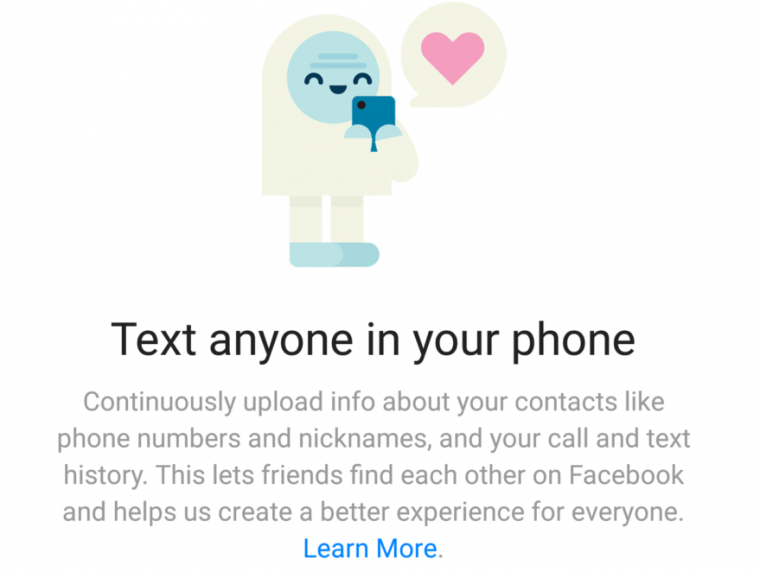 [/color]
[color=rgba(0, 0, 0, 0.65098)]Enlarge / This screen in the Messenger application offers to conveniently track all your calls and messages. But Facebook was already doing this surreptitiously on some Android devices until October 2017, exploiting the way an older Android API handled permissions.[/color]
[color=rgba(0, 0, 0, 0.65098)]Facebook[/color]
[Update, March 25, 2018, 20:24 Eastern Time]: Facebook has responded to this and other reports regarding the collection of call and SMS data with a blog post that denies Facebook collected call data surreptitiously, says that Facebook never sells the data, and that users are in control of the data uploaded to Facebook. The "fact check" contradicts several details Ars found in analysis of Facebook data downloads and testimony from users who provided the data. More on the Facebook response is appended to the end of the original article below.
This past week, a New Zealand man was looking through the data Facebook had collected from him in an archive he had pulled down from the social networking site. While scanning the information Facebook had stored about his contacts, Dylan McKay discovered something distressing: Facebook also had about two years' worth of phone call metadata from his Android phone, including names, phone numbers, and the length of each call made or received.
This experience has been shared by a number of other Facebook users who spoke with Ars, as well as independently by us—my own Facebook data archive, I found, contained call-log data for a certain Android device I used in 2015 and 2016, along with SMS and MMS message metadata.
In response to an email inquiry by Ars about this data gathering, a Facebook spokesperson replied, "The most important part of apps and services that help you make connections is to make it easy to find the people you want to connect with. So, the first time you sign in on your phone to a messaging or social app, it's a widely used practice to begin by uploading your phone contacts."
The spokesperson pointed out that contact uploading is optional and installation of the application explicitly requests permission to access contacts. And users can delete contact data from their profiles using a tool accessible via Web browser.
Facebook uses phone-contact data as part of its friend recommendation algorithm.
And in recent versions of the Messenger application for Android and Facebook Lite devices, a more explicit request is made to users for access to call logs and SMS logs on Android and Facebook Lite devices. But even if users didn’t give that permission to Messenger, they may have given it inadvertently for years through Facebook's mobile apps—because of the way Android has handled permissions for accessing call logs in the past.
If you granted permission to read contacts during Facebook's installation on Androida few versions ago—specifically before Android 4.1 (Jelly Bean)—that permission also granted Facebook access to call and message logs by default. The permission structure was changed in the Android API in version 16. But Android applications could bypass this change if they were written to earlier versions of the API, so Facebook API could continue to gain access to call and SMS data by specifying an earlier Android SDK version. Google deprecated version 4.0 of the Android API in October 2017—the point at which the latest call metadata in Facebook users' data was found. Apple iOS has never allowed silent access to call data.
Facebook provides a way for users to purge collected contact data from their accounts, but it's not clear if this deletes just contacts or if it also purges call and SMS metadata. After purging my contact data, my contacts and calls were still in the archive I downloaded the next day—likely because the archive was not regenerated for my new request. (Update: The cached archive was generated once and not updated on the second request. However, two days after a request to delete all contact data, the contacts were still listed by the contact management tool.)
As always, if you're really concerned about privacy, you should not share address book and call-log data with any mobile application. And you may want to examine the rest of what can be found in the downloadable Facebook archive, as it includes all the advertisers that Facebook has shared your contact information with, among other things.
Update, March 25, 2018, continued:
Facebook responded to reports that it collected phone and SMS data without users' knowledge in a "fact check" blog post on Sunday. In the response, a Facebook spokesperson stated:
Quote:[color=rgba(0, 0, 0, 0.65098)]Call and text history logging is part of an opt-in feature for people using Messenger or Facebook Lite on Android. This helps you find and stay connected with the people you care about, and provide you with a better experience across Facebook. People have to expressly agree to use this feature. If, at any time, they no longer wish to use this feature they can turn it off in settings, or here for Facebook Lite users, and all previously shared call and text history shared via that app is deleted. While we receive certain permissions from Android, uploading this information has always been opt-in only.[/color]
This contradicts the experience of several users who shared their data with Ars. Dylan McKay told Ars that he installed Messenger in 2015, but only allowed the app the permissions in the Android manifest that were required for installation. He says he removed and reinistalled the app several times over the course of the next few years, but never explicitly gave the app permission to read his SMS records and call history. McKay’s call and SMS data runs through July of 2017.
In my case, a review of my Google Play data confirms that Messenger was never installed on the Android devices I used. Facebook was installed on a Nexus tablet I used and on the Blackphone 2 in 2015, and there was never an explicit message requesting access to phone call and SMS data. Yet there is call data from the end of 2015 until late 2016, when I reinstalled the operating system on the Blackphone 2 and wiped all applications.
While data collection was technically "opt-in", in both these cases the opt-in was the default installation mode for Facebook's application, not a separate notification of data collection. Facebook never explicitly revealed that the data was being collected, and it was only discovered as part of a review of the data associated with the accounts, which the users we talked to performed after the revelations about Cambridge Analytica’s use of Facebook data.
Facebook began explicitly asking permission from users of Messenger and Facebook Lite to access SMS and call data to "help friends find each other" after being publicly shamed in 2016 over the way it handled the "opt-in" for SMS services. That message mentioned nothing about retaining SMS and call data, but instead offered an "OK" button to approve "keeping all of your SMS messages in one place."
Facebook says that they keep the data secure and do not sell it to third parties. But they don't address why it would be necessary to retain not just the numbers of contacts from phone calls and SMS messages, but the date, time and length of those calls for years.
|
|
|
|
|


