 |
By LAURIE GOODSTEINFEB. 21, 2018
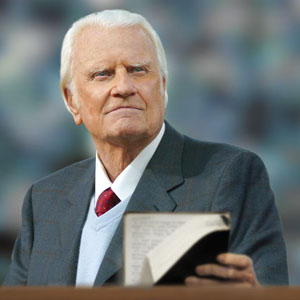
The Rev. Billy Graham, a North Carolina farmer’s son who preached to millions in stadium events he called crusades, becoming a pastor to presidents and the nation’s best-known Christian evangelist for more than 60 years, died on Wednesday at his home in Montreat, N.C. He was 99.
His death was confirmed by Jeremy Blume, a spokesman for the Billy Graham Evangelistic Association.
Mr. Graham had dealt with a number of illnesses in his last years, including prostate cancer, hydrocephalus (a buildup of fluid in the brain) and symptoms of Parkinson’s disease.
Mr. Graham spread his influence across the country and around the world through a combination of religious conviction, commanding stage presence and shrewd use of radio, television and advanced communication technologies.
A central achievement was his encouraging evangelical Protestants to regain the social influence they had once wielded, reversing a retreat from public life that had begun when their efforts to challenge evolution theory were defeated in the Scopes trial in 1925.
But in his later years, Mr. Graham kept his distance from the evangelical political movement he had helped engender, refusing to endorse candidates and avoiding the volatile issues dear to religious conservatives.
Continue reading the main story
RELATED COVERAGE
Opinion Op-Ed Contributor
Billy Graham, the Last Nonpartisan Evangelical? FEB. 21, 2018
Opinion Op-Ed Contributor
Billy Graham’s Missed Opportunities FEB. 21, 2018
Billy Graham Crusade Begins (June 25, 1970)
‘America’s Pastor’: At 74, Billy Graham Begins to Sum Up, Regrets and All (Feb. 3, 1993)
New York Hears Words of Hope From Billy Graham (Sept. 23, 1991)
“If I get on these other subjects, it divides the audience on an issue that is not the issue I’m promoting,” he said in an interview at his home in North Carolina in 2005 while preparing for his last American crusade, in New York City. “I’m just promoting the Gospel.”
A Mass Media Megaphone
Mr. Graham took the role of evangelist to a new level, lifting it from the sawdust floors of canvas tents in small-town America to the podiums of packed stadiums in the world’s major cities. He wrote some 30 books and was among the first to use new communication technologies for religious purposes. During his “global crusade” from Puerto Rico in 1995, his sermons were translated simultaneously into 48 languages and transmitted to 185 countries by satellite.
Mr. Graham’s standing as a religious leader was unusual: Unlike the pope or the Dalai Lama, he spoke for neither a particular church (though he was a Southern Baptist) nor a particular people.
At times, he seemed to fill the role of national clergyman. He read from Scripture at President Richard M. Nixon’s funeral in California in 1994, offered prayers at a service in the National Cathedral for victims of the Sept. 11, 2001, terrorist attacks, and, despite his failing health, traveled to New Orleans in 2006 to preach to survivors of Hurricane Katrina.
His reach was global, and he was welcomed even by repressive leaders like Kim Il-sung of North Korea, who invited him to preach in Pyongyang’s officially sanctioned churches.
In his younger days, Mr. Graham became a role model for aspiring evangelists, prompting countless young men to copy his cadences, his gestures and even the way he combed his wavy blond hair.
He was not without critics. Early in his career, some mainline Protestant leaders and theologians accused him of preaching a simplistic message of personal salvation that ignored the complexities of societal problems like racism and poverty. Later, critics said he had shown political naïveté in maintaining a close public association with Nixon long after Nixon had been implicated in the cover-up of the Watergate break-in.
Mr. Graham’s image was tainted in 2002 with the release of audiotapes that Nixon had secretly recorded in the White House three decades earlier. The two men were heard agreeing that liberal Jews controlled the media and were responsible for pornography.
“A lot of the Jews are great friends of mine,” Mr. Graham said at one point on the tapes. “They swarm around me and are friendly to me because they know that I’m friendly with Israel. But they don’t know how I really feel about what they are doing to this country.”
Mr. Graham issued a written apology and met with Jewish leaders. In the interview in 2005, he said of the conversation with Nixon: “I didn’t remember it, I still don’t remember it, but it was there. I guess I was sort of caught up in the conversation somehow.”

Mr. Graham addressed an estimated 13,000 people at Madison Square Garden in May 1957. Credit Hans Von Nolde/Associated Press
In the last few decades, a new generation of evangelists, including Mr. Graham’s elder son, Franklin Graham, began developing their own followings. In November 1995, on his 77th birthday, Mr. Graham named Franklin to succeed him as head of the Billy Graham Evangelistic Association. His daughter Anne Graham Lotz and his grandsons Will Graham and William Graham Tullian Tchividjian are also in ministry.
Franklin Graham has drawn criticism since the Sept. 11 attacks for denigrating Islam. His father, however, retained the respect of vast numbers of Americans, enough to earn him dozens of appearances on Gallup’s annual list of the world’s 10 most admired men and women.

Billy Graham delivered a sermon to more than 100,000 people at the Olympic Stadium in Berlin in 1954. Credit Associated Press
Repent and Be Born Again
With a warm, courtly manner that was readily apparent both to stadium crowds and to those who met him face to face, Mr. Graham could be a riveting presence. At 6-foot-2, with a handsomely rugged profile fit for Hollywood westerns, he would hold his Bible aloft and declare that Scripture offered “the answer to every human longing.”
Mr. Graham drew his essential message from the mainstream of evangelical Protestant belief. Repent of your sins, he told his listeners, accept Jesus as your Savior and be born again. In a typical exhortation, he declared: “Are you frustrated, bewildered, dejected, breaking under the strains of life? Then listen for a moment to me: Say yes to the Savior tonight, and in a moment you will know such comfort as you have never known. It comes to you quickly, as swiftly as I snap my fingers, just like that.”
Mr. Graham always closed by asking his listeners to “come forward” and commit to a life of Christian faith. When they did so, his well-oiled organization would match new believers with nearby churches. Many thousands of people say they were first brought to church by a Billy Graham crusade.
At the dedication of the Billy Graham Library in Charlotte, N.C., in June 2007, former President Bill Clinton said of Mr. Graham, “When he prays with you in the Oval Office or upstairs in the White House, you feel like he is praying for you, not the president.”
Mr. Graham was by no means unique in American history as a popular evangelist. George Whitefield in the mid-18th century, Charles G. Finney and Dwight L. Moody in the 19th century, and Billy Sunday at the turn of the 20th were all capable of drawing vast crowds.
But none of them combined the ambition, the talent for organization and the reach of Mr. Graham, who had the advantages of jet travel and electronic media to convey his message. In 2007, the Billy Graham Evangelistic Association estimated that he had preached the Gospel to more than 215 million people in more than 185 countries and territories since beginning his crusades in October 1947 in Grand Rapids, Mich. He reached hundreds of millions more on television, through video and in film.
“This is not mass evangelism,” Mr. Graham liked to say, “but personal evangelism on a mass scale.”
Ball-Playing Dreams
William Franklin Graham Jr. — Billy Frank to his family and friends as a boy — was born near Charlotte on Nov. 7, 1918, the first of four children of William Franklin Graham and Morrow Coffey Graham. He was descended on both sides from pre-Revolution Scottish settlers, and both his grandfathers were Confederate soldiers.
Though the Grahams were Reformed Presbyterians, and though his father insisted on daily readings of the Bible, Billy Frank was an unenthusiastic Christian. He was more interested in reading history, playing baseball and dreaming of becoming a professional ballplayer. His worldliness, his father thought, was mischievous and devilish.
It was the Rev. Mordecai Ham, an itinerant preacher from Kentucky, who was credited with “saving” Billy Graham, in the autumn of 1934, when Billy was 16. After attending Mr. Ham’s revival sessions on a Charlotte street corner several nights in a row, Billy walked up to Mr. Ham to make a “decision for Christ.”
“I can’t say that I felt anything spectacular,” Mr. Graham recalled years later. “I felt very little emotion. I shed no tears. In fact, when I saw others had tears in their eyes, I felt like a hypocrite, and this disturbed me a little. I’m sure I had a tremendous sense of conviction: The Lord did speak to me about certain things in my life, I’m certain of that. But I can’t remember what they were.”
Returning home with a friend that night, Mr. Graham said, he thought: “Now I’ve gotten saved. Now whatever I do can’t unsave me. Even if I killed somebody, I can’t ever be unsaved now.”
After he graduated from high school in 1936, Mr. Graham spent the summer selling Fuller brushes door to door before spending an unhappy semester at Bob Jones College, then an unaccredited, fundamentalist school in Cleveland, Tenn. (It is now Bob Jones University, in Greenville, S.C.) He then went to another unaccredited but less restrictive institution, the Florida Bible Institute (now Trinity College), near Tampa.

Mr. Graham preaching in 1947. Credit Billy Graham Center
It was there, he wrote in his 1997 autobiography, “Just as I Am,” that he felt God calling him to the ministry. The call came, he said, during a late-night walk on a golf course. “I got down on my knees at the edge of one of the greens,” he wrote. “Then I prostrated myself on the dewy turf. ‘O God,’ I sobbed, ‘if you want me to serve you, I will.’ ”
“All the surroundings stayed the same,” he continued. “No sign in the heavens. No voice from above. But in my spirit I knew I had been called to the ministry. And I knew my answer was yes.”

Mr. Graham was about to depart on a Latin American tour in January 1958 when this photograph was taken. From left are his wife, Ruth, and his children Nelson (who was four days old), Franklin, 5, Ruth, 7, Virginia, 12, and Anne, 9. Credit Associated Press
A Wife, Then a Pulpit
After graduating from the Bible Institute, Mr. Graham went to Wheaton College in Illinois, among the nation’s most respected evangelical colleges. At Wheaton, from which he received a degree in anthropology in 1943, he met Ruth McCue Bell, a fellow student whose father was Dr. L. Nelson Bell, a prominent Presbyterian missionary surgeon who had spent many years in China.
Soon after marrying Ms. Bell in 1943, Mr. Graham accepted the pulpit of the First Baptist Church in Western Springs, Ill., a Chicago suburb. (It later changed its name to the Village Church.) He imbued his sermons with the brand of interdenominational appeal that was to be his hallmark.
It was also in 1943 that he was invited to take over “Songs in the Night,” a Sunday hour of sermonizing and gospel singing broadcast by a Chicago radio station. The program introduced him to electronic evangelism. Its principal singer, the baritone George Beverly Shea, who died in 2013, would earn fame as a member of the “Billy Graham team.”
In the mid-1940s, Mr. Graham became the chief preacher for the Youth for Christ rallies organized by the Rev. Torrey M. Johnson, a radio evangelist, and George W. Wilson, the owner of a religious bookstore in Minneapolis and a lay leader of the First Baptist Church there. With them, he established the Graham Youth for Christ, which found moderate success holding “crusades” across North America and in Britain.
Mr. Graham’s fortunes took a career-building turn in 1949, thanks in no small measure to the power of the Hearst press. He was holding a three-week “mammoth tent crusade” in downtown Los Angeles inside a 6,000-seat “canvas cathedral” pitched on a vacant lot. The newspaper ads proclaimed him “America’s sensational young evangelist.” But what really caught the attention of the aged newspaper baron William Randolph Hearst was that Mr. Graham was preaching a fiery brand of anti-Communism.
From his retreat in San Simeon, Calif., Mr. Hearst is said to have issued a terse directive: “Puff Graham.”
“The Hearst newspapers gave me enormous publicity, and the others soon followed,” Mr. Graham said years later. “Suddenly, what a clergyman was saying was in the headlines everywhere, and so was the box score of commitments to Christ each night.” Time, Newsweek and Life magazines followed suit.

Mr. Graham as seen on television as he addressed a capacity crowd at Madison Square Garden in New York in 1957. He saw the power of television in its infancy and used it to spread his message globally. Credit Associated Press
Flocking to His ‘Crusades’
Mr. Graham began taking his “Crusade for Christ” on the road. In 1957, he drew more than two million people to a series of rallies, extended to 16 weeks, at Madison Square Garden in New York. The crusades became international: One, in West Germany, was televised live in 10 other European countries. In 1966, he preached to nearly one million people in London.
As Mr. Graham’s popularity grew, so did his stature with Christian critics who had dismissed his interpretation of Scripture as overly literal. He told his audiences, for example, that heaven was a physical place, though not necessarily in this solar system.
Early on, he abandoned the practice, common among Southern fundamentalists, of speaking only before racially segregated audiences. He refused to “preach Jim Crow,” as he put it, and in the turbulent 1960s he made several “visits of racial conciliation” to the South.
Mr. Graham pledged to local church sponsors that all donations would be used for crusade expenses, with any excess going to his Billy Graham Evangelistic Association. His own compensation, he said, would be limited to his expenses plus “the salary of a fairly well-paid local minister,” or about $50,000 in 1980 (the equivalent of almost $160,000 today). The association’s books were always open to inspection.
By maintaining fiscal integrity and personal probity — he stuck to his rule never to be alone with a woman other than his wife — Mr. Graham kept himself untarnished by the kind of sex and money scandals that brought down evangelists and religious broadcasters like Jim Bakker and Jimmy Swaggart in the 1980s.
The Grahams lived on a 200-acre mountain retreat in Montreat, N.C. His wife, Ruth Bell Graham, died in 2007. He is survived by his sons, the Rev. William Franklin III and the Rev. Nelson Graham, known as Ned; three daughters, Virginia Tchividjian (known as Gigi), Anne Graham Lotz and Ruth Graham McIntyre; and numerous grandchildren and great-grandchildren.

Mr. Graham attended a prayer breakfast in Washington in February 1966 with President Lyndon B. Johnson. Credit John Rous/Associated Press
A Kinship With Presidents
Recognizing his influence, presidents made a point of seeking friendly relations with Mr. Graham; Lyndon B. Johnson did so assiduously. Mr. Graham was a frequent guest of Ronald Reagan, and in January 1991, George H. W. Bush invited him to spend the night at the White House the day before American-led forces began bombing Iraq. Mr. Clinton asked Mr. Graham to offer prayers at his inauguration in 1993.
President George W. Bush said that it was after a walk with Mr. Graham at the Bush family’s compound in Kennebunkport, Me., that Mr. Bush, as a younger man, decided to become more serious about his faith and quit drinking. President Barack Obama visited Mr. Graham at his North Carolina home in 2010.
Former President Jimmy Carter released a statement on Wednesday saying that he had counted Mr. Graham among his advisers and friends, adding that the minister had “had an enormous influence on my own spiritual life.” And President Trump tweeted: “The GREAT Billy Graham is dead. There was nobody like him! He will be missed by Christians and all religions. A very special man.”
Of the presidents, Mr. Graham was most closely associated with Nixon. The two had met in the early 1950s, when Nixon was a senator from California. As vice president, Nixon addressed a capacity crowd at Yankee Stadium for the closing meeting of Mr. Graham’s New York crusade in 1957.
In the 1960 presidential campaign, Mr. Graham, a registered Democrat, was strongly sympathetic to Nixon, a Republican, and offered him advice in his campaign against Senator John F. Kennedy, a Roman Catholic. At one point, concerned that a Kennedy administration would be influenced by the Vatican, Mr. Graham invited more than two dozen Protestant leaders to a meeting to discuss ways to defeat him.

Mr. Graham with President Richard M. Nixon in Knoxville, Tenn., in May 1970. Credit Bettman, via Getty Images
He went on to endorse Nixon in the 1968 presidential race and allowed that endorsement to be used in television commercials. He gave the invocation at Nixon’s 1969 inauguration and came to be described as Nixon’s unofficial White House chaplain.
Mr. Graham said he had been “innocently unaware” of the storm gathering over Watergate. But when the extent of the scandal became known — disclosures of the break-in and the subsequent cover-up orchestrated by the White House — Mr. Graham tended to look the other way, his critics said.
In 1982, Mr. Graham displeased the Reagan administration when, after a visit to the Soviet Union, he spoke in favor of universal nuclear disarmament. He also visited Russian churches, and his comment that he had seen no evidence of religious repression by the Soviet authorities created a furor among conservative church members in the United States.
It was during this period, in his sixth decade as an evangelist, that Mr. Graham and his organization experimented with new technologies. In 1986, in Paris, he used direct satellite transmissions to carry his sermons to about 30 other French cities. With his crusade in San Juan, P.R., in 1995, he expanded his satellite reach more than sixfold.

Mr. Graham continued to preach well into his later years. In November 2004, he appeared with his son Franklin before a large crowd at the Rose Bowl in Pasadena, Calif. Mr. Graham named Franklin to succeed him as head of his evangelical organization. Credit Monica Almeida/The New York Times
Mr. Graham also broke ground by going to places where religious activity was officially restricted, including China and North Korea. The first of his 30 books was “Peace With God,” published in 1953; his last was “Nearing Home,” in 2011.
Mr. Graham, like most conservative preachers of his age and era, regarded same-sex relationships as “sinful.” But unlike the culture warriors who succeeded him, Mr. Graham rarely spoke about homosexuality, and condemning it was not a staple of his preaching.
Pressed to weigh in on same-sex marriage, he said he preferred to stick to the Gospel. But once, preaching in Ohio in 1993, he said he thought that AIDS could be “a judgment of God,” and added, “I could not be sure, but I think so.”
Two weeks later he walked it back, saying: “I do believe God stands in judgment of all sins ... but AIDS is a disease that affects people and is not part of that judgment. To say God has judged people with AIDS would be very wrong and very cruel. I would like to say that I am very sorry for what I said.”
The Billy Graham Evangelistic Association continues to organize crusades. It also produced Mr. Graham’s “Hour of Decision” global radio program and prime-time television specials, trains thousands of evangelists and missionaries, and publishes Decision magazine. A rapid-response team deploys chaplains to disaster areas.
Why it all came about remained a puzzle to Mr. Graham. In his autobiography, he wrote: “I have often said that the first thing I am going to do when I get to Heaven is ask: ‘Why me, Lord? Why did You choose a farm boy from North Carolina to preach to so many people, to have such a wonderful team of associates, and to have a part in what You were doing in the latter half of the 20th century?’ ”
“I have thought about that question a great deal,” he added, “but I know also that only God knows the answer.”

Mr. Graham addressed a crowd at a football stadium in April 1954. Credit Edward Miller/Getty Images
The Story is HERE
|


