| Welcome, Guest |
You have to register before you can post on our site.
|
| Latest Threads |
Odds and Ends ... With So...
Forum: The Lounge
Last Post: IceWizard
11-13-2026, 01:20 AM
» Replies: 11
» Views: 3,084
|
Here are a couple I found
Forum: IOPList Suggested IOP's
Last Post: gujjernoran
11-12-2026, 08:26 PM
» Replies: 1
» Views: 798
|
www.MacroMass.COM.PH
Forum: IOPList (Approved & Recommended)
Last Post: Macro Mass
11-11-2026, 04:56 PM
» Replies: 3,854
» Views: 7,144,235
|
The Juke Box is OPEN
Forum: The Lounge
Last Post: Mr. HIND
11-09-2026, 08:03 AM
» Replies: 2,939
» Views: 1,665,788
|
MOVIES
Forum: The Lounge
Last Post: IceWizard
11-09-2026, 05:10 AM
» Replies: 147
» Views: 49,584
|
www.MacroMass.COM.PH
Forum: IOP Discounts, Offers & More
Last Post: Macro Mass
11-08-2026, 09:07 PM
» Replies: 143
» Views: 81,182
|
Humorous Smilies
Forum: The Lounge
Last Post: IceWizard
11-02-2026, 01:22 AM
» Replies: 4,936
» Views: 4,272,062
|
Deaths So Far (and it's j...
Forum: World News
Last Post: IceWizard
10-31-2026, 07:15 PM
» Replies: 51
» Views: 14,564
|
'Biscuit' the dog is late...
Forum: World News
Last Post: IceWizard
10-31-2026, 06:16 PM
» Replies: 0
» Views: 164
|
GAME - Change one word ga...
Forum: The Lounge
Last Post: IceWizard
10-15-2026, 05:21 AM
» Replies: 2,142
» Views: 1,021,103
|
|
|
| Malaysia finds mass graves of 24 suspected human trafficking victims |
|
Posted by: IceWizard - 08-23-2015, 08:01 AM - Forum: World News
- No Replies
|
 |
Sun Aug 23, 2015 | 12:20 AM EDT
KUALA LUMPUR (Reuters) -
Malaysian authorities have found mass graves containing the remains of more than 20 people believed to be human trafficking victims near the border with Thailand, police said on Sunday.
The heavily forested Thai-Malay border has
been a transit point for smugglers bringing
people to Southeast Asia by boat from
Myanmar and Bangladesh.
The migrants are often held for ransom in
squalid detention camps and according to some accounts face torture and starvation.
Police uncovered 24 bodies on Saturday in the
Bukit Wang Burma area near the Malaysian
border with Thailand, close to where authorities in May had found hundreds of bodies in illegal detention camps.
"Following on from the operation in which we
found ... bodies of illegal immigrants, 24 more
bodies have been found and dug up," police
said in a statement, adding that the remains
had been handed over to medical experts.
It was not immediately clear if the bodies
discovered were those of Rohingya, a minority
ethnic group in Myanmar, whose members have fled widespread persecution in that country.
A crackdown by Thai authorities in May drove
traffickers to abandon thousands of migrants on rickety, overcrowded boats in Southeast Asian waters, triggering a regional humanitarian crisis that saw them land in Malaysia and Indonesia after being rescued by fishermen.
(Reporting by Trinna Leong; Writing by
Kanupriya Kapoor; Editing by Clarence
Fernandez)
|

|
|
| India-Pakistan peace talks collapse hours before start |
|
Posted by: IceWizard - 08-22-2015, 09:54 PM - Forum: World News
- No Replies
|
|
Sat Aug 22, 2015 | 2:45 PM EDT
By C.K.Nayak, and, Asad and Hashim
NEW DELHI/ISLAMABAD Aug 22 (Reuters) -
Peace talks between India and Pakistan
collapsed on Saturday hours before they were
scheduled to start, as the nuclear-armed rivals
were unable to overcome deep-rooted mutual
mistrust.
Indian Prime Minister Narendra Modi and
Pakistan's Nawaz Sharif agreed to the talks
when they met in Russia last month. But the countries failed at the last minute to agree the agenda for the meeting of their national security advisers (NSAs), due to start on Sunday, with Pakistan accusing India of imposing "preconditions".
Pakistan pulled out after India's foreign minister, Sushma Swaraj, said the talks would not take place if Pakistan's NSA Sartaj Aziz did not drop plans to meet separatists from the disputed region of Kashmir.
Swaraj also said India would only discuss
terrorism-related issues, whereas Pakistan
wanted a wider agenda that would, among
other things, discuss the Kashmir question.
Pakistan said "talks cannot be held on the basis of the preconditions set by India." "We have come to the conclusion that the
proposed NSA level talks between the two
countries would not serve any purpose,"
Pakistan's foreign ministry said in a statement.
"It is not reasonable for India to now assume
the right to decide unilaterally that from now
onwards, other issues will be discussed after
terrorism has been discussed and eliminated."
Earlier on Saturday, Aziz said that by setting
conditions India had "virtually" canceled the
talks.
India called Pakistan's decision "unfortunate".
India and Pakistan have fought three wars
since becoming separate nations in 1947, two of them over the Himalayan region of Kashmir, which both claim in full but rule in part.
New Delhi has for years accused Pakistan of
backing separatist Muslim rebels in India's part
of Kashmir.
Pakistan denies the allegations. In August last year, India called off planned meetings between the countries' foreign secretaries.
The prospects of the long-awaited talks had
been clouded in recent weeks by a series of
militant attacks and border skirmishes.
Swaraj said there has been 91 ceasefire violations since the meeting between the premiers.
But the divergence of talking points was one of
the main stumbling blocks: Indian official
sources had said they wanted to provide proof
that militants were getting support from over its
western border, while Pakistan wanted the talks to be broader and include issues on Kashmir.
Aziz said he was planning to present India's
NSA Ajit Doval three dossiers on what he called the Indian intelligence wing's involvement in promoting terrorism in Pakistan.
Pakistan earlier said it was never expecting the talks to lead to any breakthrough and the
purpose was only to reduce tensions between
the neighbors.
(Additional reporting by Rupam Jain Nair;
Writing by Aditya Kalra and Krishna N. Das;
Editing by Robin Pomeroy)
|
|
|
|
 Study: Happiness spreads, depression doesn't |
|
Posted by: IceWizard - 08-22-2015, 08:25 PM - Forum: The Lounge
- No Replies
|
|
Updated 6:15 AM ET, Thu August 20, 2015

Study: A good network of friends can help alleviate depression in teens The research modeled the spread of moods among U.S. high school students over six to 12 months
(CNN)—For teenagers, surrounding themselves with friends -- particularly friends in a good mood -- could significantly reduce their risk of developing depression, and improve their ability to recover from it.
In a study published this week, scientists analyzed the data of more than 2,000 high school students in the United States to investigate whether the moods of students influenced one another and if this could in turn impact levels of depression among teens.
The teams modeled the spread of moods among the students over six to 12 months, using techniques similar to modeling the spread of an infectious disease.
"We classified people as ill (depressed) or
not and looked at how that changed over
time," says Thomas Moore, a lecturer in
applied mathematics at the University of
Manchester, who worked on the study.
Moore says previous studies have found
depressed people tend to group into clusters, implying that this frame of mind could be spread. But the team found the opposite.
"Depression itself doesn't spread, but a healthy mood actually does," he says.
The study found that teens with a strong
group of friends not suffering from depression -- described as a "healthy" mood -- had half the probability of developing depression and double the probability of recovering if they were depressed.
"The effect was big, much bigger than you see form antidepressants," says Moore. Importantly, depressed friends didn't counter the effect. "They don't seem to drag their friends down," says Moore.
The data was taken from the ongoing National Longitudinal Study of Adolescent to Adult Health currently taking place in the United States and the team see the findings as a useful weapon in the fight against depression --particularly among teens.
According to data from the National Survey on Drug Use and Health in the United States, an estimated 2.6 million 12 to 17-year-olds had at least one major depressive episode during 2013.
This represented 10.7% of the U.S. population
aged 12 to 17.
"Depression is a major public health concern worldwide," says professor Frances Griffiths, head of social science and systems in health at Warwick Medical School, who also worked on the research.
"Our results offer implications for improving adolescent mood ... that encouraging friendship networks between adolescents could reduce both the incidence and prevalence of depression among teenagers."
Whilst the study found a difference over six to 12 months, Moore believes the change could happen sooner.
"We only got these two snapshots [of time]," he says.
Moore sees social activities such as youth groups as low-cost, low-risk options to help alleviate the burden of depression today.
"If you combine this with other things known to work, they might work even better," he says.
Current treatment for depression is complex using combinations of therapy and drugs such as antidepressants as well as encouraging a healthy lifestyle.
"When we think of staying healthy, we often think of taking exercise and eating a healthy diet. However, we should also make time for our friendships as part of a healthy lifestyle," says Jim Bolton, a Fellow of the Royal College of Psychiatrists, in the United Kingdom.
"This study is additional evidence of the
importance of friends and family in maintaining good mental health ... [and] importantly, this study indicates that when we do speak to family and friends our depression is not 'infectious,'" he says.
But he findings may not automatically apply to all teenage populations warns Shirley Reynolds, professor of evidence- based psychological therapies at the University of Reading.
"These data are certainly intriguing and if replicated and substantiated have important implications for public health and social [or]
educational interventions," she says. "However, there is no information given about the young people who took part ... this makes it impossible to know if they are representative of other teenagers in the USA, let alone teenagers in the UK or Europe."
Justin T. Baker, instructor of psychiatry at
Harvard Medical School and a psychiatrist at McLean Hospital, in Belmont, Massachusetts, says it's a clever study, but cautions that it has
several limitations.
One is that it infers a "transmission model" from just two time points -- 6 and 12 months. "Also, the authors chose to label participants as either depressed or not, even though mood and depression vary continuously along a continuum," he says. "This all-or-none label makes some sense for infection, but doesn't capture the experience of depression."
|
|
|
|
| Iran unveils new missile, says seeks peace through strength |
|
Posted by: IceWizard - 08-22-2015, 12:10 PM - Forum: World News
- No Replies
|
|
Sat Aug 22, 2015 | 4:33 AM EDT
DUBAI (Reuters) - Iran on Saturday unveiled a new surface-to-surface missile it said could
strike targets with pin-point accuracy within a
range of 500 km (310 miles) and it said military
might was a precondition for peace and
effective diplomacy. The defense ministry's unveiling of the solid-fuel
missile, named Fateh 313, came little more than
a month after Iran and world powers reached a
deal that requires Tehran to abide by new limits
on its nuclear program in return for Western
governments easing economic sanctions. According to that deal, any transfer to Iran of
ballistic missile technology during the next eight
years will be subject to the approval of the
United Nations Security Council, and the United
States has promised to veto any such requests.
An arms embargo on conventional weapons also stays, preventing their import and export
for five years. But Iran has said it will not follow parts of the
nuclear deal that restricts its military
capabilities, a stance reaffirmed by President
Hassan Rouhani on Saturday. "We will buy, sell and develop any weapons we
need and we will not ask for permission or
abide by any resolution for that," he said in a
speech at the unveiling ceremony broadcast
live on state television. "We can negotiate with other countries only
when we are powerful. If a country does not
have power and independence, it cannot seek
real peace," he said. The defense ministry said the Fateh 313,
unveiled on Iran's Defence Industry Day, had
already been successfully tested and that mass
production would start soon. THREATS Iran has one of the largest missile programs in
the Middle East. It wants to export arms to its
allies in the region and import anti-missile
systems to prevent any possible attack by its
arch-foe Israel. "In our aerospace industry we have various
ballistic missiles with different ranges under
production," Defence Minister Hossein
Dehghan said on Friday. "We will continue this path with maximum power
in line with our defensive needs and
proportionate to threats ahead of us." Fars news agency, which is close to the
country's Revolutionary Guards, released a
music video on Saturday praising Iran’s missile
capabilities. It contained pictures of what the
agency called a new and unknown missile of
the Islamic Revolutionary Guards Corps (IRGC). A senior IRGC commander said on Friday Iran
would hold a large ballistic missile maneuver in
the near future. "Some wrongly think Iran has suspended its
ballistic missile programs in the last two years
and has made a deal on its missile program ...
We will have a new ballistic missile test in the
near future that will be a thorn in the eyes of our
enemies," the commander of the aerospace division of the IRGC, Brigadier General Amirali
Hajizadeh, said on Friday.
(Reporting by Bozorgmehr Sharafedin; Editing
by Gareth Jones)
|
|
|
|
| North Korea goes on war footing against South Korea as deadline looms |
|
Posted by: IceWizard - 08-22-2015, 12:13 AM - Forum: World News
- No Replies
|
|
Fri Aug 21, 2015 | 5:51 PM EDT
By Ju-min Park and James Pearson
SEOUL (Reuters) -
North Korea put its troops on a war footing on Friday as South Korea rejected an ultimatum to stop propaganda broadcasts or face military action, prompting China to voice concern and urge both sides to step back after an exchange of artillery fire.
North Korea's Foreign Ministry said the
country's military and the public stood ready to
safeguard its regime even if it meant fighting an all-out war, and rejected the idea of restraint in an apparent rebuff to China's call.
North Korea's official media said its military was not bluffing, and the deputy North Korean
ambassador to the United Nations, An Myong
Hun, reiterated Pyongyang's threat of "strong
military counter-action" if the South Korean
broadcasts did not stop.
An also told reporters North Korea had asked
the 15-member United Nations Security Council
to hold an urgent meeting on the situation.
United Nations Secretary-General Ban Ki-moon appealed for the Koreas not to take any action that could further aggravate tensions, but diplomats said there had been no discussion among Security Council members about holding a meeting.
South Korea rejected an ultimatum that it halt
anti-Pyongyang broadcasts by Saturday
afternoon or face attack.
It began blasting anti-North propaganda over
the Demilitarized Zone (DMZ) separating the
countries on Aug. 10, resuming a tactic both
sides had stopped in 2004, a few days after
landmines wounded two South Korean soldiers
along the DMZ. North Korea resumed its own broadcasts on Monday and on Thursday, according to Seoul, launched four artillery shells into South Korea in apparent protest at loudspeaker broadcasts.
The South fired back 29 artillery rounds.
Pyongyang accused the South of inventing a pretext to fire into the North. The United States, which has 28,500 military personnel based in South Korea, said it had resumed its annual joint military exercises there after a temporary halt to coordinate with Seoul over the shelling from North Korea.
The annual exercise, code-named Ulchi
Freedom Guardian, began on Monday and runs until next Friday.
North Korea regularly condemns the maneuvers as a preparation for war and in the past has fired rockets into the sea while they proceeded.
South Korean Vice Defense Minister Baek
Seung-joo said his government expected North Korea to fire at some of the 11 sites where Seoul has set up loudspeakers on its side of the DMZ.
China, which remains reclusive North Korea's
main economic backer despite diminished
political clout to influence Pyongyang, said it
was deeply concerned about the escalation of
tension and called for calm from both sides.
In Washington, the U.S. assistant secretary of
defense for East Asia, David Shear, said the
United States was "very concerned" by the
North Korean shelling and called on the North
"to cease provocations across the DMZ and
restore calm to the peninsula."
SIDES HAVE PULLED BACK FROM BRINK IN PAST
Since the 1950-53 Korean War ended in a truce, not a peace treaty, Pyongyang and Seoul have often exchanged threats, and dozens of soldiers have been killed in clashes, yet the two sides have always pulled back from a return to all-out war.
Both sides reported no casualties or damage in their territory from the latest incidents,
indicating that the exchanges this time were
just warning shots.
However, the incidents have been some of the
most serious since the deadly 2010 sinking of a South Korean warship, which Seoul blames on Pyongyang and represent a further blow to
South Korean President Park Geun-hye's
efforts to improve North-South ties, which have been virtually frozen since then.
Park canceled an event on Friday and made a
visit to a military command post, dressed in
army camouflage. North and South Korea traded harsh rhetoric late into Friday night. South Korean Defense Minister Han Min-koo
accused North Korea of committing "cowardly
criminal acts."
"This time, I will make sure to sever the vicious
cycle of North Korea's provocations," he said. North Korea's official news agency said North
Korean leader Kim Jong Un had declared a
"quasi-state of war" in front-line areas and
South Korea's Yonhap news agency quoted an unnamed South Korean official as saying there were indications the North was preparing to fire short-range missiles.
Yang Moo-jin, professor at the University of
North Korean Studies in Seoul, said the fact
that the shells had caused no damage was
positive. "There is always a chance for war, but that chance is very, very low," he said.
Joel Wit of 38 North, a North Korea monitoring
project at Johns Hopkins University in
Washington, said the artillery exchanges were
worrying but added that tensions could well cool off again.
"When it's happened in the past, there have
been dangers of escalation and the U.S. has
had to restrain South Korea. It's a very
dangerous situation, though it could die down,
and chances are it will die down," he said.
North Korea's shelling came after it had
demanded last weekend that South Korea end
the broadcasts or face a military response - a
relatively rare case of following up on its
frequent threats against the South.
Its 48-hour ultimatum, delivered in a letter to the South Korean Defense Ministry, was also
uncharacteristically specific, said John Delury, a North Korea expert at Seoul's Yonsei
University.
The deadline is around 5 p.m. on Saturday in Seoul (4.00 a.m. EDT). Baek, the South Korean vice defense minister, said the broadcasts would continue unless North Korea accepted responsibility for the 2004 incidents and apologized for the mines.
Pyongyang has denied responsibility.
Daniel Pinkston of the International Crisis
Group think-tank said the large U.S. troop
presence for the military exercises could reduce the risk of escalation by pressuring South Korea to exercise restraint, and deterring North Korea.
"This is a bad time to pick a fight with the South while it has all these resources there," he said.
(Additional reporting by Choonsik Yoo, Hooyeon Kim and Jack Kim in Seoul, Megha
Rajagopalan in Beijing, David Brunnstrom in
Washington and Michelle Nichols at the United
Nations; Editing by Mark Heinrich and Ken
Wills)
|
|
|
|
| The Heroin Epidemic, in 9 Graphs |
|
Posted by: IceWizard - 08-21-2015, 09:01 AM - Forum: World News
- Replies (1)
|
|
Heroin use has skyrocketed in the U.S., and it's hitting young adults the hardest.

In this photo taken on Feb 11, 2013, freshly
dumped hypodermic syringes and a needle litter an abandoned cemetery in Myitkyina, the
provincial capital of Kachin state, Myanmar.
By Lindsey Cook
Aug. 19, 2015 | 1:28 p.m. EDT
The White House released a plan this week to
pour $5 million into combating heroin use and
trafficking. The plan followed months of
warnings from the Centers of Disease Control
and Prevention about the explosion in heroin
use in the U.S. Presidential candidates have also spoken out on the issue.
Hillary Clinton has called the heroin and methamphetamine addiction a "quiet epidemic" and held roundtables to discuss the issue with voters.
Rand Paul has spoken repeatedly about the racial aspect of the war on drugs and said that he would change minimum sentencing laws if elected.
Chris Christie has enacted reforms in his home state of New Jersey, saying he favored treatment instead of imprisonment, and calling drug addiction a disease that "can happen to anyone from any station in life."
In the last decade, heroin abuse has skyrocketed. The rate of heroin-related overdose deaths increased 286 percent
between 2002 and 2013. In 2002, 100 people per 100,000 were addicted to heroin but that
number had doubled by 2013.

The CDC says males, non-hispanic whites, 18- to 25-year-olds and people living in large
metropolitan areas are at the most risk for
heroin addiction, which covers most of the U.S.
Heroin addiction spans all ages, races, genders, incomes, insurance statuses and locations.
The problem of substance abuse touches many
areas of public policy, from border security to the health system and criminal justice. The rise may have been spurred partially by an increase in supply: the amount of heroin seized at the border with Mexico quadrupled by 2013 from the 2000s, making the drug cheaper in the U.S. and more pure.
During 2008-2011, there were about 1.1 million emergency department visits for drug
poisoning each year, or 35.4 visits per 10,000
people. Abuse has increased most drastically in the Midwest.

Age-adjusted rates for drug-poisoning deaths
involving heroin, by census region: United
States, 2000, 2007, and 2013
Who Abuses Heroin?
The average user of heroin has changed
drastically in the last decade. In 2000, black
Americans aged 45-64 had the highest death
rate for drug poisoning involving heroin.
Now, white people aged 18-44 have the highest rate. The share of people who say they have used heroin in the past year is actually decreasing for non-whites.
Heroin has taken hold of the white suburbs, which has prompted more attention for what is now being called a "health problem."

Rates for drug-poisoning deaths involving
heroin, by selected age and race and ethnicity
groups: United States, 2000 and 2013
The heroin epidemic is hitting young adults more than other age groups. The use among
Americans aged 18-25 increased 109 percent
from 2002-2004 and 2011-2013. For Americans
26 and older, it increased 58 percent.

Rates for drug-poisoning deaths involving
heroin, by selected age groups: United States, 2000–2013

Emergency department visit rates for drug
poisoning, by age: United States, 2004–
2007 and 2008–2011
Although people aged 18 to 25 are more at risk
for heroin use, according to the CDC, on
average, heroin is a drug for slightly older adults probably because it is perceived as being more risky (rightly so) and because most heroin users have used other drugs in the past.
Nine in 10 people who use heroin use it with at least one other drug, most with at least three other drugs.

Although heroin is perceived by teenagers as
the most dangerous drug, the share of 12 to 17-
year-olds who perceive the drug as very risky
has declined slightly since 2002, according to
the results of a 2013 survey by the U.S. Department of Health and Human Services. Teens also say it is the most difficult to obtain with the share of teens saying heroin is fairly or very easy to obtain declining from 15.8
percent in 2002 to 9.1 percent in 2013.
But prescription drug abuse is the bigger epidemic.
Heroin abuse is tightly tied to prescription drug
abuse. Almost half of people addicted to heroin
are also addicted to painkillers. People are 40 times more likely to be addicted to heroin if they are addicted to prescription painkillers.
Abuse of prescription painkillers is incredibly
common — one in 20 Americans age 12 and
older reported using painkillers for non-medical reasons in the past year.
While it's true that heroin abuse has skyrocketed in the last years, prescription drug abuse is more common. The number of overdose deaths from prescription pain medication is larger than those of heroin and cocaine combined.

Age-adjusted rates for drug-poisoning deaths, by type of drug: United States, 2000–2013
By 2011-2013, painkiller dependence among
heroin users was more common than alcohol,
marijuana or cocaine dependence.

Annual average percentage of past-year heroin users* with past-year selected substance abuse or dependence, by time interval — United States, 2002–2013
One of the main differences between the two
issues is that while the issue of heroin is
intertwined with border security, the abuse of
prescription drugs is largely the fault of our own health system.
Enough painkillers were prescribed by American doctors during one month in 2010 to medicate every American around the clock for an entire month.
A majority of those who take prescription pain
medicine for non-medical reasons get them free from a friend or relative. In nearly 85 percent of those cases, the friend or relative obtained them from one doctor. One in five users obtain prescriptions themselves from one doctor.
States have more ability to increase the
monitoring of prescription drugs, identify people showing signs of problematic use earlier, and stop inappropriate prescriptions of painkillers (which can lead to abuse and then, abuse of heroin).

While some have warned that a crackdown on
prescription drug abuse will only spur more
abuse of heroin, one analysis of death rates in
28 states found that while heroin overdose rates were associated with an increase in overdose rates for prescription medication, a decrease in the prescription drug rate was not associated with an increase in the death rate for heroin.
Still, more research is needed to combat both
issues.
|
|
|
|
 Feels like 1986: Oil on track for longest weekly losing streak in 29 years |
|
Posted by: IceWizard - 08-21-2015, 08:37 AM - Forum: World News
- No Replies
|
|
Fri Aug 21, 2015 | 3:03 AM EDT
By Jacob Gronholt-Pedersen
SINGAPORE (Reuters) -
Oil prices resumed their downward trend on Friday pulled lower by weaker global stock markets and a sharp contraction in China's manufacturing activity, with the U.S. benchmark on track for its longest weekly losing streak since 1986.
Activity in China's factory sector shrank at its
fastest pace in almost 6-1/2 years in August as
domestic and export demand dwindled, adding
to worries about lower demand for crude in the
world's second biggest oil consumer.
Asian stocks also fell on Friday, following Wall
Street down as fears took hold of a China-led
deceleration in global growth. [MKTS/GLOB] Key oil benchmarks were trading near 6-1/2
year lows, with the U.S benchmark headed for
its eighth straight weekly decline, the longest
weekly losing streak since 1986.
In late 1985, oil prices slumped to $10 from
around $30 over five months as OPEC raised
output to regain market share following an
increase in non-OPEC production.
BP (BP.L) CEO Bob Dudley said in late-July,
when oil prices were some $8 a barrel higher
than now, that "it does feel like 1986".
U.S. crude for October delivery CLc1 was 46
cents lower at $40.86 a barrel at 0656 GMT.
The September contract CLU5, which expired
on Thursday, ended 34 cents higher.
The U.S. benchmark hit a 6-1/2 year low of $40.21 a barrel on Thursday. Brent LCOc1 was on track for its seventh weekly decline in the past eight, trading 41 cents lower at $46.21 a barrel, after settling 54 cents lower on Thursday.
The dollar .DXY continued retreating on
shrinking expectations of an U.S. interest rate
hike in September, providing some support for
oil prices. U.S. crude inventories continued to rise last week, as imports rose and shale production fell slower than anticipated, despite falling prices.
[EIA/S] "The only silver lining we are seeing coming from the United States is that refining rates remain high and that crude production
continues to fall," Singapore-based Philip
Futures said in a note to clients.
Despite the rout in oil prices, some mutual funds keep plowing money into oil exploration and production companies in the United States in a bet that production will retreat sharply over the next 12 months, setting the stage for a rebound towards $65-70 per barrel.
A glut of U.S. oil is about to repeat itself north of the border, with traders scrambling to secure more storage space in western Canada as crude stockpiles surge to record highs.
Spot prices of Western Canada Select (WCS),
a marker for heavy, diluted bitumen from
Alberta's oil sands sank to a 12-year low near
$20 per barrel.
(Reporting By Jacob Gronholt-Pedersen;
Editing by Michael Perry)
|
|
|
|
| North Korea orders troops on war footing after exchange of fire with South |
|
Posted by: IceWizard - 08-21-2015, 08:20 AM - Forum: World News
- No Replies
|
|
Fri Aug 21, 2015 | 2:43 AM EDT
By Ju-min Park and James Pearson
SEOUL (Reuters) -
North Korean leader Kim Jong Un ordered his troops onto a war footing from 5 p.m on Friday after his government issued an ultimatum to Seoul to halt anti-Pyongyang propaganda broadcasts by Saturday afternoon or face military action.
South Korean Vice Defence Minister Baek
Seung-joo said it was likely the North would fire at some of the 11 sites where the loudspeakers are set up on the South's side of the Demilitarised Zone (DMZ), which separates the two countries.
Tension escalated on Thursday when North
Korea fired shells into South Korea to protest
against the broadcasts. The South responded
with its own artillery barrage. Both sides said
there were no casualties or damage in their
territory.
The North's shelling came after it had
demanded last weekend that South Korea end
the broadcasts or face military action - a
relatively rare case of it following up on its
frequent threats against the South.
Its 48-hour ultimatum to halt the broadcasts,
delivered in a letter to the South Korean
Defence Ministry via a joint military
communications channel, was also
uncharacteristically specific.
The deadline is around 5 p.m. (0400 EDT) on Saturday in Seoul. Baek told parliament the broadcasts would continue unless the North accepted responsibility and apologized for recent landmine explosions that wounded two South Korean soldiers along the DMZ. Pyongyang has denied it was responsible.
"There is a high possibility that North Korea will attack loudspeaker facilities," Baek said. In the North, Kim would put his troops on a "fully
armed state of war" starting from 5 p.m. and
had declared a "quasi-state of war" in frontline
areas, Pyongyang's official KCNA news agency reported.
There were indications the North was preparing to fire short-range missiles, the
South's Yonhap news agency said, citing an
unnamed government source.
The North often fires rockets into the sea during annual U.S.- South Korean military exercises, which are currently under way.
Pyongyang's declaration of a semi-state of war
was its first use of such terminology since the
North shelled a South Korean island in 2010,
Yonhap said.
Two South Korean marines and two civilians were killed in that incident, which followed another ultimatum delivered by the North.
The precise nature of the latest ultimatum was a bit unusual, said John Delury, a North Korea
expert at Yonsei University in Seoul.
"North Korea is a constant font of generalized
threats, but putting a time stamp on it is a little
bit different. It puts both Seoul and Pyongyang's necks on the chopping board.
Someone has to blink here," he said. South Korea's won currency KRW= and shares .KS11 fell as the heightened tensions added volatility to markets already hit by concerns about the global economy.
The U.S. military, which has 28,500 personnel
based in South Korea, said it was closely
monitoring the situation. Washington earlier urged Pyongyang to halt any "provocative" actions in the wake of Thursday's exchange of fire, the first between the two Koreas since last October.
Japan called on North Korea to exercise restraint.
"VERY GRAVE SITUATION"
Despite the tensions, life went on as normal in
both capitals.
"People are going about their business
completely as usual," Morten Traavik, a
Norwegian who organized a two-show visit to
Pyongyang by Slovenian avant-garde rock
band Laibach, said from the North Korean
capital.
"There have of course been news bulletins on
North Korean television announcing the North
Korean military's pretty bombastic statements,"
he said by phone.
Fishing was suspended around three South
Korean islands off the west coast, the
coastguard said. Most of the nearly 800 South
Koreans ordered to leave their dwellings near
the border on Thursday had returned home,
although one village remained evacuated, local officials said.
South Korea limited entry into an industrial park it runs jointly with North Korea near the border, but the complex, seen as a barometer for the state of inter-Korean relations, continued to operate.
"This is now a very grave situation. So we need to operate Kaesong Industrial Complex with necessary but minimum personnel," said Jeong Joon-hee, spokesman for the South's
Unification Ministry, which handles inter- Korean affairs.
The renewed hostility is a further blow to South
Korean President Park Geun-hye's efforts to
improve North-South ties, which have been
virtually frozen since the deadly 2010 sinking of a South Korean navy ship, which Seoul blames on Pyongyang.
Seoul began blasting anti-North Korean
propaganda from loudspeakers on the border
on Aug. 10, resuming a tactic that both sides
had stopped in 2004, after the landmine
explosions.
North Korea on Monday began conducting its
own broadcasts. Daniel Pinkston of the International Crisis Group think tank said the large presence of U.S. troops in the South for the military exercises could reduce the risk of escalation.
"This is a bad time to pick a fight with the South while it has all these resources there," he said.
(Additional reporting by Choonsik Yoo and
Hooyeon Kim; Writing by Tony Munroe; Editing
by Dean Yates)
|
|
|
|
 Jimmy Carter on cancer: Future in God's hands |
|
Posted by: IceWizard - 08-20-2015, 10:58 PM - Forum: World News
- No Replies
|
|
CNN - 10 minutes ago
Atlanta (CNN)—
In a remarkable press conference marked by grace and devoid of self-pity, former President Jimmy Carter said Thursday that four spots of cancer had spread to his brain.
Carter, 90, said he initially thought he had only weeks to live when he first learned of the diagnosis. He's now more optimistic, placing his fate in the hands of God.
At the news conference in Atlanta where he sat alone before a bank of reporters and cameras, Carter said he would begin a course of radiation therapy on Thursday afternoon.
"I have had a wonderful life," Carter said
with the same unsparing honesty and
meticulous detail that marked his presidency. "I'm ready for anything and I'm looking forward to new adventure," Carter said, in the 40-minute appearance before the cameras, in which he frequently beamed his huge smile and never fell prey to emotion.
"It is in the hands of God, whom I worship." Carter, speaking slowly and softly and wearing a coat and tie with blue jeans, said he had been overwhelmed with phone calls of support -- including outreach from Secretary of State John Kerry and former presidents George H. W. and George W. Bush, who called at once. Carter said he wasn't in a lot of discomfort but had some shoulder pain.
I spoke with President Carter to wish him well,
and he sounded strong. Bar and I are wishing
him the very best as he fights the good fight. — George Bush (@GeorgeHWBush) August 20, 2015 Carter said in the immediate aftermath of the diagnosis, "I just thought I had a few weeks left (to live), but I was surprisingly at ease -- much more so than my wife was."
His devoted partner Rosalynn, the former First Lady, looked on, as Carter described her as the "pinnacle" of his life. "We've had 69 years together, still together," Carter said.
The former president announced that he would cut back on the globetrotting personal diplomacy, peacemaking, election monitoring and pioneering public health work with which he has redefined the role of presidents once they leave office.
He said his symptoms first appeared during a trip to Guyana earlier this year. On his return, doctors found a small tumor on his liver and diagnosed melanoma, which was later found to have spread to four spots on his brain.
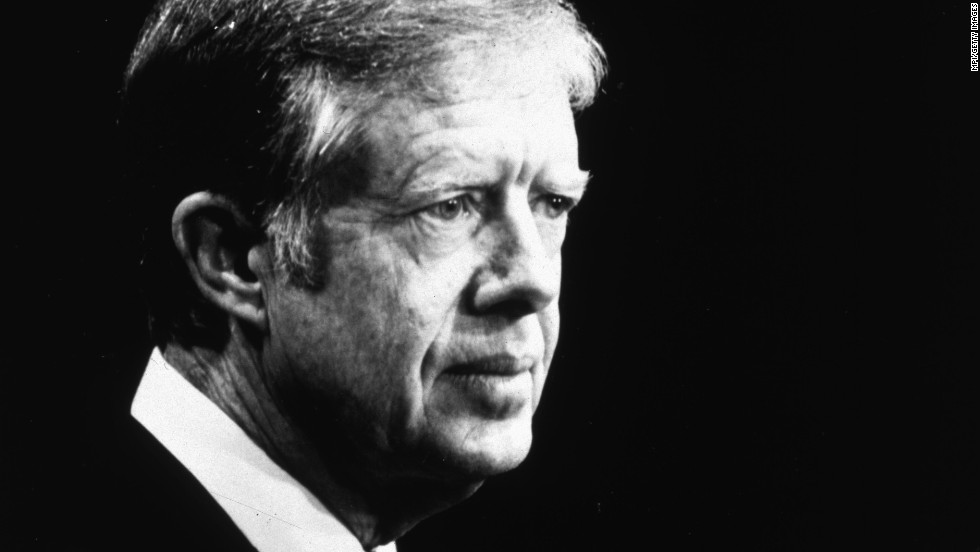
But the 39th president's appearance didn't feel like a goodbye, as Carter said he still hoped to mount a visit to Nepal later this year for the "Habitat for Humanity" charity which builds shelter for homeless people.
In fact — with the political world immersed in the fury of another election campaign, Carter
seemed almost a throwback to a past, more courtly era.
Carter's sanguine acceptance of his prognosis seems to lie in his deep religious belief, and he pledged to continue teaching Sunday school at his church "as long as I'm physically able."
"I do have deep religious faith, which I'm very grateful for, and I was pleasantly surprised that I didn't go into an attitude of despair or anger or anything like that. I was just completely at ease." He continued: "I can't really anticipate how I'll be feeling. Obviously I'll have to defer quite substantially to my doctors who are in charge of the treatment,"
Carter said Thursday, saying he'll get his first radiation treatment this afternoon.
Carter had a "small mass" removed from his liver in an early August surgical procedure. So far, he said the only places where cancer had been found in his body were in his brain and liver, though he also discussed his family's history with the disease.
He said it is likely that other spots of cancer would show up elsewhere in his body.
What a family history of cancer can mean Elected in 1976 and ousted in the 1980 election by Ronald Reagan, Carter has a family history of pancreatic cancer -- a disease that claimed his father, brother and two sisters. His mother had breast cancer, which later spread to her pancreas.
"For a long time my family was the only one on earth that had four people who have died of pancreatic cancer," he said.
After providing a detailed briefing on his diagnosis, Carter was asked to reflect on his life and career in politics, including the single term presidency between 1977 and 1981 that yielded some notable achievements overseas but ended when Republican Ronald Reagan swept to power amid the humiliation of a 444 day hostage crisis in Iran and a sickly
economy at home.
Carter said that looking back, he wished he had insisted on more firepower for a botched U.S. 1980 operation to rescue the U.S. hostages in Tehran, which ended when a helicopter crashed into a U.S. transport plane in the desert, killing eight servicemen.
"I wish I had sent one more helicopter to get the hostages, and we would have rescued them, and I would have been reelected," Carter said.
The veteran Democrat said that on reflection however, he would have traded a second term for the Carter Center, which is renowned the world over for its advocacy of human rights and democracy, and which earned the former president the Nobel Peace Prize in 2002.
He said that if he had one wish for the rest of his life it would be that he gets to see peace in the Middle East but bemoaned the fact that that goal seems "more dismal than any time I remember in the last 50 years. The only process is practically dormant," he said, and took a swipe at the administration of Prime
Minister Benjamin Netanyahu. "The government of Israel has no desire for a two-state solution, which is the policy of all other nations in the world, and the United States has practically no influence compared to past years in either Israel or Palestine. So I feel very discouraged."
And he said that he was hoping to outlive one of the many scourges that has caused misery for millions of people in tropical Africa that his Carter Center has worked to eradicate. "I'd like for the last guinea worm to die before I do."

|
|
|
|
 Designer drug wreaking havoc across America |
|
Posted by: IceWizard - 08-20-2015, 07:59 PM - Forum: World News
- Replies (6)
|
|
CBS NEWS
A cheap new designer drug called flakka is causing havoc in cities across America.
It can cause bizarre and violent reactions when people take it and has been found in Illinois, Ohio, Texas, Kentucky, California and Florida so far, reports CBS News' Mark Albert.
Videos posted online show what can happen
when flakka takes over.
"I am God! I am God! Burn in Hell! I am life!"
one person rants in a video.
Its effects can include psychotic breakdowns,
hallucinations and indiscriminate violence.
In June, an 82-year-old great-grandmother died weeks after being randomly attacked in her Riviera Beach, Florida, home by a man who, police say, was high on flakka.
Another man impaled himself on a fence at the
Fort Lauderdale police station while on the drug.
Mike Haney, who lives near Chicago, said he
doesn't remember what he did for two days after taking flakka. "I was completely out of my mind. I could have killed somebody. I could have killed myself,"
Haney said. Flakka, also known as gravel, is a synthetic stimulant, a cousin of the drug found in baths salts. It's an ever-changing mixture of various substances and can come in a capsule or powder. Users can smoke, swallow or inject the drug.
Florida is now the "epicenter" of the outbreak
with 25 flakka-related deaths in South Florida's
Broward County in the past 10 months alone.
Special agent Kevin Stanfill in Miami is leading
the DEA's flakka fight.
"We have individuals high on flakka that are
coming up to parents with their kids, trying to
take their kids," Stanfill said. "They're not just
getting high, they're going out and hurting other people. You don't see that with a lot of the other drugs like you are with flakka right now."
Stanfill said flakka is often imported from China. It's up to 10-times cheaper than the synthetic drug cocktail "Molly"; just three to five dollars per hit, and easier to get.
Fakka can be ordered online and delivered to
your door. It's described as more powerful than
heroin or cocaine and users are often numb to
pain.
"I feel for those officers who are going to be out on patrol and they roll up on somebody and they are on flakka and they have that superhuman strength," Stanfill said. "When it takes six police officers to hold them down, that's a problem."
Brad Lamm, an addiction interventionist in Los
Angeles, had no flakka patients at his practice
as of just eight weeks ago. Now, they've had a
dozen people calling for help.
"The drug takes away all the inhibitions and also erases the body's ability to clamp down on dopamine and serotonin, so you just feel like you can do anything," Lamm said. "I think we're going to see waves of this that are going to be very, very devastating."
Lamm said even proactive parents who give
their teens urine tests after suspecting drug use are stunned. Those who make flakka are
constantly changing its makeup, so as to fool
common tests.
"The old reliable drug test, you know at the
corner store, will not show positive for this drug. They're not even able to test for it yet. It's just not included. It's ahead of the curve," Lamm said.
Lamm said his patients on this drug are taking
several weeks longer to recover than those on
other bath salts, or even crystal meth. Often, the key ingredient in flakka is known as
alpha-PVP.
The DEA's Miami division told CBS News it has already seized over three times the amount of alpha-PVP in the first six months of this year than it seized in all of last year.
© 2015 CBS Interactive Inc. All Rights Reserved
|
|
|
|
|


