 |
MAY 9, 2017 FORT LAUDERDALE, FLA. —
When she enrolled in a South Florida drug treatment program in 2015, Alison Flory had high hopes of getting her life in order and starting anew.
But instead of receiving life-saving health care, the 23-year-old from a Chicago suburb found herself being recruited from one recovery residence to another as a string of shady drug treatment facilities systematically overcharged her mother’s health insurance policy for expensive, unnecessary procedures and tests.
By October 2016, Alison was dead.
This is the story of how two troublesome national trends – booming drug addiction rates and widespread fraud in the health care industry – conspired to destroy a young woman’s life.
The US is in the midst of an epidemic of drug addiction and fatal overdoses with more than 52,000 deaths in 2015 – and the numbers are rising. The carnage is fueled in part by the widespread legal distribution of opiates to medical patients, easy availability of cheap heroin, as well as an ever-expanding lineup of other types of prescription drugs and synthetic intoxicants ripe for abuse.
The crisis is creating a broad new spectrum of Americans struggling with addiction – from suburban high school students, to young adults, to white-collar office workers, to grandmothers on Medicare.
At the same time, America is facing an epidemic of fraud in the health-care industry. Experts estimate that the government and private insurance companies lose $100 billion each year to health care scams and fraudulent claims. (That is more than the entire GDP of 131 of the world’s 195 countries. It would place 24th on the Fortune 500 list of largest US corporations, ahead of Boeing, Microsoft, and Bank of America.)
Some Americans cynically dismiss health-care fraud as something less than a major crime problem, federal investigators say. It is just money from the government or money from deep-pocket insurance companies, these cynics suggest.
But when greed replaces much needed health care for the most vulnerable in society, experts say, the result can be devastating – even fatal.
This is Alison’s story.
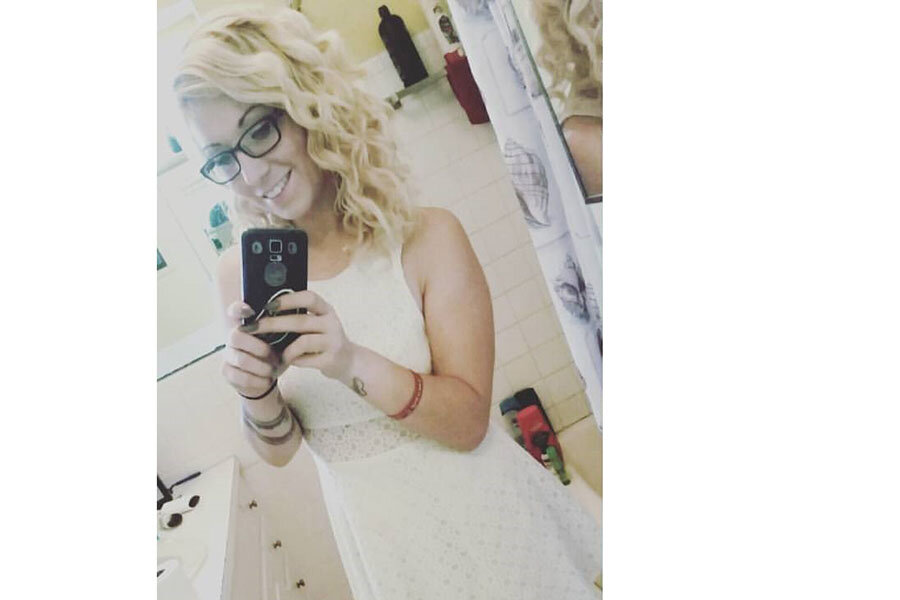
Over a 15-month period in 2015 and 2016, Alison moved nine times to different drug treatment centers. It was largely the work of fellow addicts – young men – who were paid to lure her and others away from their current treatment program. They did so with the promise of free rent, free use of a scooter, and other benefits – including possible romance – if the patient agreed to enroll in a particular treatment program and live in a recovery residence or sober home associated with that treatment program.
Sobriety had nothing to do with it. It is an open secret among addicts enrolled in South Florida treatment facilities that hundreds of suburban homes posing as drug-free recovery residences are little more than co-ed flop houses where the use of drugs is permitted and sometimes encouraged.
Rather than promoting health and healing, the business model that supports this multimillion-dollar health-care fraud involves warehousing addicts in fake sober homes to facilitate the perpetual fleecing their parents’ insurance policies.
Many of the addicts are complicit in the scam, using their parents’ insurance benefits like a credit card to fund a work-free and responsibility-free South Florida lifestyle while hiding behind a false façade of “treatment.”
For individuals struggling under the weight of addiction with poor judgment, low self-esteem, and inadequate coping skills, this scam and the associated lifestyle is the antithesis of rehabilitation.
“This goes beyond anything I could ever imagine, that so many people are so selfish and heartless,” Alison’s mother, Jennifer Flory, said in an interview.
At first, Ms. Flory was relieved that under the Affordable Care Act a parent’s health insurance policy extends to their children up to age 26 – including requiring open-ended coverage for drug treatment programs.
A mother of five, Flory was working in a job she didn’t particularly like, but she resolved to remain in that job because it came with a generous health insurance plan that she couldn’t otherwise afford. “I thought [having health insurance covering Alison] was a blessing. I thought, I have to keep this job until Alison is out of treatment,” she said.
Now, two years later, she has a different perspective. “Oh my God, if I would have just lost my job and not had insurance, she would still be alive.”
Evidence of fraud
Throughout her daughter’s ordeal, evidence of fraud arrived almost daily at Flory’s house in Illinois. But she didn’t know what to look for.
“I would get bills and bills and bills in the mail and half of the time I would just throw them in a drawer,” she said. “I just thought, ‘Oh cool, Alison is getting treatment.’ ”
Many of the statements were for expensive drug tests at sophisticated laboratories. Random spot tests cost $5 to $10 each and can be performed once a week or less.
In contrast, under the fraudulent business model that has taken root in South Florida and elsewhere, certain treatment programs are collecting their patient’s urine three times a week and sending it to a lab for highly sophisticated testing. Instead of $5 to $10, these tests cost anywhere from $1,000 to $4,000, or more.
Such bills are routinely being sent out and they are routinely being paid by insurance companies. They fuel an insurance-funded web of bribes and kickbacks with a steady stream of payoffs flowing between treatment centers, patient recruiters, sober homes, and laboratory operators, according to law enforcement officials.
During Alison’s 15 months in drug treatment, her mother estimates her insurance company was billed $750,000. It is not clear how much of that was actually paid by the company.
In a single day, she says, her insurance was once charged $10,000 from a treatment center that her daughter may or may not have attended for that one day. “She never told me anything about it,” Flory says.
For Flory, her daughter’s experience has produced more questions than answers.
“My question to the treatment centers is this: So you guys have billed my insurance almost $750,000 and my daughter is dead. You mean to tell me that $750,000 cannot get a person to a stable point in life to be able to function?”
How patients are recruited
Alison’s story begins with a tragedy eight years ago, in May 2009, when she was in high school. Shortly after she broke up with her boyfriend, he threw himself in front of a speeding train. Alison was at his side in the hospital when he was pronounced dead.
She was 17.
The pain and guilt nearly crushed her, according to her mother. A friend wanted to help and gave her some pills to make her feel better. That is the moment the door opened to addiction.
After graduating from high school, Alison studied video-game design and art in college. Then she worked at a fabric store, as a dance instructor, and at the front desk of a hotel.
By 2015, Alison’s mother recognized that her daughter had a drug problem. Alison admitted her addiction and said she wanted her life back. She enrolled in a drug treatment program in Pompano Beach, Fla.
Once in Florida, she improved and seemed to be firmly on the path to recovery. After being released from detox, she moved to an intensive out-patient program (IOP) at a drug treatment center where she received counseling, therapy, and drug testing.
As an out-of-state patient, she needed to find a place to live during the treatment. That is where sober homes and halfway houses enter the picture. Such recovery residences are usually a group house in a suburban neighborhood shared by other recovering addicts. Legitimate recovery residences charge their patients rent and do not permit co-ed housing.
At some point during this second-level of treatment, Alison attended an anti-addiction group meeting where she was approached by an attractive young man who suggested that she move to a different treatment center and into a co-ed recovery residence where she wouldn’t have to pay any rent.
“She ended up admitting [later] that she was following him [for potential romantic reasons], but what she didn’t realize is that the guy was getting paid,” says Flory. “So it was never in her best interest, ever.”
In retrospect, it was a turning point.
It took Alison off a road to recovery and put her instead on a path toward relapse after relapse after relapse.
A shady treatment center
By switching, she was leaving behind a reputable and successful treatment program to enroll in something called Reflections Treatment Center in Margate, Fla.
Reflections paid patient recruiters and brokers to identify young patients whose parents’ insurance policies could be systematically overcharged.
Scores of unscrupulous treatment centers in South Florida are conducting the same insurance scam, but law enforcement and other officials say Reflections appears to have been the worst of the worst.
Reflections was run by Kenneth “Kenny” Chatman, a convicted felon who had served time in federal prison for stealing credit card numbers. He registered Reflections in his wife’s name to conceal his own involvement.
Others in the drug-treatment community saw what he was doing.
“Everyone knows Chatman was a [problem], I mean basically we all knew,” says Richard Riccardi, owner of Fellowship Living Facilities, which runs long-established, legitimate recovery residences in Margate and Fort Lauderdale.
FBI agents raided and shut down Reflections in December. Mr. Chatman was arrested and later pleaded guilty to health-care fraud. He also admitted that he engaged in sex trafficking by recruiting some of his addicted female patients to work in the sex industry.
John Lehman, president of the Florida Association of Recovery Residences, says Chatman showed up on his radar several years ago. “All the kids that were living in various [recovery] houses in Palm Beach and Broward Counties would be transported to Reflections for ‘treatment,’ ” he says. “But none of them were getting any treatment. It was a joke.”
In 2014, Mr. Lehman began pushing for an investigation. Eventually he went to the Palm Beach Post. Reporters began writing news stories about Chatman and corruption in the drug treatment and sober home industry. The Post reported that drug treatment had become a $1 billion business in Palm Beach County, the county’s fourth-largest industry.
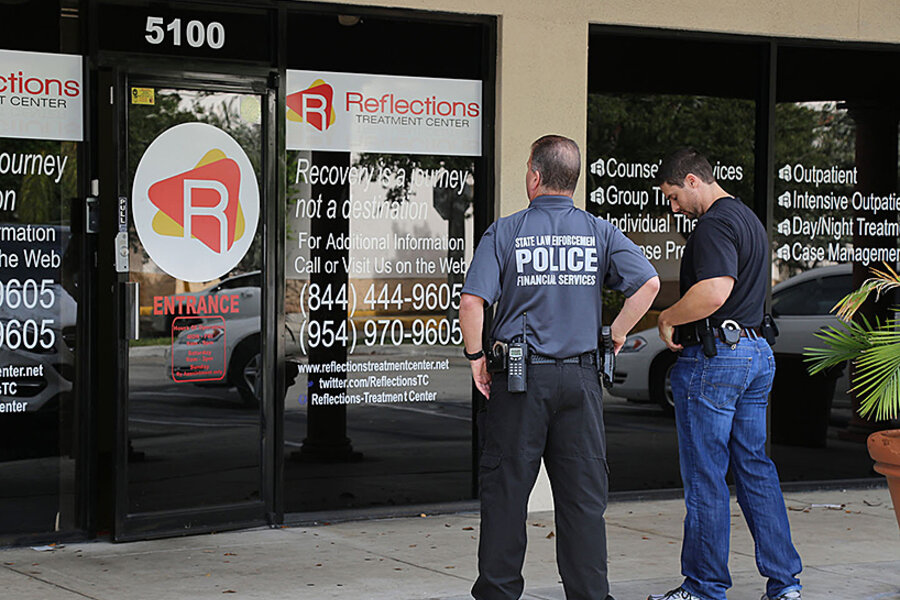
The stories sparked a public outcry that prompted criminal investigations. A Sober Homes Task Force was set up to identify legislative and other solutions.
But in September, just as federal agents were zeroing in on Chatman’s alleged scams, his wife, Laura, applied for a license to open a second drug treatment facility. To Lehman’s disbelief, the Florida Department of Children and Family Services granted a provisional license.
“Everyone on the planet knew that this guy should be shut down, yet they make application and are issued another provisional license,” Lehman says.
A systemic problem
It wasn’t just Chatman and Reflections. The proliferation of overbilling and sober home scams in Florida have made it difficult for legitimate recovery residences to stay in business.
There are 958 licensed drug treatment centers in Florida and roughly 3,000 legitimate recovery residences in the state. Lehman estimates that 6,000 to 7,000 houses claiming to be sober homes are really drug dens or flop houses.
At any one time there are as many as 10,000 patients enrolled in clinical drug treatment services in Florida. Of those, 75 percent are from out of state, he says.
Most will seek to live in a recovery residence in Florida rather than return home immediately after detox treatment, creating a market of addicts that is exploited by corrupt treatment centers. They pay kickbacks of $400 to $500 per week to sober homes for each insured resident who signs up for treatment, Lehman says.
The need for housing is the leverage that these treatment centers use to obtain new patients and gain access to their parents’ insurance benefits, officials say. Insurance companies will pay for drug treatment, but not forever. When the coverage lapses, the fraudsters need a way to extend the insurance gravy train.
Shady treatment centers often give their clients two options: Hit the road or “take what is behind Door No. 2,” says Lehman.
He says the option behind “Door No. 2” sounds something like this: “It says here on your medical chart you are a heroin user. You go out and have a weekend party with your friends and you shoot lots of heroin and then you go back to detox and when you get out of detox you can come back into the [IOP] program and your insurance benefits will be reset because it will be a new episode of care. And we can bill your insurance company and therefore you can have all the housing you want.”
It sets up a cycle of recovery and relapse.
“I have met people on the street and they have been down here for two or three years on the spin cycle under two or three different policies,” says Maureen Kielian, Florida director of Steered Straight, an anti-addiction group, and a member of the Sober Homes Task Force.
Ms. Kielian says there is a huge downside to drug treatment insurance scams. “It keeps those seeking recovery sick,” she says. “It just keeps them sick, and they are dying.”
Consequences: overdose deaths
Between 2012 and 2015, the number of overdose deaths more than doubled in Palm Beach County, where many of the treatment centers and recovery residences are located. The county medical examiner is still compiling the total for 2016, but the expectation is that it will almost double again from 307 to nearly 600 overdose deaths in 2016.
“It is horrific,” says Al Johnson, chief assistant in the Palm Beach State Attorney’s Office, who heads the Sober Homes Task Force.
Johnson says his office receives frequent phone calls from parents worried about their children in treatment. One said she was sure her son wouldn’t survive the year. She wanted to come to Florida to see him one last time.
Another parent called and said her daughter had relapsed and she didn’t know where she was but that she was sure she was in a “bad place.” Johnson adds: “Our investigator said, ‘Ma’am, get on an airplane, come down, get your daughter, and take her home.’ ”
The point of the task force is to save the legitimate treatment centers and recovery residences and weed out the bad actors, Johnson says. “Let’s clean up the industry so this truly is the place to go for effective, productive treatment,” he says. “There are good providers that are dedicated not to a profit motive but to recovery.”
There are signs of a potential turnaround. “I was told by the code enforcement chief in Delray Beach that 40 houses have closed down,” Johnson says, referring to flop houses.
How Reflections was shut down
One of the biggest problems faced by addicts and their family members is trying to differentiate between legitimate providers and corrupt providers.
“It’s disgusting, these people and what they do,” says Flory. “Alison’s case was particularly horrible because she got wrapped up in the Kenny Chatman thing,” she says.
“She got into every sad thing I think there was,” Flory says of her daughter’s experience in South Florida.
She partly blames herself. “I told her to trust the people who were looking over her. I told her she needs to not make decisions on her own. Let the people around her who care about her and are treating her, the doctors and so forth, let them help her to make decisions.”
The mother adds: “Little did I know I was telling her to put all her trust and faith into these people who were taking advantage of her. That’s what got me, there is so much more to it than just a young girl making bad choices.”
Among those people was Chatman.
On March 15, he appeared in federal court in West Palm Beach in handcuffs and leg irons. Prosecutors said he and his companies received fraudulent insurance reimbursement payments of between $9.5 million and $25 million.
According to a signed statement as part of his guilty plea, Chatman and others recruited some of his female patients residing in sober homes into prostitution. They advertised on websites like Craig’s List and Backpage.com.
The statement adds: “The defendant and co-conspirators provided controlled substances to these addicted patients to induce them to perform sexual acts.”
Implicit in this arrangement was Chatman’s power to also withhold controlled substances from drug-dependent women. Those who were noncompliant with Chatman’s wishes could face debilitating symptoms of sudden drug withdrawal, loss of income, and eviction from the sober home. In essence, they could be dumped on the street, sick and homeless.
By contrast, those who complied were not required to attend drug treatment sessions and submit to drug testing – but their insurance policies were billed as if they had, according to the signed statement.
At one female-only sober home, near West Palm Beach, Chatman confiscated cell phones, screwed down the windows, and prohibited the women from leaving the house, according to court documents.
Chatman could have faced up to life in prison on the sex trafficking charge, but with federal sentencing guidelines he will likely spend 12 ½ to 15 years in prison under his plea agreement. His sentencing is set for May 17.
Chatman wasn’t the only one responsible for the fraud at Reflections.
The medical director at Reflections was Donald Willems. During his tenure at Reflections, Dr. Willems was under indictment in state court on pending racketeering conspiracy charges for allegedly helping to run an opiate pill mill in Pompano Beach a few years earlier.
On March 23, Willems pleaded guilty in the Chatman case. He admitted that he used his position as a licensed physician to falsely declare that the excessive drug testing and other treatments at Reflections were medically necessary and thus covered by health insurance policies.
In addition to excessive drug tests, he authorized expensive saliva, DNA, and allergy testing, regardless of whether patients had allergies or any need for such tests.
Despite his actions in the Chatman case and the pending charges in the 2012 pill mill case, Willems’ medical license remained in good standing with a “Clear/Active” listing right up to the day of his guilty plea.
Barry Gregory, a licensed mental health counselor, worked as the clinical director at Reflections. In a YouTube video shot in September 2015, Dr. Gregory said Reflections was licensed to provide three different levels of care. “We really believe our job is to save lives and that is what we are doing,” he says on the video.
On Feb. 16, Gregory pleaded guilty to conspiring to commit health-care fraud. In a signed statement as part of his guilty plea, Gregory admitted that he knew that Chatman was telling patients that they were allowed to continue to use drugs while they were clients at the treatment center.
“As many as 90 percent of the patients [at Reflections] continued to use controlled substances while purportedly obtaining treatment,” Gregory said in the statement.
Oct. 14, 2016
In August 2016, Alison moved with her boyfriend into her last sober home, this one a yellow three-bedroom ranch-style house on NW 33rd Avenue in Lauderdale Lakes.
The neighborhood had seen better days. Two years ago, the community of 35,000 was named one of the 10 most dangerous towns in Florida. Crack cocaine was being sold in the parking lot of a convenience store a few blocks from the sober home.
But Alison had a reason to move in. She could live there rent-free, and was also being paid $350 a week. According to her mother, the payment was for her work as a “house manager.” She was also enrolled at Reflections and supposedly was attending treatment sessions three times a week. This was her second stint as a patient at Reflections.
Flory confirms that her insurance was being billed during that period for treatments and drug tests.
The sober home on NW 33rd Avenue was rented by a man who lived next door and ran the sober home. He had a van and would transport the clients to their treatment sessions at Reflections. According to Alison’s mother, sometimes Chatman himself would arrive in a van to pick up Reflections clients.
At some point in the early morning hours of Oct. 14, Alison and one of her housemates, Nicole De La Pena, decided to smoke crack cocaine. Earlier, they made a purchase down the street, according to an account Nicole gave to her mother, Johanna.
What neither Alison nor Nicole could know was that the crack cocaine they were about to smoke was laced with carfentanil.
Three weeks earlier, the Drug Enforcement Administration had issued a nationwide warning about carfentanil, a synthetic opiate said to be 10,000 times more powerful than morphine. The DEA warned that mere skin contact could cause an overdose in a paramedic or police officer responding to an emergency. A dose of carfentanil about the size of a grain of salt would likely be fatal to a human, experts say.
Alison was last seen alive by her boyfriend at 4 a.m. when he saw her asleep in her bed and still breathing.
Later that morning around 8:30 a.m., the man who ran the sober home arrived to take clients to their treatment sessions at Reflections. He was unable to awaken Alison.
According to a recording of the 911 call, it took the house manager 37 seconds to vocalize a muffled, “Hello.”
“Your phone dialed 911. Do you have an emergency,” the operator asked.
“Yes, I am trying to figure out right now,” the manager responded. “Um, um, I have, I have, I have someone in here and she’s – we’re trying to wake her up but I don’t feel no pulse.”
At no point during the 911 call was the manager able to state the address of his sober home or even the nature of the emergency despite requests from the emergency operator. The call lasted one minute and 48 seconds.
Some advocates for reform of the sober home industry say that those who run sober homes should be trained in CPR and maintain a stock of naloxone, an antidote for opiate overdoses.
It is not clear that this would have saved Alison’s life on the morning of Oct. 14, but experts say it might have.
When paramedics arrived, they were unable to revive Alison. She was pronounced dead at 9:08 a.m.
The medical examiner’s report says Alison died of carfentanil and cocaine toxicity.
Police photos taken inside Alison’s room in the sober home shortly after her death show the presence of three postage-stamp sized pink plastic bags with white residue inside. Two were on the floor near her closet, one was inside a shoe. They are the type of bags that are used to sell street quantities of illegal drugs.
In addition, the photos reveal a five-inch glass tube with smoke residue inside and seven pills in a cluster on the night stand beside the bed.
'All they care about is the money'
Flory says there is no way to measure the pain caused to parents and other family members of addicts lost to drug addiction. “It is the most horrible thing I would imagine ever having to go through, losing my oldest kid,” Flory says.
“We talked, we confided in each other, we hung out, we had the same sense of humor,” she says of her daughter. “She was literally my best friend.”
Until Alison’s experience in South Florida, Flory said she never really considered the full cost of fraud in the American health-care system.
“I just thought it didn’t really affect anybody. Yeah, insurance fraud is making people’s premiums go up, but that’s it,” Flory says. “I didn’t know it was killing people.”
At some point during her ordeal in the South Florida spin cycle, Alison apparently figured it out. In a moment of candor she told her mother it was fraud, that it was all a gigantic scam. “All they care about is the money,” Alison said, according to her mother.
“I told her, no, that’s not true,” Flory said she replied to her daughter. “She told me that these people are just greedy and selfish and they just want to make money. I said that is ridiculous.”
The mother adds: “I just thought she was trying to be dramatic. But yeah, she is laughing now. She is looking down and saying, ‘I told you so.’ ”
|


