| Welcome, Guest |
You have to register before you can post on our site.
|
| Latest Threads |
Odds and Ends ... With So...
Forum: The Lounge
Last Post: IceWizard
11-13-2026, 01:20 AM
» Replies: 11
» Views: 3,087
|
Here are a couple I found
Forum: IOPList Suggested IOP's
Last Post: gujjernoran
11-12-2026, 08:26 PM
» Replies: 1
» Views: 798
|
www.MacroMass.COM.PH
Forum: IOPList (Approved & Recommended)
Last Post: Macro Mass
11-11-2026, 04:56 PM
» Replies: 3,854
» Views: 7,144,683
|
The Juke Box is OPEN
Forum: The Lounge
Last Post: Mr. HIND
11-09-2026, 08:03 AM
» Replies: 2,939
» Views: 1,666,091
|
MOVIES
Forum: The Lounge
Last Post: IceWizard
11-09-2026, 05:10 AM
» Replies: 147
» Views: 49,614
|
www.MacroMass.COM.PH
Forum: IOP Discounts, Offers & More
Last Post: Macro Mass
11-08-2026, 09:07 PM
» Replies: 143
» Views: 81,198
|
Humorous Smilies
Forum: The Lounge
Last Post: IceWizard
11-02-2026, 01:22 AM
» Replies: 4,936
» Views: 4,272,892
|
Deaths So Far (and it's j...
Forum: World News
Last Post: IceWizard
10-31-2026, 07:15 PM
» Replies: 51
» Views: 14,569
|
'Biscuit' the dog is late...
Forum: World News
Last Post: IceWizard
10-31-2026, 06:16 PM
» Replies: 0
» Views: 164
|
GAME - Change one word ga...
Forum: The Lounge
Last Post: IceWizard
10-15-2026, 05:21 AM
» Replies: 2,142
» Views: 1,021,245
|
|
|
 The Ambien Effect |
|
Posted by: IceWizard - 06-07-2016, 09:57 AM - Forum: World News
- Replies (3)
|
 |
I saw this on a show called "Viceland" and it's just unreal!! So... I looked it up:::
The zolpidem, better known as the name of Stilnox / Ambien, is a drug used to treat insomnia. But some cases may have shown that zolpidem have the ability to normalize functioning in certain types of damaged neurons. It’s called the “ambien effect”.
Written by LODE Baptiste, LESVIER Benoit,
CHA Léo – Medical studies, second year

In 1999 Louis Viljoen, a 25 years old south- African, was hit by a car. After this accident he wasn’t able to speak because he undergone cerebral lesions. For 3 years, he didn’t pronounce any word.
One day, his mother gave him a Stilnox because he had convulsions. An unexpectedly fact happened : 30 minutes later, he spoke for the first time since his accident !
The day after, Dr Wally came to watch the “Ambien effect” and he decided to initiate a treatment : 3 pills per day. Nowadays Louis take a half pill two times per day, and Dr Wally noted a benefic evolution of his IQ before and after the taking : 70 before, and 90 two hours after.
After this story, Doctor Ralph Klaus decided to work on the zolpidem biochimical effect. He realized a MRI of brain perfusion before and after the patient’s Ambien taking.
The results showed 2 big areas in the parietal lobe which didn’t work before and were normalized after the action of the drug (from 40% of the normal to 100%). Dr Klaus explains the activity of the drug by 2 phenomena.
There is an « exotic toxic effect » and at the same time, it stabilizes the micro-environment, as if there were cells sacrificing themselves to make some other ones survive. We don’t know exactly which mechanism the drug is using but Klaus thinks it affects the GABA-A receptors.
After a skull traumatism, the receptors would sustain an epigenetic change. This would cause a disorderly flow of chloride ions and so, the suppression of the neuronal activity. The zolpidem would distort traumatized receptors and normalize them.
Finally, the brain is less limited and we can see the results on a scanner or from a clinical point of view.
These effects seem to affect other pathologies, according to Dr Wally. Some doctors already use zolpidem to heal dementia or some paralysis.
Two of these other cases are Jonathan Pool and Thomas Rohe. Jonathan was a bank manager, and he had a stroke which provoked a disability, with an auditory agnosis. Taking Ambien seems to readjust his hearing system and his comprehension of numbers and names.
And also the case of Thomas, a voice-over artist, who has problems of diction since he had an accident during a dentist surgery. As a consequence, he can not speak normally and was fired.One night, he took ambien due to his sleeping problems, and it happened that instead of making him sleep, it solved his disabilities.
Nowadays, he still uses ambien and doesn’t suffer of his pathology anymore.
In conclusion, exploring zolpidem effects could be a path to many treatments, against pathologies with neuronal origins.
Watch This 19 min video... Unreal
|

|
|
 Kimbo Slice, street fighter and MMA pioneer, dies aged 42 |
|
Posted by: IceWizard - 06-07-2016, 08:35 AM - Forum: World News
- Replies (1)
|
|

Kimbo Slice’s improbable ascent was one of MMA’s most intriguing plotlines. Photograph: Sipa Press/Rex/Shutterstock
Associated Press
Tuesday 7 June 2016 03.07 EDT
Kimbo Slice, the bearded street fighter who parlayed his internet popularity into a mixed martial arts career and worldwide fame, has died. He was 42.
Slice, whose real name was Kevin Ferguson, was taken to a hospital in Margate, Florida, near his home Monday, Coral Springs Police Sgt Carla Kmiotek said. Slice’s death was confirmed by Mike Imber, his longtime manager.
“We lost our brother today,” Imber said in a text message to the Associated Press. The cause of death was still unclear.
Kmiotek said there is no active police investigation, and no foul play is suspected.
Slice was a Bahamian-born ex-football player and strip club bouncer who began competing in unsanctioned street fights in 2003. Videos of his violent knockout victories in those bouts became wildly popular online, both for his punching power and his distinctive, intimidating appearance.
He studied MMA and eventually competed in several promotions, including the UFC and Bellator, which staged his two most recent fights.
Slice’s death also was confirmed by Scott Coker, the CEO of Bellator, which promoted his return to MMA last year after a five-year absence. Slice beat Dhaffir “Dada 5000” Harris with a third-round knockout at Bellator 149 in February in Houston, but the result was overturned after Slice tested positive for steroid use.
“We are all shocked and saddened by the devastating and untimely loss of Kimbo Slice,” Coker said. “One of the most popular MMA fighters ever, Kimbo was a charismatic, larger- than-life personality that transcended the sport. Outside of the cage he was a friendly, gentle giant and a devoted family man. His loss leaves us all with extremely heavy hearts.”
Slice was scheduled to headline the Bellator 158 show in London next month in a bout against James Thompson.
American Top Team, the prominent South Florida gym where Slice trained for many years, also mourned his passing. “The ATT Family and South Florida community lost a legend today,” the team said in a post on its Twitter account.
Slice was the star of the first MMA show broadcast on network television, beating Thompson by third-round knockout in May 2008 on CBS with the defunct EliteXC promotion.
With Slice and pioneering featherweight Gina Carano as the top attractions, EliteXC’s two CBS shows drew big television ratings and introduced millions of viewers to MMA.
While he went 5-2 and never won a championship belt, Slice became one of MMA’s best-known figures, attracting large television audiences and crowds to his growing sport. He also had a pro boxing career between stints in the cage, going 7-0 with six knockouts from 2011-13.
For all of his glowering in-cage swagger and viral fame, Slice was extraordinarily honest about his fighting abilities. He acknowledged being an MMA newcomer with much to learn about his new sport, never claiming to be anything but a big puncher providing for his family while constantly trying to learn the sport’s other disciplines.
“The guys who are holding the titles, heavyweight and light heavyweight, these guys are awesome,” Slice told the AP in a 2010 interview before his second UFC fight. “I’m really just having happy days in the midst – being among them, fighting on the undercards, just contributing to the UFC and the sport. That’s really what I want to do. I’m not looking ahead to winning a title or anything like that. I’m just enjoying each fight as it comes.”
|
|
|
|
| UK and EU referendum |
|
Posted by: barq2 - 06-06-2016, 04:44 PM - Forum: Political Discussion
- Replies (10)
|
 |
Hi all,
The UK is holding a referendum on whether it should remain in, or leave, the European Union later this month.
There is lots of arguing in the UK, which I don't necessarily want to bring into this thread (I'm not stating my politics here). But opinions are tied about 50:50 in the polls so it could happen - this isn't an empty gesture.
At the weekend an American friend asked me if it was true the UK might be leaving the EU, and if that was some kind of joke (like The Onion). I get the impression most countries are relatively unaware of it, and those that are are in the EU and pretty annoyed about it.
Anyone outside the UK heard much about this? Do you have an opinion?
Best wishes,
barq
|
|
|
|
| Dementia Dilemma |
|
Posted by: barq2 - 06-06-2016, 03:36 PM - Forum: Family, Friends & Relationships
- Replies (15)
|
|
Hi,
I am discussing this with family, but I would really value your impartial opinions. I know some of you have/are dealing with dementia either among your selves or with loved ones.
My father is in his mid-80s. He has had a couple of heart attacks, a stroke (he recovered well), but also a lot of TIAs over a number of years. He has medication to control all this. What has changed is that he is regressing into his childhood, struggling to form new memories, and where he makes a mistake he won't simply reverse, but will confabulate some elaborate justification why why his was right. He has become very stubborn and not open to anything new (places, people, things, food). He doesn't really follow conversation any more. He observes rather than joining in (not a problem in itself, but part of the picture). He is forgetting who people are, struggling to find words etc.
In company he can put on a good show for about 60-90 mins, but that's his limit. Unfortunately his slips are becoming more and more depressing. He suddenly become rampantly anti-Jewish (which is awkward given some of our family are Jewish). We rarely go out for meals because he can be so aggressive with staff and ruin a night out. I have had to rescue him from situations where he squared up to people like he was going to hit them. So there is a real change in personality.
I am pretty sure it is dementia. While I have a PhD in psychology, this is absolutely not my field of expertise and I do not work in heath care. I don't hold any magic keys here.
Dad is in total denial about getting old. In shops he has a standard joke where he will say "good thing I'm not buying alcohol, or you'd need to see my ID". (That's very out of place in the UK, it isn't like parts of the USA where you routinely need it.) The joke is heartbreaking. There is no knowing irony there. I can feel the desperation to still be young.
Dilemma:
Option 1) Sit him down and tell him his behaviour is really worrying us and we want him to see a doctor. Problem: He will be VERY upset. If there were a cure then maybe that would be worth it, but I fear undermining his self esteem for what remains of his life. I suspect he will refuse to see a doctor about this. He could have another stroke or heart attack any day. Every time I speak to him I make sure to end by saying "I love you," so that when one day it is the last time I'll have the slim comfort of knowing my last words to him were good. It sounds so selfish, but I don't want us to fall out for a whole in case he dies in that time. Problem 2: If he does believe us, he will be crushed. He still has a few interests and I don't want him to revert to just sitting in front of the TV. His life is getting very narrow anyway. I'm fairly sure he is depressed (and realise this is often confused with early dementia symptoms) and I think this could make him a lot worse.
Option 2) Accept that this is going to get worse, but not force the medical route upon him. We give him the best diet, suppliments and care we can. We stimulate him by letting him talk about the past. We don't make him do too much (whilst not babying him). He might not live so long. Maybe he will miss out on drugs that might have delayed the onset.
All I have done so far is convinced my mother who lives with him that they must get help as soon as he has a TIA - not wait until tomorrow to see if it gets better. I have also given them a packet of aspirin so he can be given one immediately. We also have power of attorney in place, although it is actually to my sibling who loves furtherest away and knows least about this - but it is there.
Personally... it is so hard. I'm a lot younger than you might suppose for someone with a 85 year old father. I'm not ready for him to be this old. I'm not ready to deal with dementia and lose my dad. It sounds so selfish, and I'm not suggesting that if I were twenty years older it would all be fine. But this is clouding my judgement.
There are many wise, intelligent and kind people here. I hope you don't mind me leaning on you for advice. Thank you for reading this far. It is a bit of a ramble because it is complicated and very emotional for me.
|
|
|
|
| Muhammad Ali, 'The Greatest of All Time', Dead at 74 |
|
Posted by: IceWizard - 06-04-2016, 04:20 PM - Forum: World News
- Replies (2)
|
|
JUN 4 2016, 10:57 AM ET
by JON SCHUPPE


Heavyweight champion Muhammad Ali stands over fallen challenger Sonny Liston, shouting and gesturing shortly after dropping Liston with a short hard right to the jaw on May 25, 1965, in Lewiston, Maine. The bout lasted only one minute into the first round. JOHN ROONEY / AP
Muhammad Ali, the silver-tongued boxer and civil rights champion who famously proclaimed himself "The Greatest" and then spent a lifetime living up to the billing, is dead. A
li died Friday at a Phoenix-area hospital, where he had spent the past few days being treated for respiratory complications, a family spokesman confirmed to NBC News. He was 74.
"After a 32-year battle with Parkinson's disease, Muhammad Ali has passed away at the age of 74. The three-time World Heavyweight Champion boxer died this evening," Bob Gunnell, a family spokesman, told NBC News.
Ali had suffered for three decades from Parkinson's, a progressive neurological condition that slowly robbed him of both his verbal grace and his physical dexterity.
A funeral service is planned in his hometown of Louisville, Kentucky. His daughter Rasheda said early Saturday that the legend was "no longer suffering," describing him as "daddy, my best friend and hero" as well as "the greatest man that ever lived."
Even as his health declined, Ali did not shy from politics or controversy, releasing a statement in December criticizing Republican presidential candidate Donald Trump's proposal to ban Muslims from entering the United States.
"We as Muslims have to stand up to those who use Islam to advance their own personal agenda," he said.
The remark bookended the life of a man who burst into the national consciousness in the early 1960s, when as a young heavyweight champion he converted to Islam and refused to serve in the Vietnam War, and became an emblem of strength, eloquence, conscience and courage. Ali was an anti-establishment showman who transcended borders and barriers, race and religion. His fights against other men became spectacles, but he embodied much greater battles.
Born Cassius Marcellus Clay on Jan. 17, 1942 in Louisville, Kentucky, to middle-class parents, Ali started boxing when he was 12, winning Golden Gloves titles before heading to the 1960 Olympics in Rome, where he won a gold medal as a light heavyweight.
He turned professional shortly afterward, supported at first by Louisville business owners who guaranteed him an unprecedented 50-50 split in earnings. His knack for talking up his own talents — often in verse — earned him the dismissive nickname "the Louisville Lip," but he backed up his talk with action, relocating to Miami to work with top trainer Angelo Dundee and build a case for getting a shot at the heavyweight title.
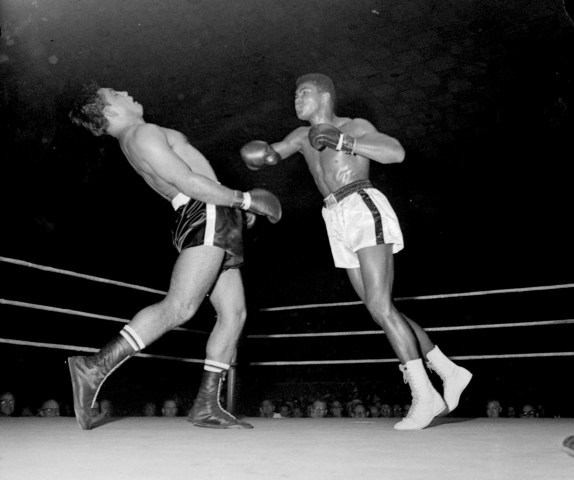
Muhammad Ali, right, attacks Alex Mitoff in the sixth round in which Ali clobbered the Argentinean to the canvas, on Oct. 7, 1961 in Louisville, Ky. H.B. Littell / AP, file
As his profile rose, Ali acted out against American racism. After he was refused services at a soda fountain counter, he said, he threw his Olympic gold medal into a river.
Recoiling from the sport's tightly knit community of agents and promoters, Ali found guidance instead from the Nation of Islam, an American Muslim sect that advocated racial separation and rejected the pacifism of most civil rights activism.
Inspired by Malcolm X, one of the group's leaders, he converted in 1963. But he kept his new faith a secret until the crown was safely in hand.
That came the following year, when heavyweight champion Sonny Liston agreed to fight Ali. The challenger geared up for the bout with a litany of insults and rhymes, including the line, "float like a butterfly, sting like a bee." He beat the fearsome Liston in a sixth-round technical knockout before a stunned Miami Beach crowd.
In the ring, Ali proclaimed, "I am the greatest! I am the greatest! I'm the king of the world."
A Controversial Champion The new champion soon renounced Cassius Clay as his "slave name" and said he would be known from then on as Muhammad Ali — bestowed by Nation of Islam founder Elijah Muhammad.
He was 22 years old.
The move split sports fans and the broader American public: an American sports champion rejecting his birth name and adopting one that sounded subversive. Ali successfully defended his title six times, including a rematch with Liston. Then, in 1967, at the height of the Vietnam War, Ali was drafted to serve in the U.S. Army.
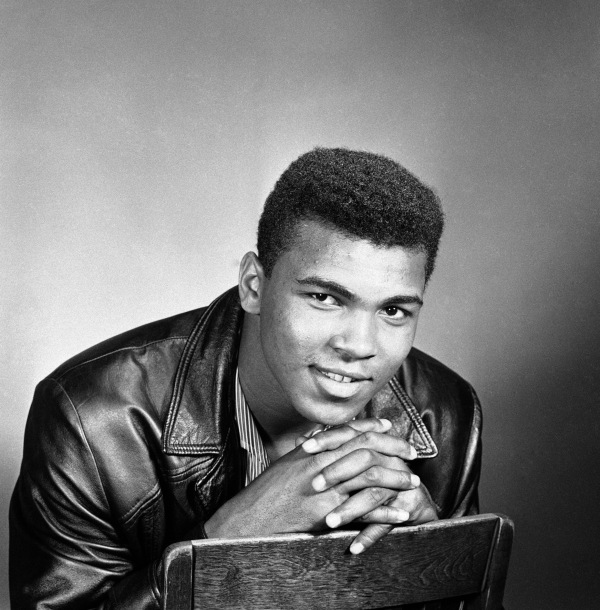
Speaking at a press conference in Chicago on Sept. 25, 1970, deposed world heavyweight champion Muhammad Ali "Cassius Clay" said he might fight Jerry Quarry in New York if Georgia Gov. Lester Maddox succeeds in halting the scheduled Atlanta bout. Charles Kolenovsky / AP, file
He'd said previously that the war did not comport with his faith, and that he had "no quarrel" with America's enemy, the Vietcong.
He refused to serve.
"My conscience won't let me go shoot my brother, or some darker people, some poor, hungry people in the mud, for big powerful America, and shoot them for what?" Ali said in an interview. "They never called me nigger. They never lynched me. They didn't put no dogs on me."
His stand culminated with an April appearance at an Army recruiting station, where he refused to step forward when his name was called.
The reaction was swift and harsh. He was stripped of his boxing title, convicted of draft evasion and sentenced to five years in prison.
Released on appeal but unable to fight or leave the country, Ali turned to the lecture circuit, speaking on college campuses, where he engaged in heated debates, pointing out the hypocrisy of denying rights to blacks even as they were ordered to fight the country's battles abroad.
"My enemy is the white people, not Vietcongs or Chinese or Japanese," Ali told one white student who challenged his draft avoidance. "You my opposer when I want freedom. You my opposer when I want justice. You my opposer when I want equality. You won't even stand up for me in America for my religious beliefs and you want me to go somewhere and fight but you won't even stand up for me here at home."
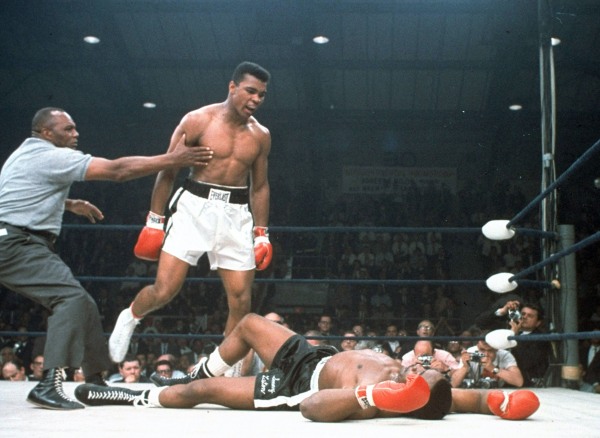
Muhammad Ali is held back by referee Joe Walcott, left, after Ali knocked out challenger Sonny Liston in the first round of their title fight in Lewiston, Maine on May 25, 1965. AP, file
Ali's fiery commentary was praised by antiwar activists and black nationalists and vilified by conservatives, including many other athletes and sportswriters. His appeal took four years to reach the U.S. Supreme Court, which in June 1971 reversed the conviction in a unanimous decision that found the Department of Justice had improperly told the draft board that Ali's stance wasn't motivated by religious belief.
Return to the Ring
Toward the end of his legal saga, Georgia agreed to issue Ali a boxing license, which allowed him to fight Jerry Quarry, whom he beat. Six months later, at a sold-out Madison Square Garden, he lost to Joe Frazier in a 15-round duel touted as "the fight of the century."
It was Ali's first defeat as a pro.
That fight began one of boxing's and sport's greatest rivalries. Ali and Frazier fought again in 1974, after Frazier had lost his crown. This time, Ali won in a unanimous decision, making him the lead challenger for the heavyweight title.
He took it from George Foreman later that year in a fight in Zaire dubbed "The Rumble in the Jungle," a spectacularly hyped bout for which Ali moved to Africa for the summer, followed by crowds of chanting locals wherever he went.
A three-day music festival featuring James Brown and B.B. King preceded the fight. Finally, Ali delivered a historic performance in the ring, employing a new strategy dubbed the "rope-a-dope," goading the favored Foreman into attacking him, then leaning back into the ropes in a defensive stance and waiting for Foreman to tire. Ali then went on the attack, knocking out Foreman in the eighth round. The maneuver has been copied by many other champions since.
The third fight in the Ali-Frazier trilogy followed in 1975, the "Thrilla in Manila" that is now regarded as one of the best boxing matches of all time.
Ali won in a technical knockout in the 15th round.
Ali successfully defended his title until 1978, when he was beaten by a young Leon Spinks, and then quickly took it back.
He retired in 1979, when he was 37, but, seeking to replenish his dwindling personal fortune, returned in 1980 for a title match against Larry Holmes, which he lost.
Ali lost again, to Trevor Berbick, the following year. Finally, Ali retired for good. 'He's Human, Like Us'
The following year, Ali was diagnosed with Parkinson's.
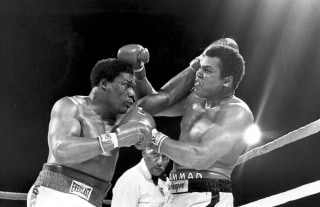
Muhammad Ali, right, takes a punch from Trevor Berbick, of Canada, during the first round of their 10-round bout in Nassau, Bahamas, in this Dec. 11, 1981 file photo. AP, file
"I'm in no pain," he told The New York Times. "A slight slurring of my speech, a little tremor. Nothing critical. If I was in perfect health — if I had won my last two fights — if I had no problem, people would be afraid of me. Now they feel sorry for me. They thought I was Superman. Now they can go, 'He's human, like us. He has problems.' ''
Even as his health gradually declined, Ali — who switched to more mainstream branches of Islam — threw himself into humanitarian causes, traveling to Lebanon in 1985 and Iraq in 1990 to seek the release of American hostages. In 1996, he lit the Olympic flame in Atlanta, lifting the torch with shaking arms. With each public appearance he seemed more feeble, a stark contrast to his outsized aura. He continued to be one of the most recognizable people in the world.
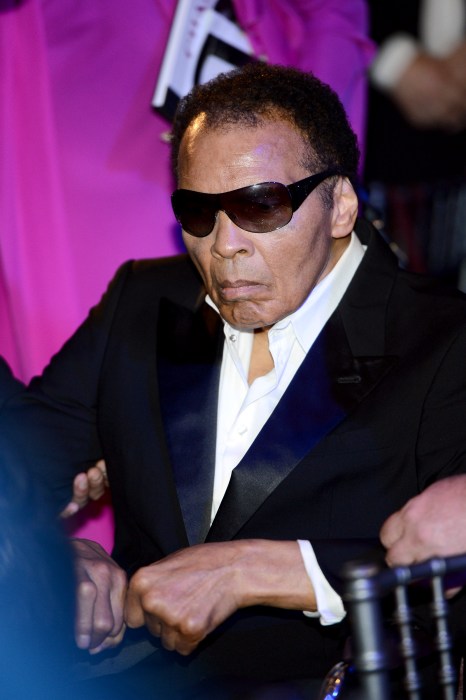
Muhammad Ali attends the Sports For Peace Fundraising Ball at The Vamp;A on July 25, 2012 in London. Ian Gavan / Getty Images, file
He traveled incessantly for many years, crisscrossing the globe in appearances in which he made money but also pushed philanthropic causes.
He met with presidents, royalty, heads of state, the Pope. He told "People" magazine that his largest regret was not playing a more intimate role in the raising of his children. But he said he did not regret boxing.
"If I wasn't a boxer, I wouldn't be famous," he said. "If I wasn't famous, I wouldn't be able to do what I'm doing now."
In 2005, President George W. Bush honored Ali with the Presidential Medal of Freedom, and his hometown of Louisville opened the Muhammad Ali Center, chronicling his life but also as a forum for promoting tolerance and respect.
Divorced three times and the father of nine children — one of whom, Laila, become a boxer — Ali married his last wife, Yolanda "Lonnie" Williams, in 1986; they lived for a long time in Berrien Springs, Michigan, then moved to Arizona.
In recent years, Ali's health began to suffer dramatically.
There was a death scare in 2013, and last year he was rushed to the hospital after being found unresponsive. He recovered and returned to his new home in Arizona.
In his final years, Ali was barely able to speak. Asked to share his personal philosophy with NPR in 2009, Ali let his wife read his essay:
"I never thought of the possibility of failing, only of the fame and glory I was going to get when I won," Ali wrote. "I could see it. I could almost feel it. When I proclaimed that I was the greatest of all time, I believed in myself, and I still do."
Note
Rest in peace now... There's no one ever like you...
30 Photos:
Float Like a Butterfly: Muhammad Ali's Life in Pictures
|
|
|
|
|


 !! Anyway, thanks again to those who have posted so much helpful information. I look forward to reading more of your posts and success stories. Thank you everyone.

